

Introduction
Enterprises are under pressure to modernize IT environments, reduce costs, and provide seamless remote access to applications. Traditional Virtual Desktop Infrastructure (VDI) solutions like Citrix, VMware Horizon, and Microsoft Azure Virtual Desktop (AVD) often come with high licensing costs, complex architectures, and vendor lock-in.
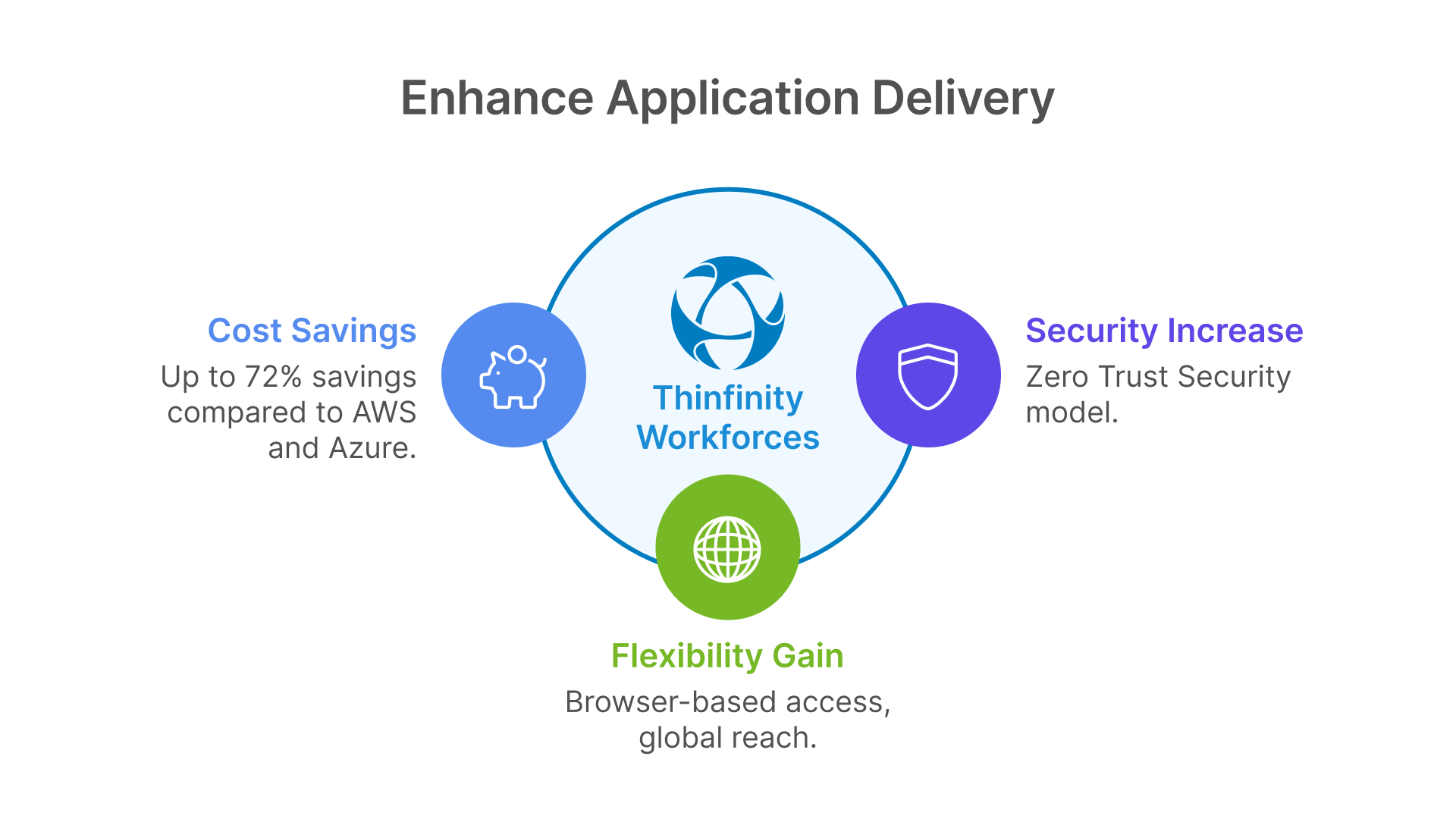
In 2025, Oracle Cloud Infrastructure (OCI) combined with Thinfinity Workspace is emerging as a cost-effective, high-performance alternative. Organizations can achieve up to 72% savings compared to AWS and Azure while maintaining enterprise-grade security and performance. This article provides a comprehensive deep dive into OCI’s capabilities for Windows virtual applications and how Thinfinity enhances application delivery with Zero Trust security and browser-native access.
Oracle Cloud Infrastructure: Performance Meets Cost Leadership
OCI has positioned itself as one of the fastest-growing hyperscalers, reporting 49% growth in Q3 2024. Its strength lies in cost efficiency, flexibility, and global scale—key factors for enterprises deploying virtual applications.
Infrastructure Capabilities
- Bare Metal GPU Instances: Support for NVIDIA A100, H100, V100, and AMD MI300X for graphics-intensive workloads like CAD, 3D modeling, and video editing.
- Flexible VM Shapes: Customizable down to 1 OCPU and 1GB RAM increments, avoiding resource overprovisioning.
- Global Footprint: 44 regions in 24 countries, enabling data sovereignty and compliance for regulated industries.
- Generous Networking: 10TB of free data egress per month, compared to far lower limits from AWS and Azure.
Cost Advantages
- Compute: Up to 50% cheaper than AWS and Azure.
- Storage: 70% lower costs with OCI block storage.
- Networking: 80% cost savings on outbound traffic.
📊 Example:
OCI’s E4.Flex VM at $77/month vs. Azure/AWS at $140/month for similar performance.
Windows VM Cost Comparison Across Cloud Providers
| Cloud Provider | VM Type (4 vCPU, 16GB RAM, Windows Server 2019) | Monthly Cost | Notes |
|---|---|---|---|
| OCI (E4.Flex) | Customizable, per-second billing | $77 | Consistent pricing across all regions |
| AWS EC2 | t3.xlarge (Windows) | $142 | Regional price variations, includes Windows license |
| Azure VM | D4s_v3 (Windows) | $148 | Higher licensing and network egress costs |
| Google Cloud | n2-standard-4 (Windows) | $139 | Less flexible VM shapes than OCI |
 Windows Licensing Flexibility on OCI
A major differentiator for OCI is its Windows licensing model. While AWS and Azure often bundle licensing into inflated per-VM pricing, OCI offers flexible options:
- Oracle-Provided Licenses: Per-OCPU, per-second billing for Windows.
- Bring Your Own License (BYOL): Support for Microsoft’s Flexible Virtualization Benefit.
- Dedicated Hosts: For organizations requiring strict compliance environments.
- Billing Efficiency: Paused billing when instances are stopped on standard shapes.
OCI supports Windows Server 2016, 2019, 2022 and 2025 across multiple editions, offering more control over cost structures.
Thinfinity Workspace: End-to-End Application Virtualization on OCI
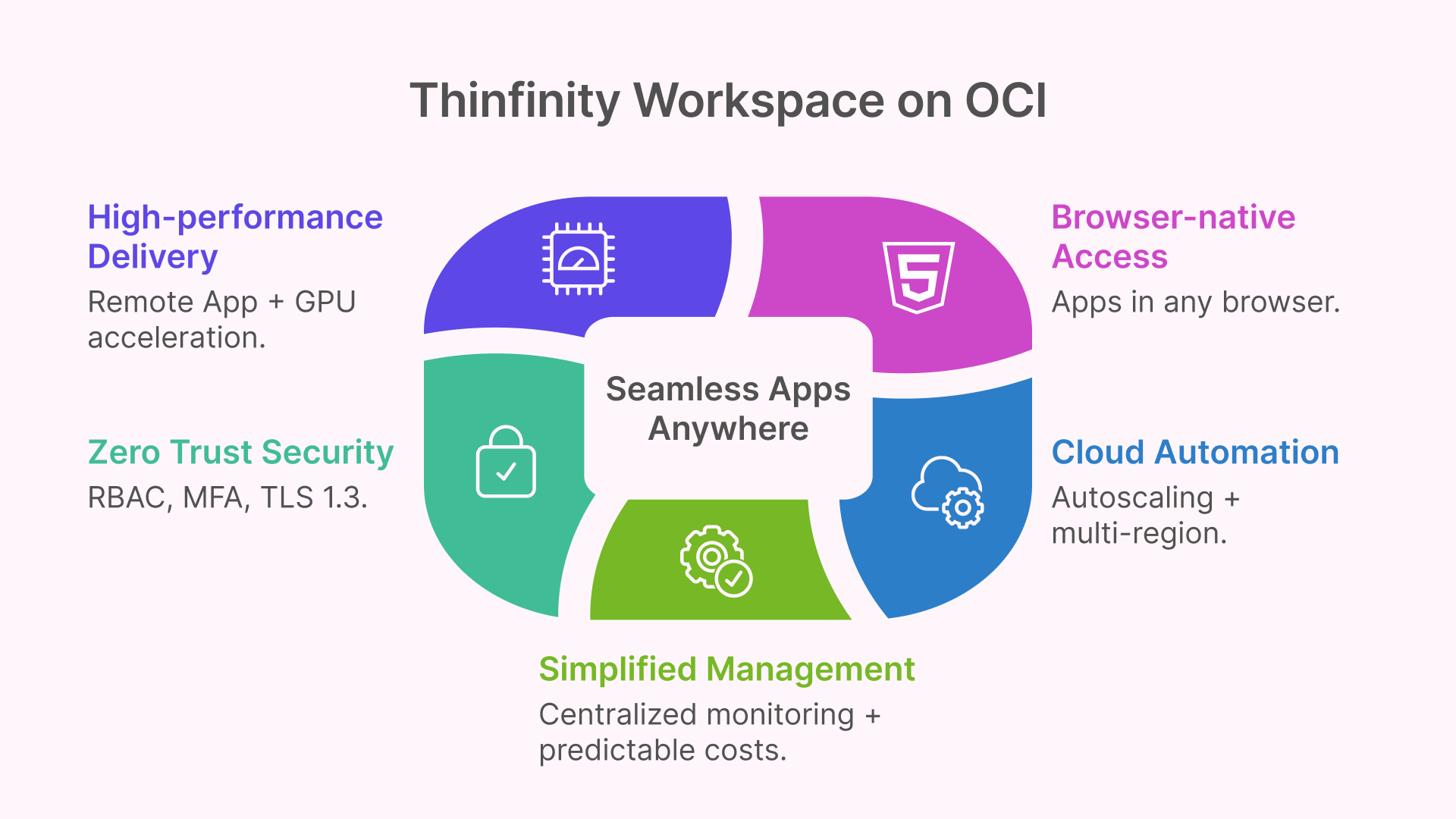
Thinfinity Workspace redefines application delivery on Oracle Cloud Infrastructure by combining its proprietary RDC RemoteApp technology, Zero Trust security, and cloud-native automation. Instead of deploying full desktops, IT teams can publish individual Windows applications with a seamless, high-performance user experience—delivered securely to any browser, anywhere.
High-Performance Application Delivery
- Thinfinity RDC RemoteApp: Purpose-built for application-level virtualization, enabling users to access business-critical apps as if installed locally.
- H.264 Video Compression & GPU Acceleration: Harness OCI’s bare-metal GPUs and advanced codecs for low-latency graphics and multimedia performance, critical for engineering, design, and healthcare workloads.
- Browser-Native Access: Applications launch instantly from any modern browser, with no client software, plugins, or versioning issues to manage.
Cloud Management and Autoscaling
- Thinfinity Cloud Manager for OCI: Delivers automated provisioning, scaling, and lifecycle management for virtualized apps.
On-Demand Autoscaling: Spin up or hibernate application servers dynamically based on real-time demand, optimizing costs while maintaining responsiveness. - Multi-Region Deployment: Deploy across OCI’s 44 global regions with GeoIP-based access controls for compliance and data sovereignty.
- Centralized Monitoring & Backup: Integrated observability ensures stability and simplifies administration at scale.
Zero Trust Security for Application Access
- Granular RBAC (Role-Based Access Control): Define access policies per user, group, or application.
- MFA and SSO: Secure authentication with enterprise IdPs like Azure AD, Okta, and Google.
- Microsegmentation: Isolates applications and prevents lateral movement inside the network.
- TLS 1.3 Encryption & No Inbound Ports: Secure application delivery without exposing the network, eliminating VPN vulnerabilities.
By uniting OCI’s price-performance leadership with Thinfinity’s RDC-driven application virtualization, organizations can achieve:
- End-to-end automation for provisioning and scaling applications.
- Best-in-class performance with GPU acceleration and H.264 streaming.
Enterprise-grade security rooted in Zero Trust. - True flexibility with browser-based access and global OCI reach.
For infrastructure administrators, this means simplified management and predictable costs. For end-users, it delivers a seamless, secure, and high-performance experience that makes remote applications indistinguishable from those running locally.
Competitive Analysis: Thinfinity + OCI vs. Traditional Virtual Apps (Citrix, VMware, AVD, AppStream)
Premise: If your goal is application delivery (not full desktops), Thinfinity on OCI uses RDC RemoteApp, H.264 streaming, and GPU acceleration to give users a local-like experience in the browser—while cutting complexity and cost. Here’s how it stacks up against traditional virtual app offerings.
Citrix Virtual Apps (formerly XenApp)
- Architecture & Ops: Requires multi-tier components (Delivery Controllers, StoreFront, Gateway/ADC). Higher design/upgrade overhead. Thinfinity is browser-native and clientless, simplifying deployment and lifecycle management.
- Licensing & Cost: Typically named user. In typical Azure scenarios ~$70.60/user/month; Thinfinity + OCI averages ~$18.08 per concurrent user—often ≈65% lower for app-only use cases.
- UX & Performance: Advanced, but many features assume an installed client. Thinfinity delivers RDC RemoteApp + H.264 + GPU in the browser, minimizing endpoint friction.
- Cloud & Lock-In: Citrix integrates with multiple clouds but pulls you into the Citrix stack. Thinfinity is cloud-agnostic and optimized for OCI’s price/performance.
- Scaling & Predictability: Larger control-plane footprint; autoscaling is doable but complex. Thinfinity + OCI uses Cloud Manager for on-demand autoscaling/hibernation with pay-for-use economics.
VMware Horizon Apps
- Architecture & Ops: Needs Connection/Broker servers, UAGs, Horizon licensing. Thinfinity can talk directly to vCenter (or run natively on OCI) to streamline app delivery.
- Licensing & Cost: Typically named (or per-device). Effective cost commonly higher than Thinfinity’s concurrent model.
- UX & Performance: Good with the full VMware stack; GPU supported. Thinfinity brings H.264 streaming and multi-monitor into a clientless model with zero inbound ports.
- Cloud & Lock-In: Horizon is most efficient in VMware-centric environments. Thinfinity keeps you flexible across OCI/hybrid.
- Scaling & Predictability: More moving parts to scale elastically. Thinfinity’s Cloud Manager automates provisioning, scale-out, and hibernation to control spend.
Microsoft Azure Virtual Desktop (AVD) – RemoteApp
- Architecture & Ops: Azure-native PaaS makes sense if you’re all-in on Azure. Thinfinity reduces agents/clients and centralizes controls for multi-cloud or OCI-first strategies.
- Licensing & Cost: Named user—can be inefficient for shifts/seasonality. Thinfinity’s concurrent model commonly yields 40–50% savings in app-only delivery.
UX & Performance: Solid Azure experience; GPU tiers available. Thinfinity focuses on seamless app streaming via RDC + H.264 with browser launch and MFA/SSO. - Cloud & Lock-In: Azure-only. Thinfinity + OCI supports multi-cloud/hybrid, useful for governance and vendor diversification.
- Scaling & Predictability: Azure autoscale is mature; on OCI, Thinfinity’s autoscaling/hibernation delivers similar elasticity with lower infra unit costs.
Amazon AppStream 2.0
- Architecture & Ops: AWS-managed app streaming; fleet/VPC/IAM design adds AWS-specific complexity. Thinfinity delivers direct browser access with ZTNA and fewer moving parts.
- Licensing & Cost: Per-instance streaming + storage + usage hours can produce variable bills. Thinfinity + OCI pairs predictable OCI pricing with concurrent licensing for steadier TCO.
- UX & Performance: GPU-backed fleets available. Thinfinity emphasizes RDC RemoteApp + H.264 + GPU for low-latency WAN and multi-monitor without a client.
- Cloud & Lock-In: AWS-only. Thinfinity retains cloud-agnostic posture with OCI leadership in price/performance.
- Scaling & Predictability: AppStream fleets scale, but cost predictability varies with usage. Thinfinity autoscaling + hibernation keeps idle cost near zero.
Why Enterprises Choose Thinfinity + OCI for Virtual Apps
- Lowest Friction: No client to deploy or maintain; users launch apps in the browser with SSO/MFA.
- Best Performance per Dollar: H.264 hardware offload and GPU acceleration on OCI deliver local-like responsiveness—even over WAN.
- Secure by Design: Zero Trust with granular RBAC, TLS 1.3, no inbound ports, and microsegmentation.
- Autoscaling Economics: Cloud Manager orchestrates provisioning, scale-out, and hibernation, ensuring you pay only for active demand.
- Freedom to Architect: Keep a multi-cloud/hybrid stance while taking advantage of OCI’s price-performance leadership.
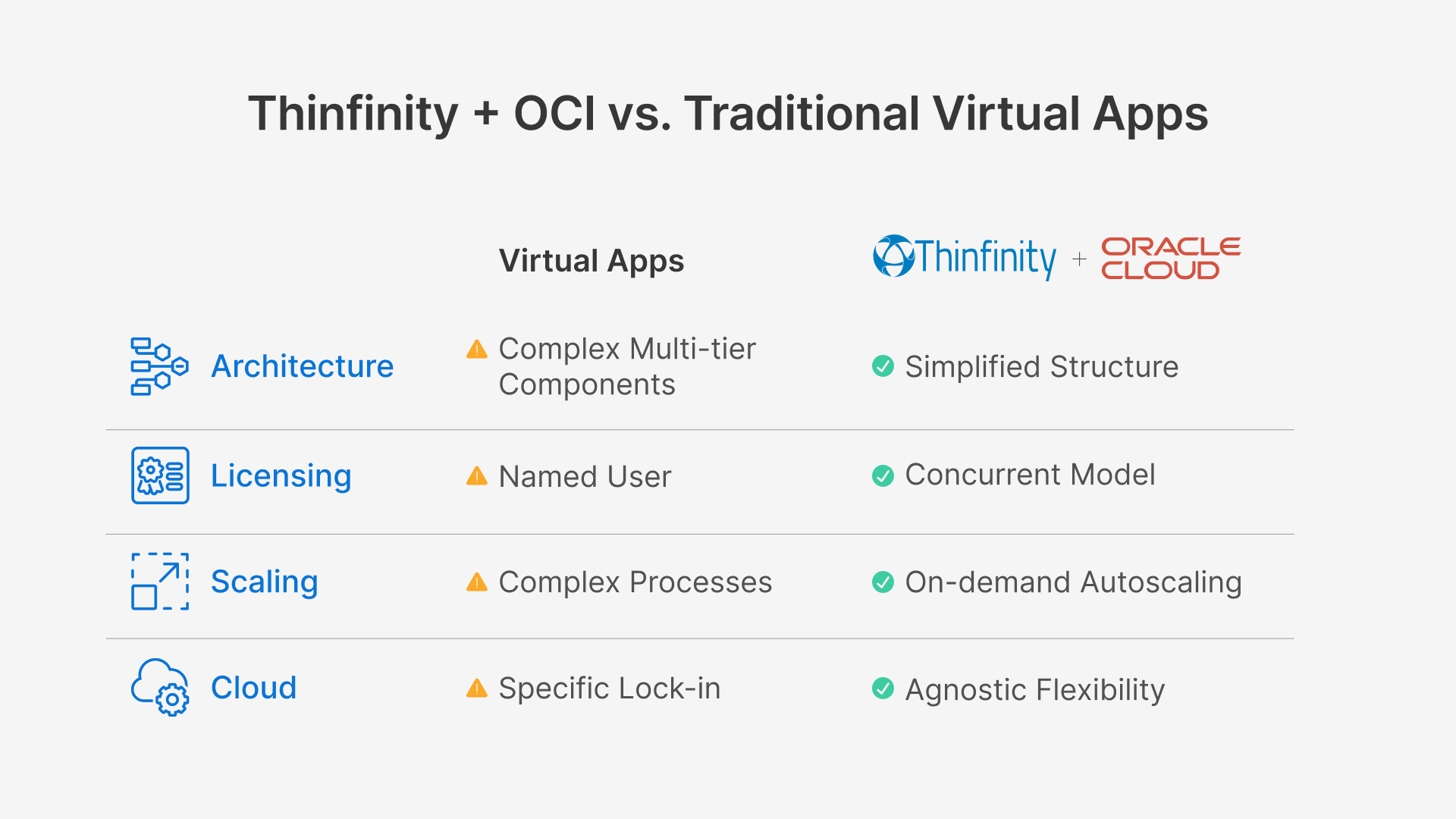
Bottom line: If your priority is fast, secure, and cost-predictable application delivery, Thinfinity on OCI outperforms traditional virtual app stacks by removing client dependencies, collapsing architectural complexity, and leveraging RDC + H.264 + GPU with autoscaling for the most efficient TCO.
Conclusion
Enterprises don’t move to the cloud just to recreate yesterday’s desktops—they move to deliver applications that feel local, scale on demand, and stay secure by design. That’s exactly what Virtual Applications on OCI with Thinfinity Workspace achieves.
By centering delivery on RDC RemoteApp and pairing it with H.264 streaming and GPU acceleration, Thinfinity delivers a clientless, browser-native experience that makes remote apps indistinguishable from locally installed software—even over the WAN and across multi-monitor setups. On the platform side, Oracle Cloud Infrastructure brings the cost/performance edge: flexible shapes, global reach, generous egress, and Windows licensing flexibility that collectively drive infrastructure savings of up to 72% versus AWS/Azure. Add concurrent licensing and autoscaling/hibernation with Thinfinity Cloud Manager, and you get a predictable, lower TCO that traditional virtual app stacks struggle to match.
Why this combination wins
- App-first user experience: Seamless, clientless delivery in any browser with RDC + H.264 + GPU for low-latency performance.
- Security by default: Zero Trust architecture, TLS 1.3, granular RBAC, MFA/SSO, no inbound ports, and microsegmentation shift protection to the application layer.
- Operational simplicity: Lightweight control plane, automated provisioning, autoscaling, and centralized monitoring reduce design and run costs.
- Financial efficiency: Concurrent licensing plus OCI’s price/performance bend the cost curve—typically 40–65% per-user savings compared to named-user models.
- Strategic flexibility: Cloud-agnostic posture on top of OCI’s 44 regions supports governance, sovereignty, and multi-cloud roadmaps.
When to choose Thinfinity on OCI
- You deliver specific Windows apps (not full desktops) to large, diverse, or seasonal workforces.
- You need GPU-backed performance for CAD, imaging, or multimedia workloads.
- You’re replacing VPN-exposed architectures with Zero Trust access.
- You require global coverage and data sovereignty with consistent pricing.
- You want predictable spend with autoscaling and hibernation to eliminate idle costs.
A pragmatic 60–90 day path to value
- Baseline & prioritize: Inventory target apps and users; benchmark current costs (compute, egress, licenses) and UX (launch time, latency).
- Architect on OCI: Select shapes (CPU/GPU), regions, and identity integration; define Zero Trust policies (RBAC, MFA/SSO).
- Pilot (50–100 users): Publish 2–3 high-impact apps via RDC RemoteApp; enable autoscaling/hibernation.
- Measure & tune: Track TTLA (time-to-launch app), session latency, FPS for GPU apps, cost per active hour, support tickets, and user NPS.
- Scale production: Roll out in waves; apply policy templates; standardize backup/monitoring and cost guardrails.
Bottom line: If your priority is fast, secure, and cost-predictable application delivery, Thinfinity on OCI is the modern blueprint. It removes client dependencies, collapses architectural complexity, and leverages RDC + H.264 + GPU with autoscaling to deliver the best performance per dollar—without locking you into a single vendor’s stack.
Ready to validate the fit? Run a targeted pilot and a TCO comparison against your current virtual apps. Most teams see immediate UX gains and measurable cost reductions within the first quarter.