

Executive Summary
Lower TCO, Superior Performance, Zero Complexity
As enterprises reassess their virtualization strategies, many are seeking Nutanix alternatives in 2025. Rising licensing costs, infrastructure complexity, and vendor lock-in have left CIOs, CTOs, and CISOs looking for more efficient ways to deliver virtual desktops and applications.
Thinfinity VDI on Oracle Cloud Infrastructure (OCI) emerges as a next-generation solution, delivering:
- 40–70% lower total cost of ownership (TCO)
- Browser-based, clientless access from any device
- Zero Trust security model that eliminates VPNs
- Native OCI integration with global reach and automation
With the global VDI market projected to hit $90.51 billion by 2034, enterprises adopting Thinfinity on OCI position themselves for cost efficiency, scalability, and future-ready security.
Why Enterprises Are Moving Beyond Nutanix
The Nutanix Challenge: Costly and Complex
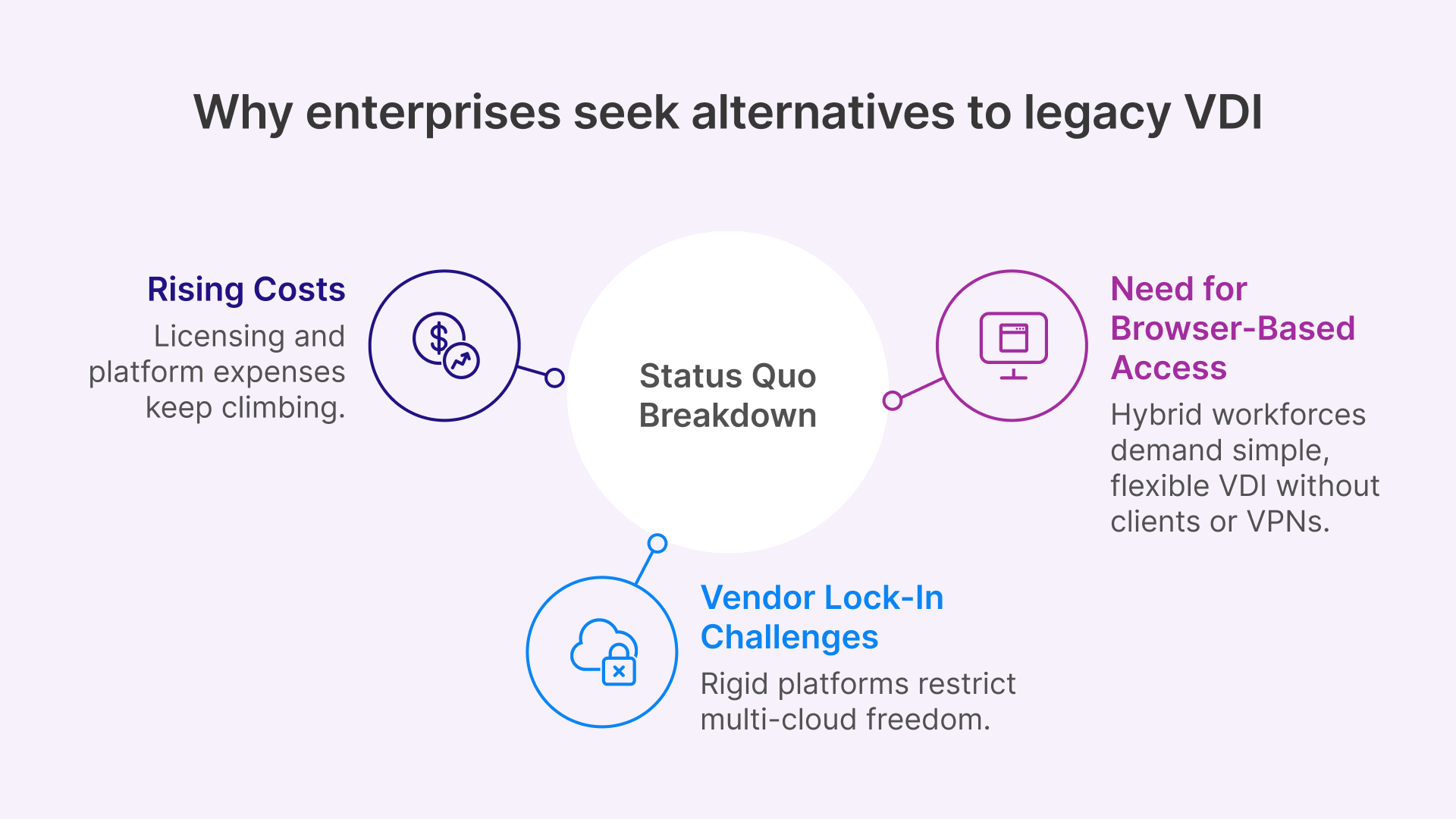
Nutanix, once a strong hyperconverged contender, now faces headwinds. Since Nutanix Frame was sold to Dizzion in 2023, customers report uncertainty in product strategy and innovation.
Key pain points include:
- High Licensing Costs: Nutanix NCI-VDI starts at $180+ per user annually, with additional compute, storage, and networking fees. Controller VMs alone can consume 32GB+ RAM per node.
- Rigid Infrastructure: Minimum 3-node clusters increase capital costs and reduce deployment flexibility.
- Vendor Lock-In: Dependency on Nutanix AHV hypervisor restricts multi-cloud adoption.
Market Reality: Enterprises Want Change
Recent research indicates 73% of organizations are exploring VDI alternatives, driven by:
- Rising subscription and infrastructure costs
- Vendor consolidation and uncertainty
- Demand for browser-based, cloud-native platforms to support hybrid workforces
Thinfinity + Oracle Cloud: The Modern Nutanix Alternative
Native OCI Integration with Zero Complexity
Thinfinity Workspace is designed for simplicity and performance:
- Cloud-Native Architecture: Infrastructure as Code automation, dynamic scaling, and multi-region deployment.
- Global Reach: Oracle Cloud spans 44 regions across 24 countries.
- Browser-Based Access: Pure HTML5, no VPNs or agents needed.
- Built-In ZTNA Security: WebSocket tunnels, end-to-end encryption, and policy-driven access replace perimeter-based VPNs.
Compelling Cost Advantages: 40–70% Lower TCO
Direct Cost Comparison (100 Users, Annual)
| Cost Category | Nutanix + Infra | Thinfinity + OCI | Savings |
|---|---|---|---|
| Licensing | $180,000+ | $97,200 | $82,800 (46%) |
| Infrastructure | $126,000+ | $71,250 | $54,750 (43%) |
| Total TCO | $306,000+ | $168,450 | $137,550 (45%) |
OCI Infrastructure Pricing Advantage (Revised with Nutanix Comparison)
| Resource | OCI Pricing / Terms | Nutanix Costs / Constraints | Implication |
|---|---|---|---|
| Compute (VMs / CPU+RAM) | OCI’s standard virtual machines (e.g. 4 vCPU / 16 GB RAM) are priced significantly lower than many alternatives. OCI offers flexible compute shapes and billing, with competitive rates when compared to AWS and Azure. (oracle.com) | Nutanix on-prem or cloud-cluster offerings (NC2) require purchasing software licenses plus the underlying hardware (servers with CPUs, memory, storage). Costs per node are higher due to dedicated infrastructure, over-provisioning, and the requirement of full cluster minimums (e.g. 3 or more nodes). Customer reports say Nutanix users often spend 2× the per-core/license costs compared to cloud alternatives. (peerspot.com) | For typical VDI workloads, OCI compute can deliver similar performance at a fraction of the cost, especially when factoring hardware procurement, maintenance, hypervisor overhead, etc. |
| Storage (Block / Disk / Performance) | OCI Block Volumes cost (standard performance) about US$0.0255 per GB per month for standard block storage. Higher performance tiers add costs, but baseline performance is often sufficient for many VDI needs. (oraclelicensingexperts.com) | In Nutanix deployments, storage is bundled as part of the hyper-converged infrastructure (HCI): multiple disks per node, SSD/NVMe tiers, controllers, replication, etc. Costs are higher per GB once you factor in redundancy, disk performance, and overhead of hardware lifecycle, plus license for storage software. Also, performance tuning often requires additional investment. (peerspot.com) | For many VDI use cases, OCI’s storage can meet performance requirements more cost-efficiently, especially when you don’t need the highest tier storage or massive IOPS/high-latency requirements. |
| Data Egress / Networking Costs | OCI provides up to 10 TB of free outbound data transfer (egress) per month, which significantly reduces costs for remote users, multi-region workloads, or cloud-integrated applications. Beyond that, OCI’s egress fees remain competitive. (finout.io) | In Nutanix on-prem or NC2 hybrid/cloud cluster models, egress costs may be hidden in hardware/network infrastructure, or costs of inter-cluster / site replication, plus connectivity. When Nutanix is paired with public cloud (for hybrid usage), public cloud egress or transit charges apply. Also, moving large amounts of data between nodes, sites, or off-premises hardware may incur direct costs or internal operational overhead. (peerspot.com) | Organizations with large user bases, remote access, or multi-region needs benefit from OCI’s generous egress allowance, lowering the networking cost component of VDI. |
Result
Because of these pricing differentials, OCI infrastructure for compute, storage, and data transfer often ends up being 30-60% cheaper or more than equivalent Nutanix HCI or NC2 solutions (when you include license, hardware, maintenance, redundancy, and networking). For VDI deployments especially, where you need many identical VMs, user profiles, storage, and frequent data movement, the savings can be very substantial.
Competitive Advantages Over Nutanix
Superior Performance and User Experience
Oracle Cloud leads hyperscalers in price-performance efficiency (81.88% better than AWS). Thinfinity maximizes this advantage:
- GPU Optimization: H.264 compression, GPU offloading, and 3D workload support
- Real-Time Audio/Video (RTAV): Native webcam/mic redirection for conferencing tools
- Multi-Device Support: Seamless access across Windows, macOS, Linux, iOS, Android
- PWA Experience: Progressive Web App with offline capabilities
Simplified & Smarter Management: Thinfinity Cloud Manager vs Nutanix Autoscaling Reality
Nutanix Capabilities: What Autoscaling & Management Looks Like Today
Nutanix offers several tools and features to scale VDI environments and automate certain operational tasks:
- Automatic Cluster Selection and the Acropolis Dynamic Scheduler (ADS) help balance workloads across hosts, mitigate hotspots, assist with data placement, and enforce policies. These are active even after deployment to optimize cluster performance.
- VDI Assurance / Per-Desktop Program gives more predictable sizing and procurement: hardware, storage, performance profiles tied to specific user types (e.g. Task, Knowledge, Power users), which helps avoid over- or under-provisioning.
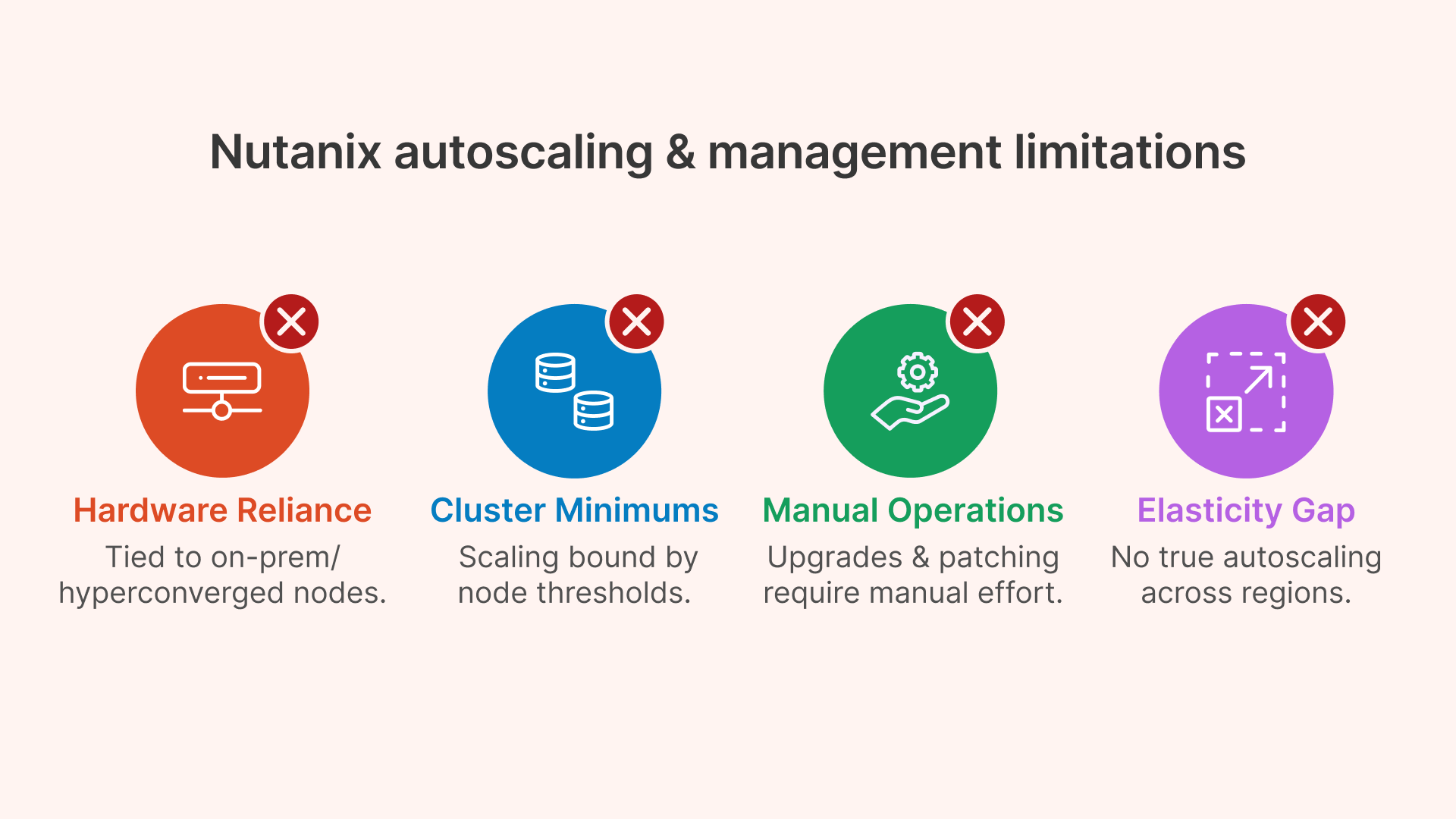
- However, many of these features still rely on hardware infrastructure, physical or hyper-converged nodes, cluster minimums, and manual intervention for lifecycle tasks like version upgrades, patching, or scaling out capacity. Autoscaling in the true cloud sense (spinning up/down VMs in response to user load across regions) is not a core strength of Nutanix’s standard on-prem or hybrid offerings; more so in hybrid/cloud offerings (NC2) or via partners. Some manual capacity planning is still required.
Cloud-Native & Hybrid Management
Nutanix Today: Cluster-Bound Automation
Nutanix provides cluster-level automation through features like Acropolis Dynamic Scheduler (ADS) for balancing workloads, FastTrack for VDI to simplify deployment, and VDI Assurance Programs for predictable sizing. While these tools reduce some operational friction, they remain tied to fixed hyperconverged clusters. Autoscaling means adding nodes, expanding storage pools, or redistributing workloads—still bound to Nutanix’s AHV or supported hypervisors.
Dynamic, cloud-style elasticity across regions, or cross-platform VM lifecycle management, is not natively part of Nutanix’s model. Enterprises often face manual planning for scaling, replication, patching, and lifecycle tasks across sites.
Thinfinity Cloud Manager on OCI: Cloud-First Automation
Thinfinity’s Cloud Manager is purpose-built for cloud elasticity. On Oracle Cloud, it delivers:
- Policy-Driven Autoscaling: Automatically provisions or decommissions OCI VMs based on user load, thresholds, or time-based policies.
- Template-Based Deployment: Golden images, desktop pools, and workload templates defined once, deployed consistently across OCI regions.
- Native OCI Hypervisor Integration: No need for separate controller VMs or cluster minimums. Thinfinity directly leverages OCI’s flexible compute, networking, and autoscaling groups.
- Multi-Region Failover: Unified management of DR policies and disaster recovery with OCI’s 44+ regions.
Result: Elastic VDI with zero hardware overhead, scaling in real time with user demand.
Thinfinity Cloud Manager for Hybrid & On-Premise: Beyond the Cloud
Unlike Nutanix’s cluster-centric approach, Thinfinity Cloud Manager also extends full orchestration to hybrid and on-prem environments, including:
- VMware vSphere / ESXi: Manage pools of VMs, provision desktops, and apply lifecycle policies directly within VMware infrastructures.
- Microsoft Hyper-V: Control VM lifecycles, integrate with Active Directory, and extend VDI across hybrid workloads.
- Proxmox VE: Automate VM creation and management for cost-sensitive or open-source deployments.
- VergeIO: Support modern SDS/HCI platforms with policy-driven VM automation for enterprises consolidating infrastructure.
This hybrid support means organizations can unify cloud-native scaling on OCI with existing datacenter investments—managing both from a single Thinfinity Cloud Manager console.
Comparative Snapshot: Nutanix vs Thinfinity Cloud Manager
| Feature | Nutanix Management | Thinfinity Cloud Manager |
|---|---|---|
| Autoscaling | Cluster expansion, node addition, ADS workload balancing | True cloud autoscaling via OCI instance pools and policy triggers |
| Infrastructure Dependence | Requires Nutanix AHV clusters, CVMs, controller VMs | No hardware minimums; runs natively on OCI |
| Multi-Region Resilience | Requires separate clusters and replication setup | Built-in OCI multi-region automation |
| Hybrid / On-Prem Support | Primarily Nutanix AHV, limited VMware integrations | VMware, Hyper-V, Proxmox, VergeIO managed under same console |
| Management Overhead | Multiple layers (Prism, AHV, AOS upgrades, clusters) | Single pane of glass with policy-driven automation |
Modern Security
Nutanix: A Legacy Approach
Nutanix environments often rely on perimeter security and VPNs, extending the corporate LAN into untrusted environments. This creates attack surface risks and compliance headaches.
Thinfinity: Built for Zero Trust
Thinfinity eliminates VPN reliance and inbound firewall rules. Instead, it enforces Zero Trust Network Access (ZTNA) with:
- Multi-Factor Authentication (MFA) for every login.
- Single Sign-On (SSO) integration with enterprise IdPs.
- Role-Based Access Control (RBAC) to enforce least privilege.
- Centralized auditing and logging for compliance.
- End-to-end TLS 1.3 encryption without VPN overhead.
The result: a secure cloud workspace with continuous verification, aligning with enterprise compliance mandates and the hybrid workforce model of 2025.
Flexible Deployment
Thinfinity VDI on OCI adapts to any enterprise cloud strategy:
- Hybrid: Keep sensitive workloads and data on-prem while seamlessly scaling desktops and apps in OCI.
- Multi-Cloud: Combine OCI with AWS, Azure, or GCP for distributed workloads and vendor risk mitigation.
- Cloud-First: Adopt a fully cloud-native model with built-in disaster recovery (DR) and automated failover across OCI’s 44+ regions.
Unlike Nutanix, which often requires dedicated infrastructure and complex scaling, Thinfinity uses OCI’s native KVM hypervisor integration with autoscaling templates to simplify operations.
Conclusion
In 2025, Nutanix’s promise of simplified VDI has given way to high costs, rigid infrastructure, and growing uncertainty. Enterprises need more than incremental fixes—they need a platform built for the cloud era. Thinfinity VDI on Oracle Cloud delivers that platform: 40–70% lower TCO, Zero Trust security without VPNs, and browser-based access that removes complexity from both users and IT teams.
By combining Thinfinity’s cloud-native automation with OCI’s unmatched price-performance and global reach, organizations gain the scalability, resilience, and governance required to support hybrid workforces and mission-critical workloads. For CIOs, CTOs, and CISOs, this means a secure, future-ready alternative that reduces risk while accelerating digital transformation.
Enterprises no longer have to choose between cost, performance, and simplicity—with Thinfinity on OCI, they can have all three.