



The Virtual Desktop Infrastructure (VDI) industry in 2025 is experiencing its most profound transformation since the early days of desktop virtualization. Accelerated by the rise of cloud adoption, cybersecurity imperatives, and the permanence of hybrid work, enterprises are overhauling how they deliver secure and scalable digital workspaces.
Global spending on desktop virtualization is expected to exceed $90 billion by 2034, with cloud-hosted VDI accounting for the majority of growth. This surge reflects a strategic pivot: organizations are shifting from traditional infrastructure-heavy deployments toward cloud-native, Zero Trust–aligned architectures that prioritize automation, flexibility, and predictable cost models.
Below are the defining trends shaping this landscape in 2025.
VDI Market Trends in 2025
1. Cloud-Native Over Legacy
Legacy systems such as Citrix, VMware (Omnissa), and Nutanix once set the standard for virtual desktop delivery—but by 2025, their dominance has eroded.
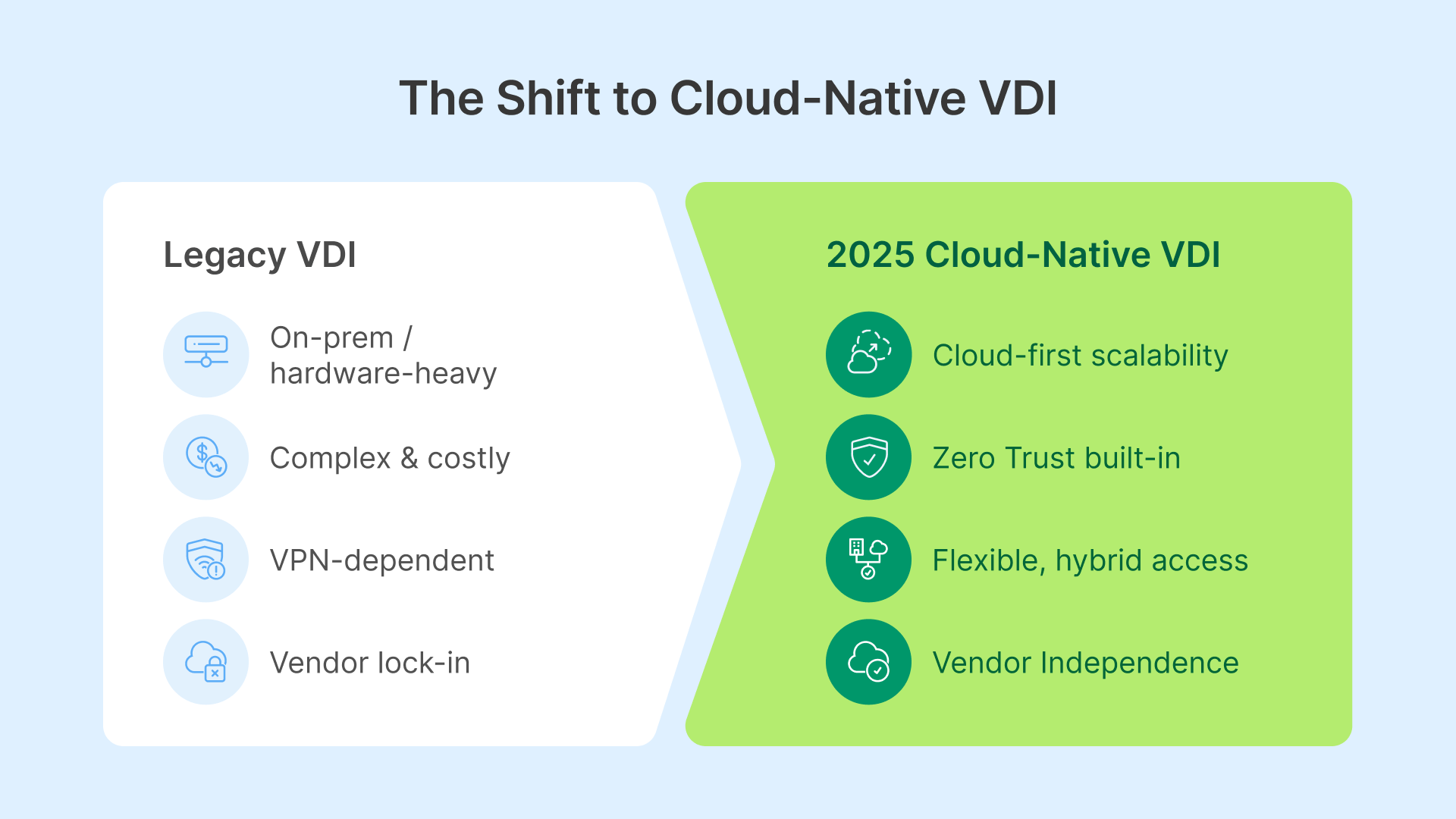
Enterprises that remain tied to on-premises hyperconverged infrastructure (HCI) or multi-layered broker stacks now face mounting challenges: escalating licensing costs, vendor lock-in, and skill shortages for maintaining specialized environments.
Modern organizations increasingly favor cloud-native VDI architectures—solutions built from the ground up for automation, scalability, and elasticity across hybrid and multi-cloud environments. These platforms minimize dependency on proprietary components and offer transparent pricing through public cloud infrastructure like Oracle Cloud Infrastructure (OCI), AWS, or Azure.
The shift is both strategic and economic: enterprises adopting cloud-first VDI report 25–40% reductions in total cost of ownership (TCO) while gaining faster provisioning and easier lifecycle management. The message is clear—cloud-native platforms have redefined what efficiency and agility mean in virtual desktop delivery.
2. Vendor Consolidation Fallout
The VDI sector in 2025 continues to feel aftershocks from major consolidations.
Broadcom’s acquisition of VMware (and the resulting Omnissa transition) introduced widespread uncertainty, with many enterprises citing unclear product roadmaps and steep price hikes. Similarly, Citrix’s integration into Cloud Software Group led to licensing increases of over 200% in some regions, driving CIOs to reconsider long-term vendor dependencies.
This instability has triggered a broader vendor diversification movement. Enterprises are actively seeking alternatives that guarantee transparency, roadmap stability, and freedom from abrupt policy shifts. The emerging winners are independent, cloud-integrated VDI vendors that emphasize interoperability, simple licensing, and API-driven automation—attributes that legacy vendors often lack.
In short, 2025 is the year enterprises learned that stability and openness are just as valuable as performance and features.
3. Zero Trust Adoption Becomes the Norm
Security has shifted from being a compliance checkbox to a structural design principle.
By mid-2025, 60% of enterprises had eliminated VPN usage entirely, replacing it with Zero Trust Network Access (ZTNA) models. This trend was accelerated by rising cyberattack frequency—84% of organizations suffered security incidents in 2025, largely due to VPN vulnerabilities and credential misuse.
Zero Trust VDI platforms now verify every access attempt in real time, regardless of device or location. Instead of relying on traditional perimeter defenses, modern solutions integrate identity providers (IdPs), enforce role-based access control (RBAC), and monitor continuous authentication.
The result is a perimeter-less workspace—where every user, endpoint, and session is continuously validated before gaining access to sensitive applications or data. This security paradigm has become essential for organizations with distributed or hybrid workforces operating outside traditional network boundaries.
4. Hybrid Workforce Enablement
The hybrid work model has cemented itself as the operational norm rather than a contingency plan.
According to industry data, 82% of enterprises now support Bring Your Own Device (BYOD) policies, while over 70% of employees access corporate applications remotely at least part-time.
End users expect seamless, secure, and device-agnostic access to their work environments—whether from a laptop, tablet, or browser. Consequently, clientless and browser-based VDI access has transitioned from a convenience to a core enterprise requirement.
For IT teams, this evolution translates into reduced endpoint management burdens, faster onboarding, and improved employee satisfaction—all while keeping corporate data centralized and under control. Browser-based access also simplifies compliance and allows for easier deployment of Zero Trust policies across global teams.
Thinfinity VDI and the 2025 Landscape
Amid these shifts, Thinfinity VDI on Oracle Cloud Infrastructure (OCI) exemplifies the characteristics defining the modern VDI era. While not the only player in this transformation, it represents how next-generation platforms are realigning the market’s expectations:
- Cloud-Native Architecture: Built directly on OCI’s KVM hypervisor, Thinfinity eliminates dependency on legacy brokers or hypervisors. It enables automation at scale through its Cloud Manager, reducing management complexity and cost.
- Zero Trust by Design: With embedded ZTNA enforcement, every session is continuously verified—removing VPN dependencies while maintaining compliance with standards like HIPAA, GDPR, and PCI-DSS.
- Browser-Based Access: End users connect through an HTML5 interface, achieving near-native GPU and audio-visual performance through H.264 compression and optimized WebSocket channels—ideal for hybrid and remote teams.
- Operational Stability: Supported by Oracle’s 44+ global regions and predictable cost models, Thinfinity provides a stable, long-term alternative to vendors affected by consolidation or pricing turbulence.
In essence, Thinfinity reflects a broader market reality: the future of VDI belongs to platforms that unify security, simplicity, and scalability in a single, transparent framework.
Conclusion
As 2025 progresses, the Virtual Desktop Infrastructure market continues to evolve from static, hardware-bound systems into flexible, service-oriented ecosystems.
CIOs and CISOs are aligning around shared goals—cost predictability, security assurance, and operational agility—as they rebuild their digital workspace strategies for the decade ahead.
Legacy models are giving way to cloud-native, Zero Trust–driven VDI platforms that reduce friction and empower hybrid teams to work securely from anywhere.
While multiple vendors are driving innovation, the organizations that thrive will be those that choose transparent, cloud-integrated, and automation-first platforms—solutions that turn digital workspaces from cost centers into strategic enablers of productivity and resilience.