

Simplifying Thinfinity VDI on OCI: Secure Profiles and Audit Logs with MySQL HeatWave
When you virtualize desktops and applications at scale, the control plane database quietly becomes one of the most critical pieces of your architecture. It stores who can access what, how sessions are routed, which policies apply, and every action that must be audited later.
On Thinfinity VDI running on Oracle Cloud Infrastructure (OCI), we remove a whole layer of complexity by delegating that responsibility to MySQL HeatWave (MySQL Database Service) as a fully managed PaaS. All Thinfinity-critical data—profiles, mappings, policies and audit logs—is safely stored in a secure, highly available OCI database service, instead of a self-managed database cluster.
Oracle’s recent update to Configurable Maintenance Windows and Auto-Upgrade Controls in MySQL HeatWave reinforces exactly why this matters for Thinfinity customers: you gain predictable change windows, controlled upgrades, and continuous compliance without babysitting infrastructure.
Why the Database Layer Is So Critical for Thinfinity
In Thinfinity VDI on OCI, the database is not “just another component.” It’s the source of truth for:
- User and group profiles – who the user is, which resources they see, what RBAC rules apply.
- Resource mappings – associations between users, desktops, applications, networks, tenants, and policies.
- Configuration state – broker settings, workspace definitions, SSO bindings, MFA policies, session parameters.
- Security and audit logs – who connected, when, from where, what they accessed, and what operations they performed.
If that data layer goes down or behaves unpredictably, your entire virtual workspace experience is at risk. That’s why offloading it to a managed, OCI-native MySQL HeatWave service is such a big win.
Removing One Layer of Complexity: From DIY DB to MySQL PaaS
Traditionally, many VDI deployments rely on:
- Self-managed MySQL or other RDBMS clusters
- Manually configured HA and replication
- DIY backup/restore and patching playbooks
- Hand-crafted upgrade windows that are easy to mis-time
Every one of these adds operational drag and risk.
With Thinfinity VDI on OCI, we leverage MySQL HeatWave as a managed PaaS database. That means:
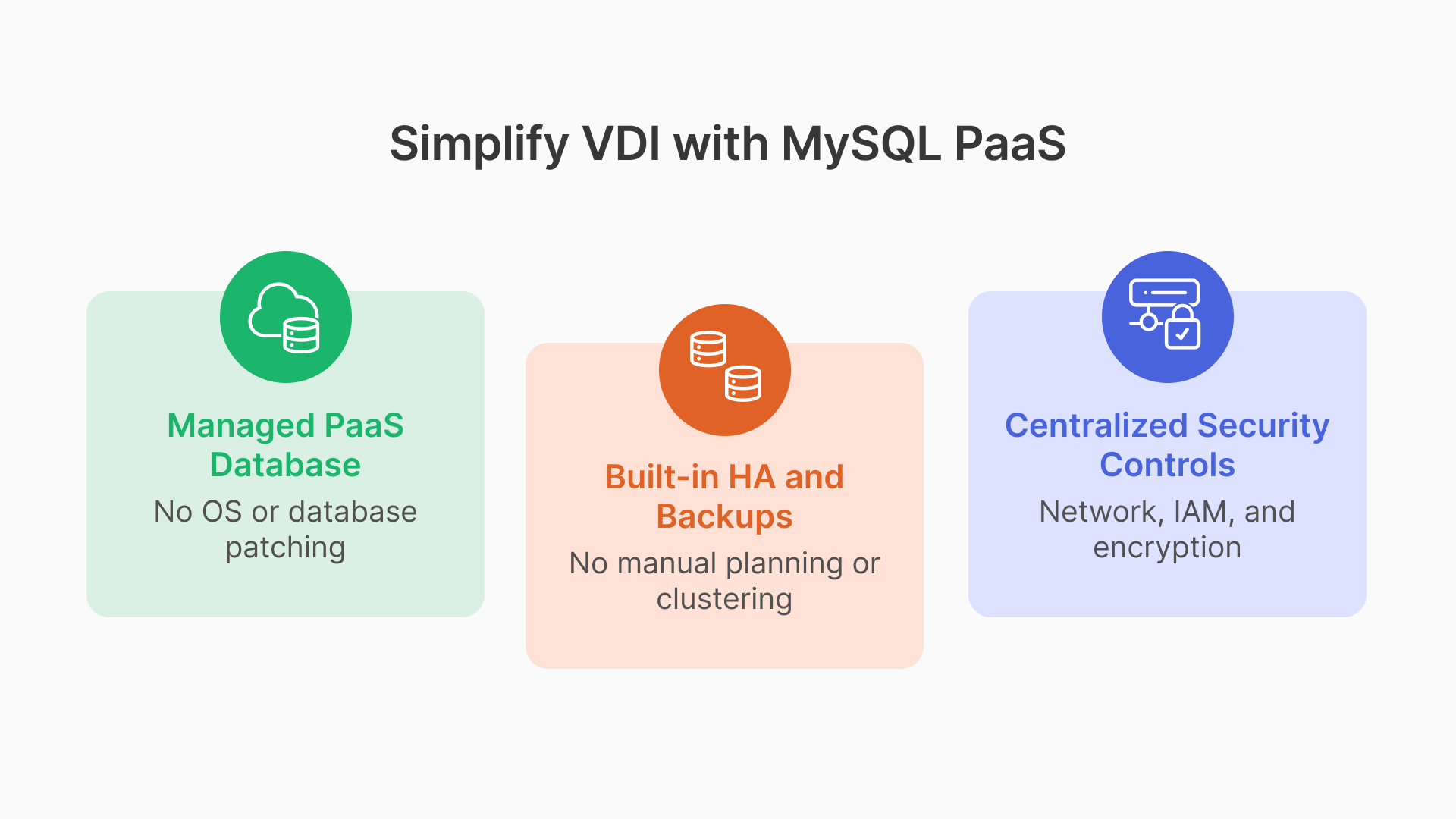
- No OS or database patching for your team
- No manual planning of failover mechanisms or clustering
- Built-in backups, durability and high availability as part of the service
- Centralized security controls within OCI (network, IAM, encryption)
Your team focuses on VDI strategy, not on shepherding a stateful database cluster.
What We Store in MySQL HeatWave for Thinfinity
Thinfinity uses the MySQL PaaS service as the central configuration and audit store for:
- Profiles & RBAC
- User & group objects
- Role assignments
- Access scopes for desktops, apps, and remote networks
- Mappings & Policies
- Mappings between identities and resources (RDP pools, apps, SSH endpoints, WAG apps, etc.)
- Tenant- and project-level configuration
- Policy rules (e.g., device posture, IP ranges, MFA requirements)
- Operational & Audit Data
- Session start/stop events
- Authentication attempts (success/failure)
- Administration actions in the Thinfinity console
- Critical configuration changes for full traceability
All of this is stored in MySQL HeatWave, benefitting from HA, backups, and lifecycle controls that Oracle manages at the platform level.
Configurable Maintenance Windows: Predictable Change for VDI
The Oracle article introduces Configurable Maintenance Windows and Auto-Upgrade Controls for MySQL HeatWave, allowing you to specify when maintenance runs and how auto-upgrades should behave.
For Thinfinity customers, that translates directly into:
- No surprise database maintenance during business-critical hours
- The ability to sync database maintenance with Thinfinity maintenance windows
- Clearly defined test vs production rollout paths for database versions
For example, you can:
- Use “Early” upgrade schedules for dev/test Thinfinity environments, testing new MySQL versions and validating Thinfinity workflows before they touch production.
- Use “Regular” upgrade schedules for production, ensuring upgrades only happen after you’ve completed testing. This keeps your profile store and audit database aligned with your internal release rhythm, instead of being forced into upgrades at awkward times.
Auto-Upgrade Controls: Innovation Without Surprises
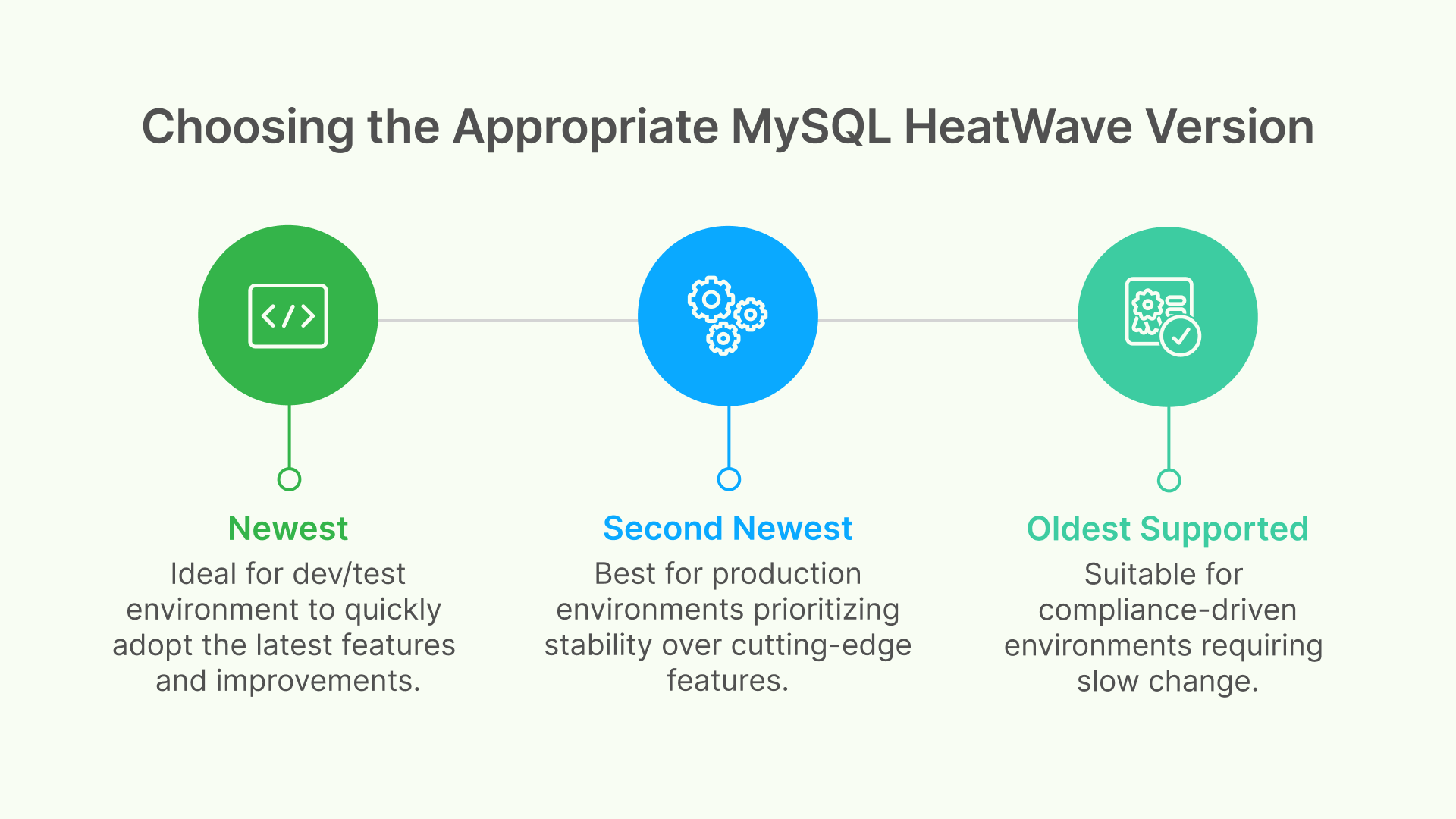 MySQL HeatWave now lets you choose not only when to upgrade but also to which version: Newest, Second Newest, or Oldest supported.
For Thinfinity on OCI, this is particularly useful:
- Newest – Ideal if you want Thinfinity dev/test to quickly adopt the latest MySQL capabilities (e.g., performance or security improvements), validating them against your workspace workloads.
- Second Newest – Best for production Thinfinity environments, where Oracle has already “burned in” the release for some time and you prioritize stability over cutting-edge features.
- Oldest (still supported) – If your compliance posture requires very slow change, you can remain on a long-lived version while still staying in support windows.
Combined with lifecycle visibility (Release → Deprecated → Unavailable), you can map exactly when you want Thinfinity production to move, and ensure you’ve exercised your environment thoroughly in dev/test first.
High Availability and Auditability Built In
Because MySQL HeatWave is an OCI PaaS service, Thinfinity benefits from:
- Built-in HA across availability domains and zones (depending on configuration)
- Automatic backups & point-in-time recovery (configured at the service level)
- Encryption at rest and in transit
- Integration with OCI networking & IAM, keeping the database on private subnets and tightly controlling who can touch it
For Thinfinity, that means:
- Your profiles, mappings, and RBAC rules remain available even during infrastructure failures.
- Your audit logs are preserved in a service designed for durability and compliance.
- You don’t need a separate database team babysitting the cluster—OCI does the heavy lifting.
Architecture at a Glance (Conceptual)
A typical Thinfinity VDI on OCI setup using MySQL HeatWave looks like this:
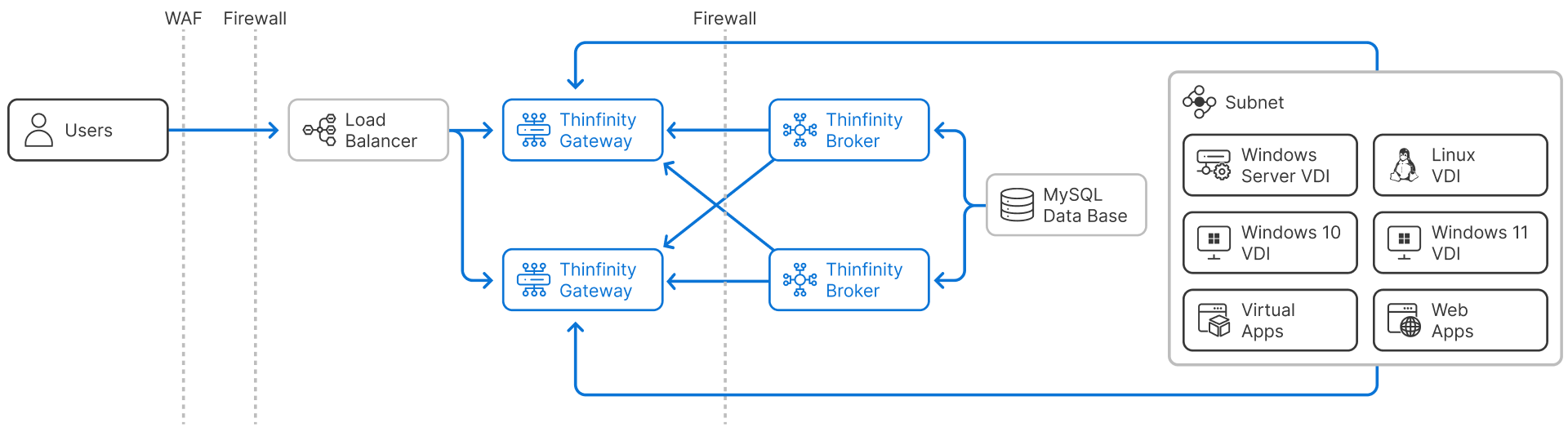
- Users connect via browser or client to the Thinfinity Workspace gateway on OCI.
- Thinfinity brokers authenticate the user (IdP, SSO, MFA) and query MySQL HeatWave for:
- User profile & roles
- Resource mappings
- Policies and entitlements
- Thinfinity instantiates the appropriate session (RDC desktop,Virtual app, SSH, WAG, etc.).
- Session events and admin operations are logged back into MySQL as auditable records.
- MySQL HeatWave handles maintenance according to your configured window and upgrade policy, so uptime and user experience remain predictable.
Your team never touches the underlying MySQL OS, replication configuration, or backup scripts. You simply consume it as a hardened, OCI-native service.
Conclusion: A Simpler, Safer Control Plane for Thinfinity on OCI
By anchoring Thinfinity VDI’s configuration, profiles, mappings, and audit logs in MySQL HeatWave on OCI, you:
- Eliminate an entire layer of complexity (no more self-managed DB clusters)
- Gain predictable maintenance with configurable windows and upgrade policies
- Ensure secure, highly available storage for your most critical Thinfinity data
- Align database lifecycle with your internal dev/test → production rollout processes
Instead of worrying about when and how to patch your control-plane database, you set a strategy once in MySQL HeatWave and let OCI enforce it—while Thinfinity keeps delivering secure virtual desktops and applications to your users.
If you want to dive deeper into the maintenance capabilities that make this possible, check out Oracle’s original article: Extending Flexibility in MySQL HeatWave Maintenance.