

A Reliability-First Perspective for University Leaders and Academic IT Executives
Virtual Desktop Infrastructure in education has entered a new phase. By 2026, the discussion is no longer centered on whether VDI can support academic environments. It already does. Universities across the world rely on virtual desktops and virtual applications to deliver classrooms, labs, faculty workspaces, and administrative systems.
The real question educational leaders now face is far more strategic:
Which VDI model delivers reliable, sustainable academic computing over years of continuous use—without creating operational debt or constraining how education actually works?
For presidents, CIOs, and executive committees, VDI reliability is not an abstract infrastructure concern. It directly affects student experience, faculty productivity, cybersecurity exposure, and long-term cost predictability. A virtual lab that works during a pilot but degrades during peak semester usage quickly becomes a reputational and operational liability.
This article examines traditional on-premises VDI and cloud VDI for education through a single, non-negotiable lens: long-term reliability at academic scale. It then explores how Thinfinity VDI on Oracle Cloud Infrastructure (OCI) fits into a modern, education-aligned cloud VDI architecture.
Why Reliability Is the Defining Metric for Academic VDI
In education, reliability is not measured by uptime statistics alone. It is experienced daily by students and faculty in subtle but cumulative ways.
A virtual classroom that slows down during exam periods, a lab environment that cannot scale for enrollment changes, or an authentication failure that prevents thousands of students from accessing coursework—each erodes confidence in institutional IT.
Reliable academic VDI environments share several traits. They remain stable under peak concurrency. They adapt to cyclical usage without permanent overprovisioning. They isolate failures instead of amplifying them. Most importantly, they continue to behave predictably as academic programs evolve.
These characteristics do not emerge accidentally. They are the outcome of architectural choices, particularly around infrastructure ownership, elasticity, and control models.
Traditional On-Prem VDI in Education: Control with Structural Constraints
Why Traditional VDI Took Hold on Campus
Traditional VDI emerged in universities as a natural extension of centralized IT. By hosting desktops in campus datacenters, institutions could standardize environments, manage licensed software centrally, and extend limited remote access beyond physical labs.
For many institutions, this model initially delivered meaningful benefits:
- Consistent desktop images across classrooms
- Simplified software deployment
- Tighter control over academic applications
- Reduced dependency on individual lab machines
In environments with stable enrollment and predictable workloads, on-prem VDI still performs adequately.
Where Traditional VDI Begins to Strain
Over time, however, traditional VDI exposes structural limits that are particularly acute in education.
Academic usage is inherently cyclical. Infrastructure must be sized for peak class hours and exam periods, even though it remains underutilized nights, weekends, and between semesters. This results in capital investment that delivers value only part of the year.
Operational responsibility is another limiting factor. Universities must manage:
- Hardware refresh cycles
- Storage growth and backup
- High availability and disaster recovery
- Network segmentation and security
As security requirements increase and budgets tighten, traditional VDI often becomes an anchor rather than an enabler. Reliability suffers not because the technology fails, but because the model resists change.
Cloud VDI for Education: Elasticity Aligned with Academic Reality
What Fundamentally Changes in the Cloud
Cloud VDI shifts the economic and operational center of gravity. Instead of building infrastructure for maximum demand, universities can provision desktops and applications dynamically, scaling up during teaching hours and scaling down when resources are idle.
This elasticity maps naturally to academic calendars and course schedules. Virtual classrooms can exist only when needed. Labs can be spun up per course, per semester, or even per session.
Cloud VDI also changes how institutions approach resilience. Availability zones, geographic redundancy, and consumption-based pricing alter how reliability is achieved and measured.
New Responsibilities Introduced by Cloud VDI
Cloud VDI is not automatically simpler. It replaces hardware management with architectural decision-making.
Institutions must carefully evaluate:
- Network behavior and long-lived session costs
- GPU availability for advanced programs
- Identity and access models for students and faculty
- Visibility into usage and consumption over time
Cloud VDI succeeds in education when it is designed as a platform, not merely as hosted desktops.
Why Cloud Choice Matters for Academic VDI Reliability
Not all cloud platforms behave the same under VDI workloads. Academic environments impose unique demands: sustained concurrency, predictable performance, and cost transparency for public or semi-public institutions.
OCI as a Foundation for Academic Cloud VDI
Oracle Cloud Infrastructure has gained traction in education and research largely due to its infrastructure economics and architectural simplicity.
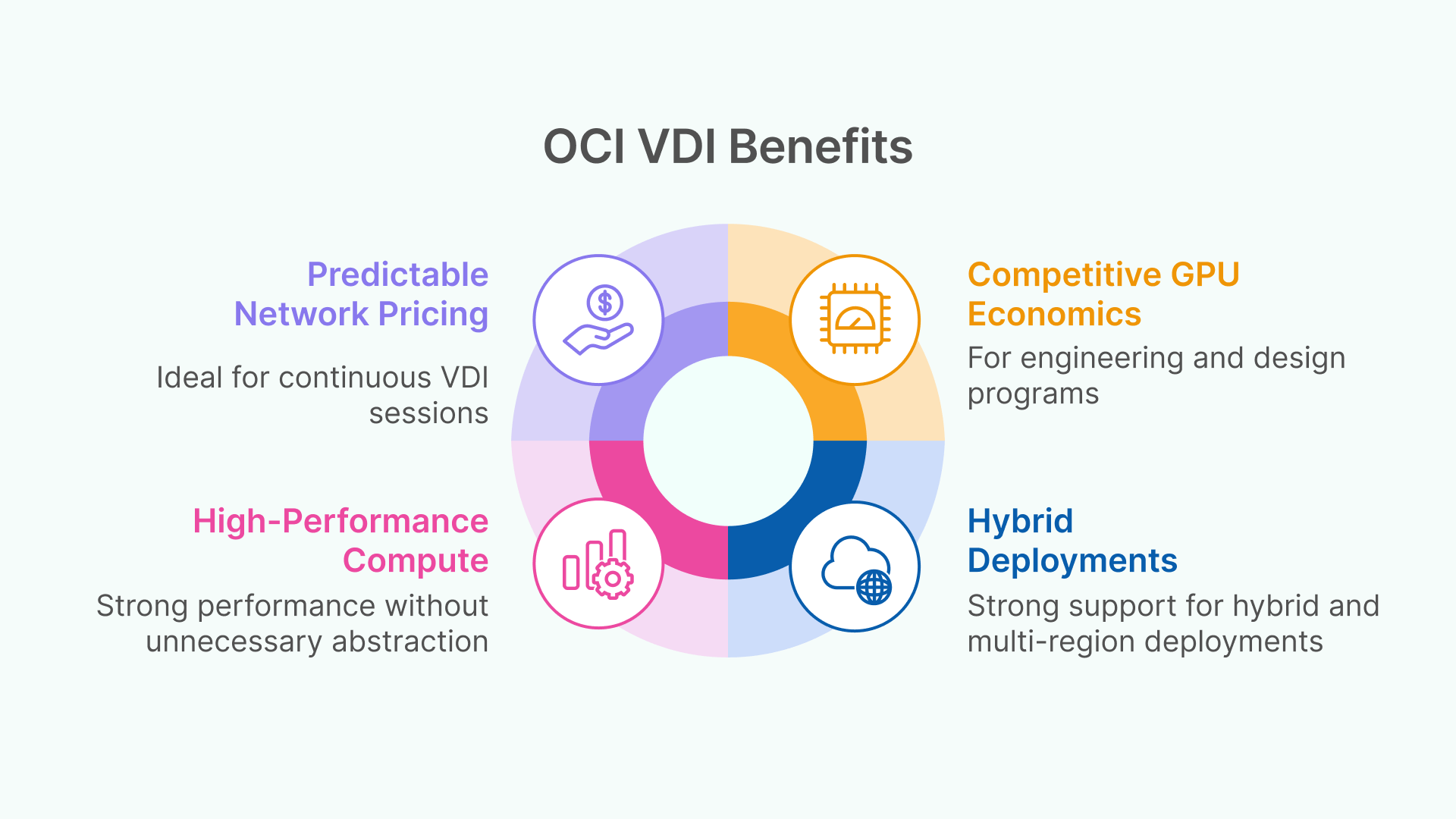
From a VDI perspective, OCI offers:
- Predictable, flat network pricing suitable for always-on sessions
- Competitive GPU economics for engineering and design programs
- High-performance compute options without forced abstraction
- Strong support for hybrid and multi-region deployments
These characteristics reduce the need for cost-driven architectural compromises that often degrade reliability over time.
Control Planes and Access: The Hidden Variable in Educational VDI
Why VDI Control Planes Fail Before Infrastructure
In large academic deployments, outages rarely originate from compute failure. They emerge from identity systems, brokering layers, or tightly coupled control planes that amplify minor disruptions.
Education environments are especially sensitive to this risk because of:
- Massive concurrent logins at class start times
- Role diversity across students, faculty, and staff
- External access from unmanaged devices
A resilient VDI model must separate access control, session orchestration, and infrastructure concerns.
Thinfinity VDI on OCI: An Education-Oriented Implementation Model
Architectural Role of Thinfinity in Cloud VDI
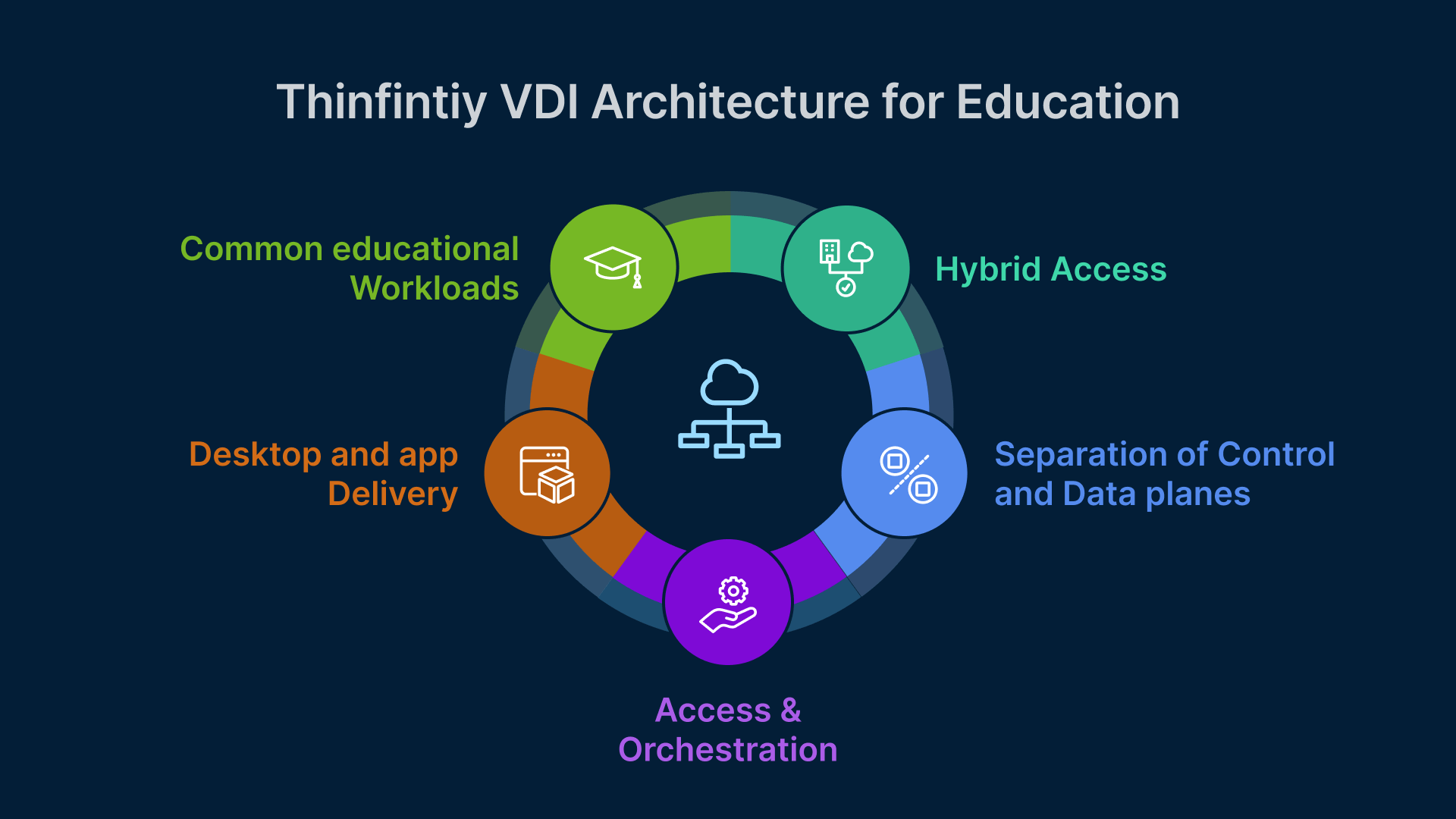
In a cloud VDI architecture on OCI, Thinfinity Workspace functions as an access and orchestration layer, rather than as a monolithic VDI stack.
This positioning allows:
- Identity-driven access without VPN dependency
- Clear separation between control and data planes
- Delivery of both full desktops and virtual applications
- Hybrid access to on-prem and cloud resources
For education, this decoupling is critical. It enables institutions to evolve infrastructure without forcing changes to how students and faculty access resources.
Academic Scenarios Supported
Within this model, common educational workloads coexist naturally:
- Scheduled virtual classrooms that scale with enrollment
- Persistent faculty desktops with secure off-campus access
- Application-level delivery for shared academic tools
- Transitional hybrid models during cloud migration phases
Reliability emerges not from rigid standardization, but from architectural flexibility.
Security and Governance in Cloud Academic VDI
Identity as the New Perimeter
Modern academic VDI increasingly relies on identity rather than network location. This reduces exposure from unmanaged student devices and removes reliance on legacy VPN models.
When implemented through a dedicated access layer, identity-first VDI enables:
- Role-based access enforcement
- Reduced lateral movement risk
- Fine-grained auditing and visibility
- Easier alignment with Zero Trust principles
Governance at Institutional Scale
Universities require transparency into how digital resources are consumed. Cloud VDI architectures that expose session data, usage patterns, and access history support both internal governance and regulatory oversight.