

Introduction: Why Cloud Choice Matters More in Education Than in Enterprise IT
As universities transition from traditional campus infrastructure to cloud-based Virtual Desktop Infrastructure (VDI), many assume that all major public clouds behave similarly. From a distance, Oracle Cloud Infrastructure (OCI) and Microsoft Azure both appear capable of hosting academic virtual desktops, labs, and faculty environments.
In practice, however, education workloads amplify differences that are less visible in enterprise VDI.
Academic environments combine long-running sessions, sharp concurrency peaks, shared infrastructure, and strict budget cycles. These conditions expose how cloud pricing models, control-plane design, and performance behavior affect reliability and long-term sustainability.
This article compares OCI and Azure specifically through the lens of education VDI, focusing on cost predictability, scalability during peak academic usage, and operational resilience over time.
Academic VDI as a Stress Test for Cloud Platforms
Why Education Pushes Cloud Assumptions to Their Limits
Unlike many enterprise environments, universities experience:
- Thousands of concurrent logins at fixed times
- High session duration during teaching hours
- Large populations of unmanaged devices
- Budget sensitivity tied to academic years, not monthly optimization
Cloud platforms that perform well under bursty or transactional workloads may behave very differently under these sustained conditions.
VDI for education is therefore less about peak performance and more about consistent behavior under predictable stress.
Network Economics: Predictability vs Optimization
Why Network Costs Matter in Academic VDI
VDI traffic is continuous and bidirectional. Unlike web applications, virtual desktops maintain active sessions for hours at a time, making network behavior a primary driver of both cost and user experience.
When network pricing is complex or variable, institutions often respond by altering architecture to control spend. Over time, these optimizations can undermine reliability.
OCI: Flat Economics That Favor Long Sessions
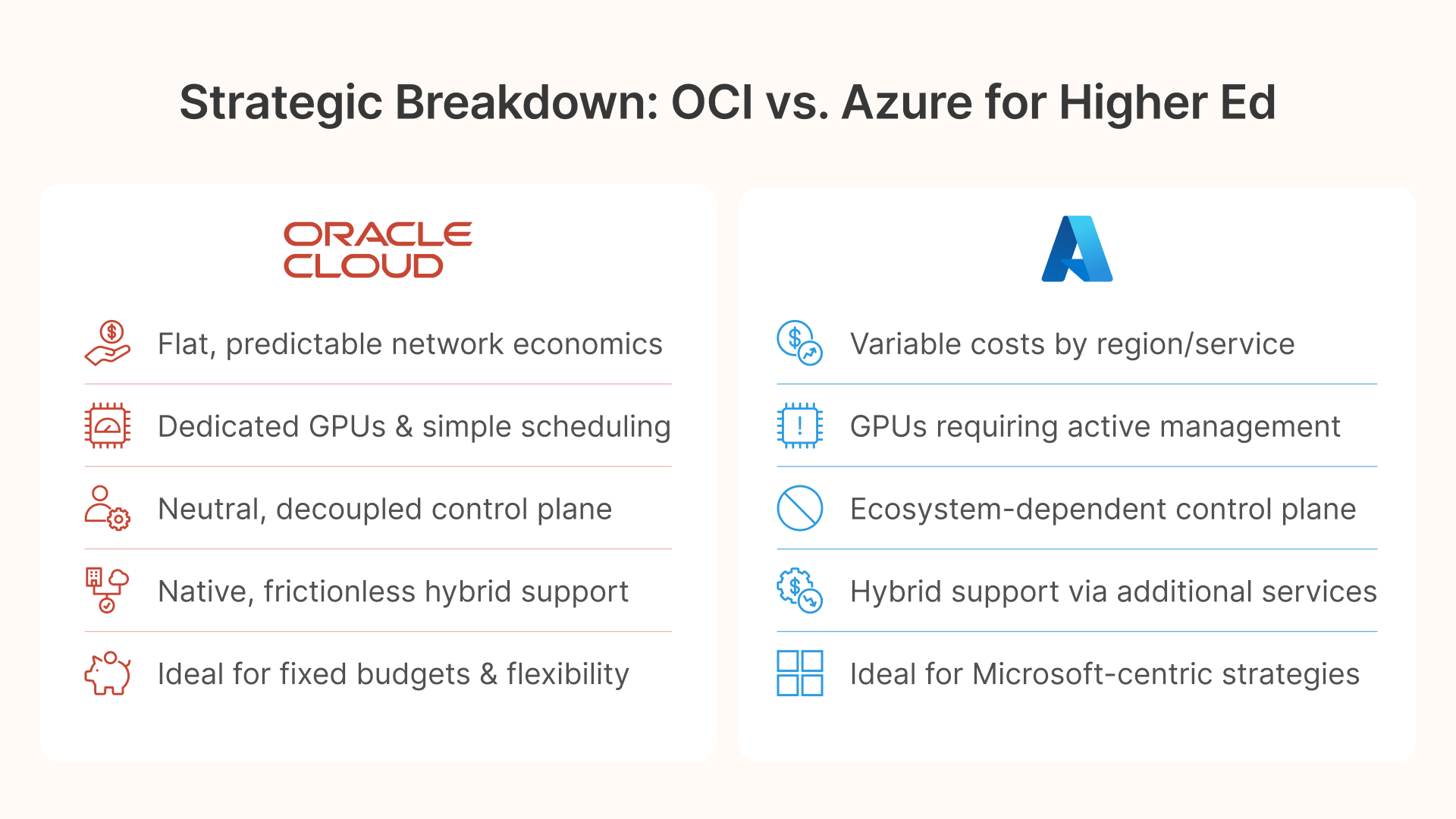
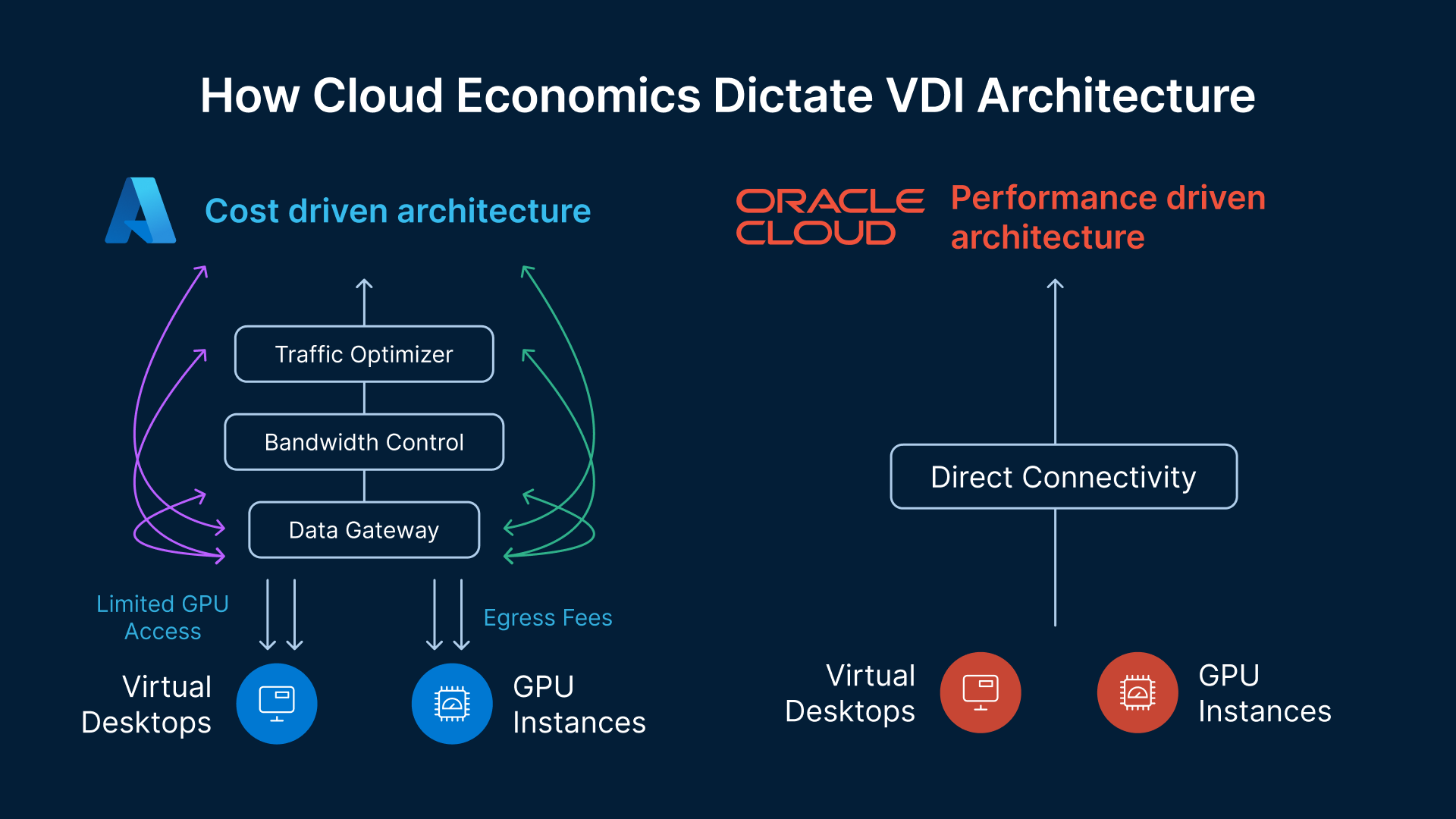
OCI’s networking model emphasizes simplicity and predictability. Flat egress pricing and minimal inter-service transfer penalties allow universities to design VDI architectures around performance rather than cost avoidance.
For academic environments, this translates into:
- Consistent session quality throughout the day
- Fewer architectural workarounds
- Easier cost forecasting across semesters
The result is not just lower cost, but lower operational risk.
Azure: Enterprise Integration with Cost Sensitivity
Azure delivers a highly capable network tightly integrated with Microsoft’s identity and desktop services. For many institutions, this integration simplifies deployment and aligns with existing Microsoft-centric strategies.
However, Azure’s network pricing varies by region, service, and traffic path. As VDI environments scale, institutions must actively manage architecture to prevent cost escalation.
This introduces a subtle trade-off: optimization decisions increasingly influence design, and reliability becomes dependent on ongoing financial governance.
GPU Economics for Academic Programs
Why GPU Cost Behavior Matters in Universities
Engineering, design, and research programs rely on GPU-backed desktops, often during limited but intense usage windows. Cost efficiency depends less on raw GPU pricing and more on how easily GPU resources can be aligned with course schedules.
OCI GPU Model: Predictability and Dedicated Performance
OCI offers competitive GPU pricing with options for dedicated and bare-metal GPU resources. This reduces oversubscription risk and simplifies performance planning for academic labs.
For education, this model supports:
- Deterministic performance during class hours
- Easier scheduling of GPU-backed labs
- Reduced variability across sessions
Azure GPU Model: Strong Ecosystem, Premium Economics
Azure provides a broad portfolio of GPU-enabled VMs and strong ISV support. Performance is reliable, but GPU instances are premium resources.
Universities often manage cost by:
- Limiting session density
- Overprovisioning to avoid contention
- Restricting access windows tightly
While effective, these measures increase complexity and administrative overhead over time.
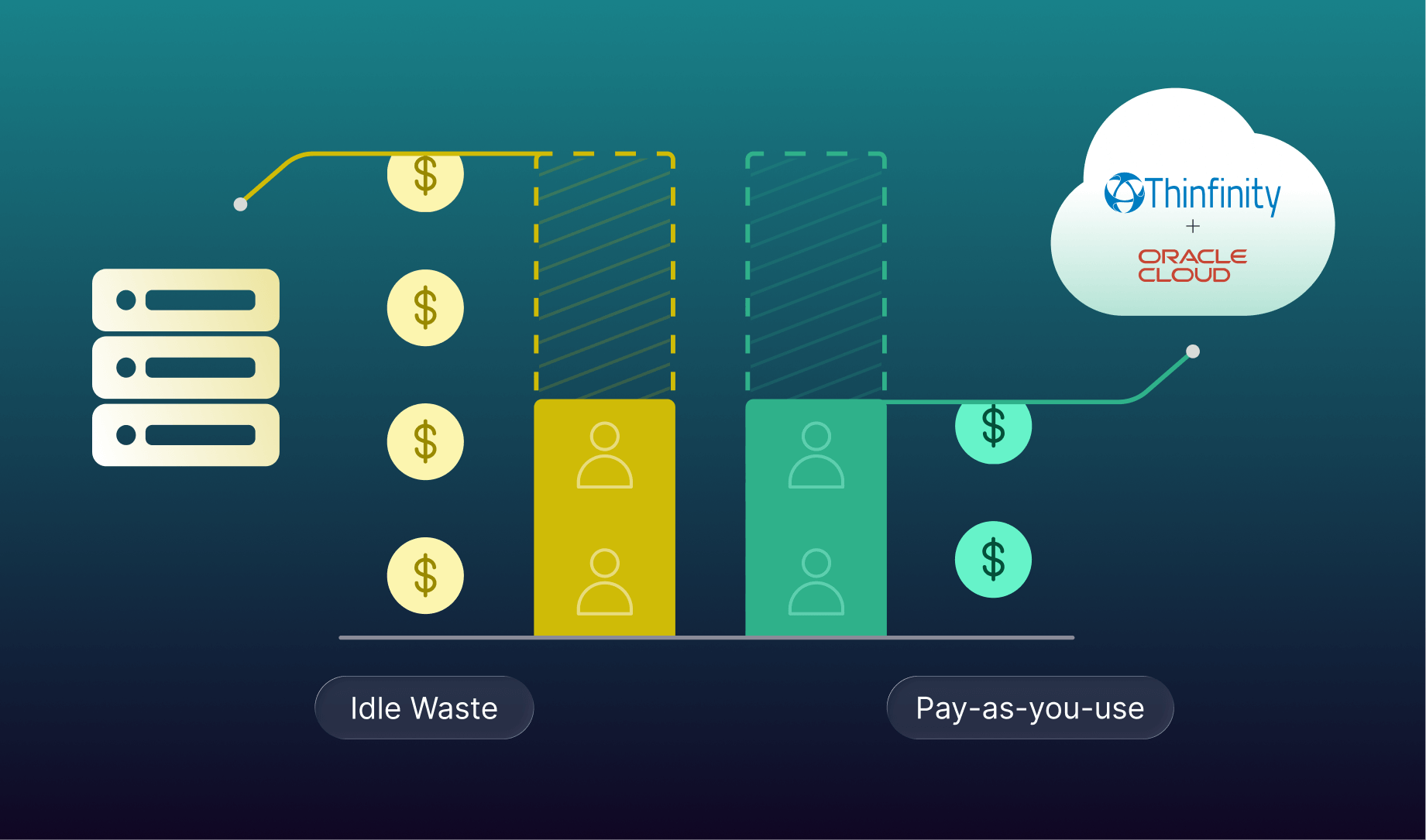
Thinfinity’s Role Across Both Platforms
Access and Orchestration Above the Cloud Layer
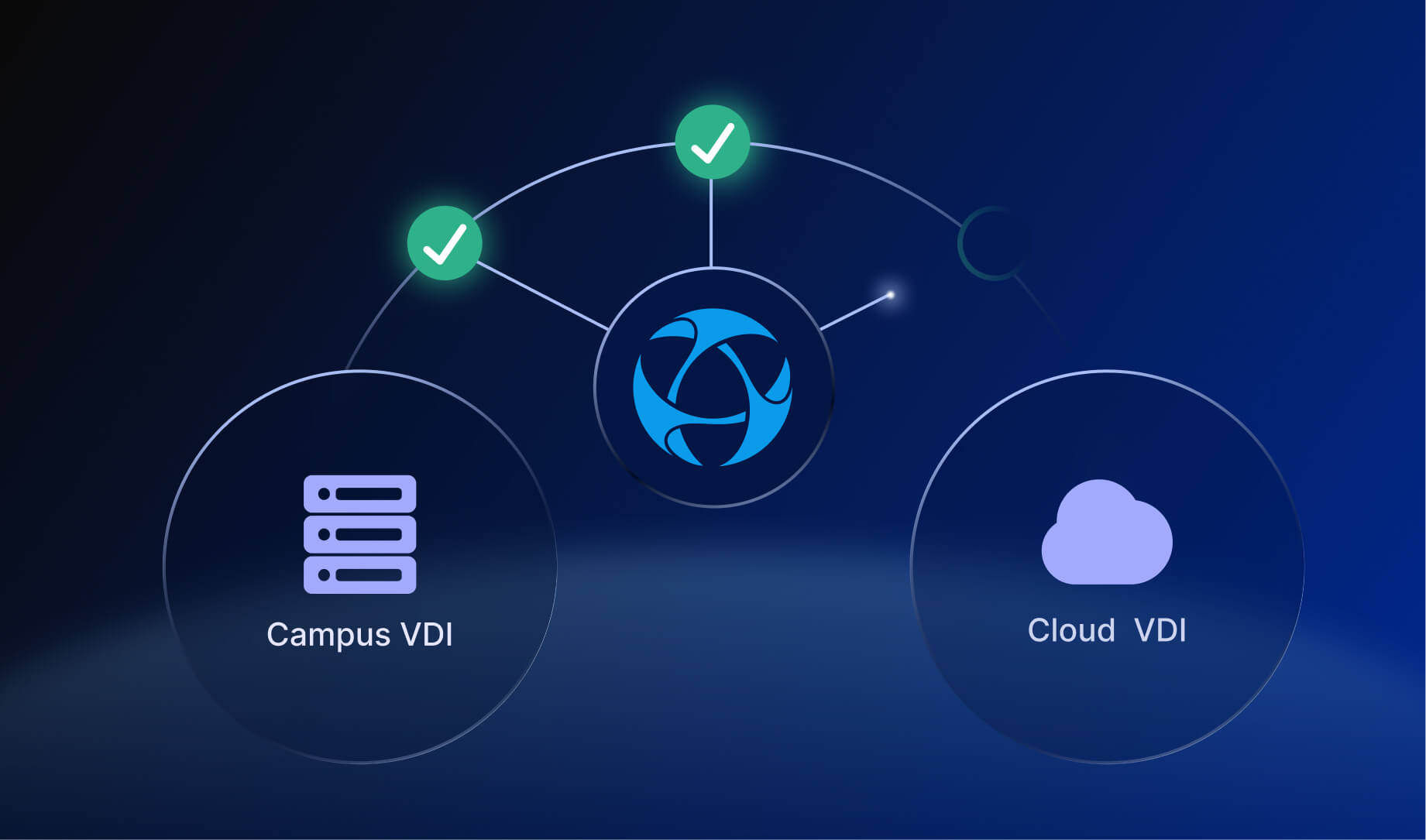
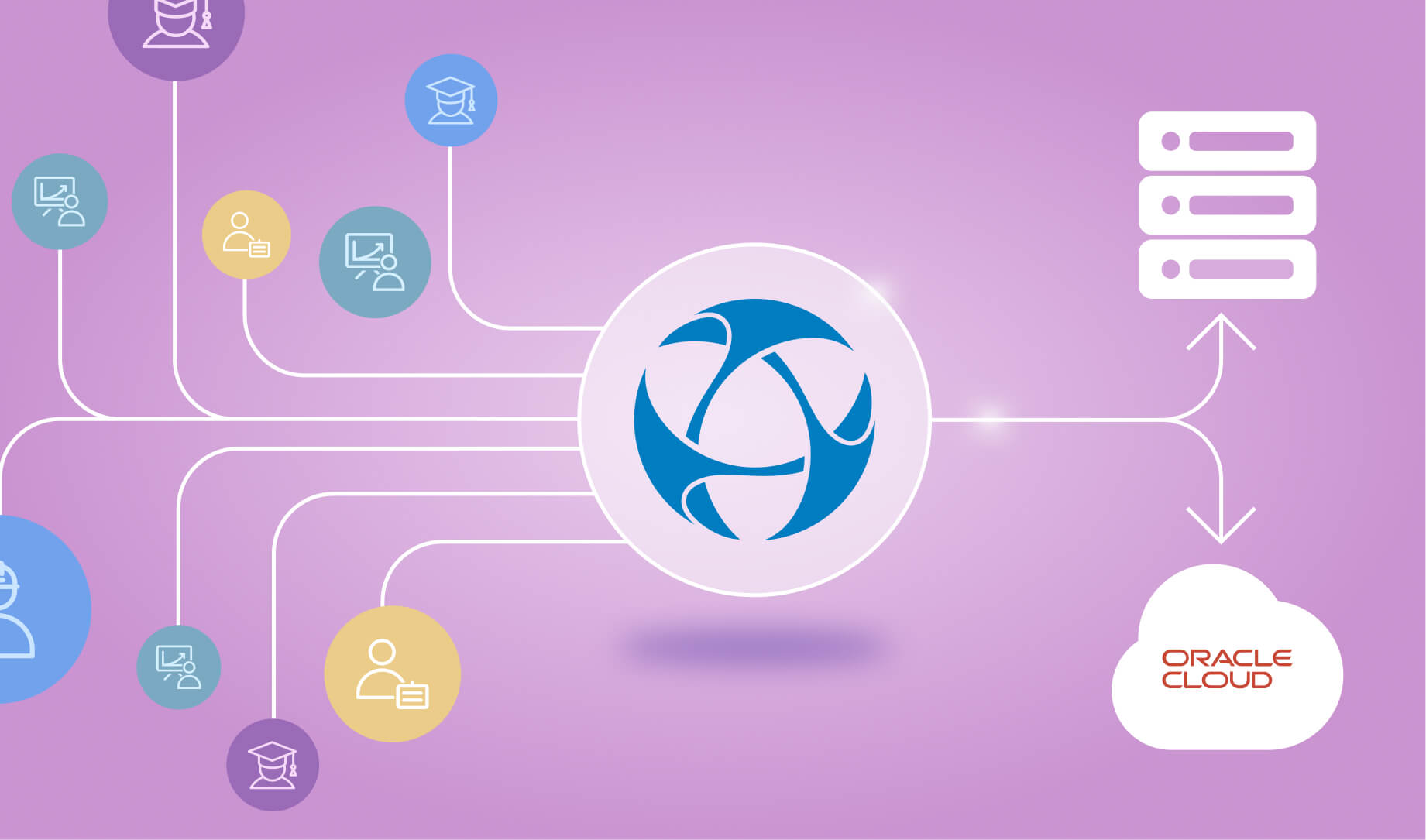
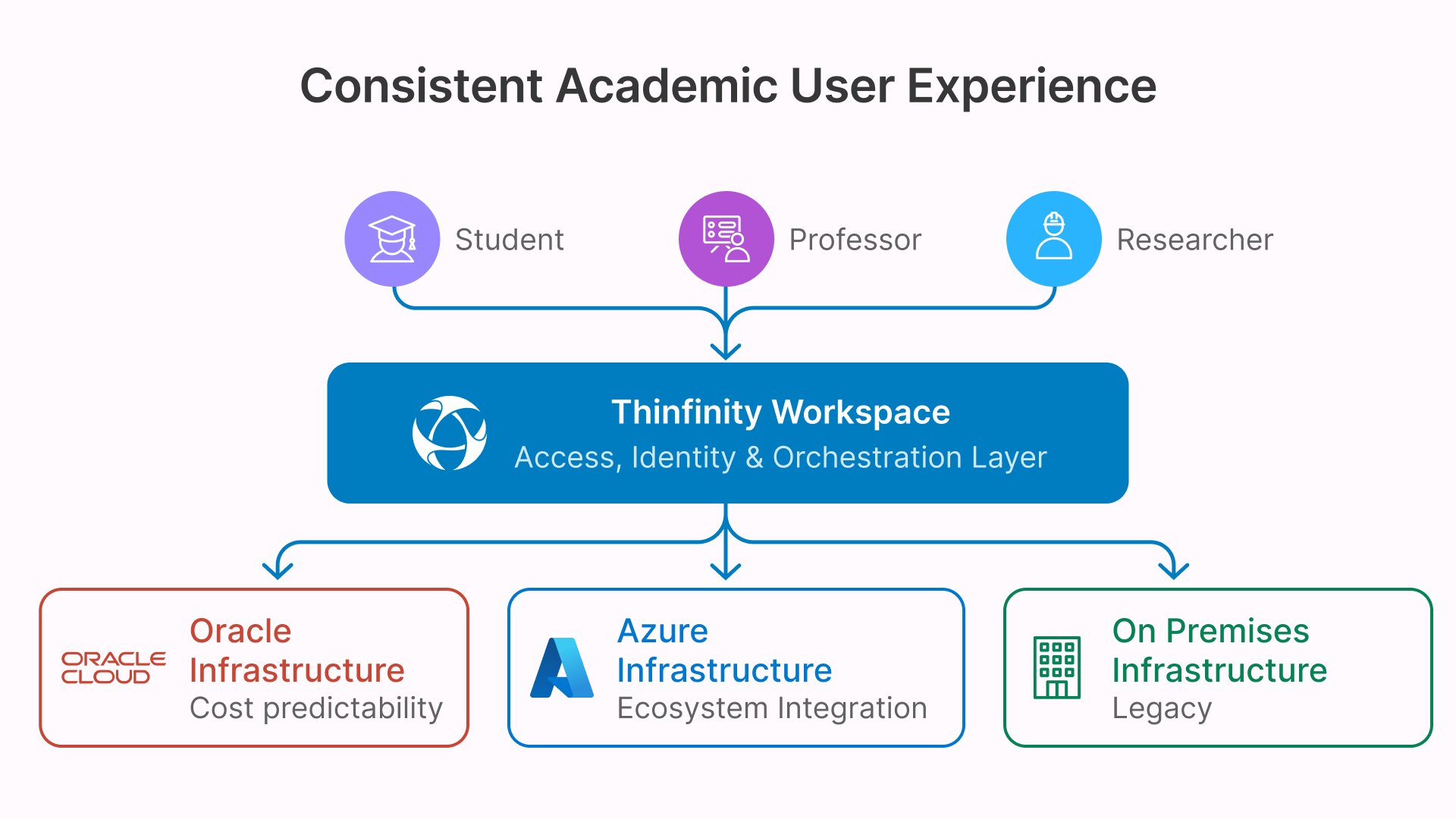
In education-focused VDI architectures, Thinfinity Workspace typically operates above the cloud layer, abstracting user access and session orchestration regardless of whether desktops run on OCI, Azure, or on-premises infrastructure. This separation is particularly relevant in academic environments, where infrastructure decisions often evolve over multiple years rather than being finalized upfront.
On OCI, Thinfinity integrates natively with KVM-based virtualization, allowing universities to deploy cloud VDI environments with capabilities comparable to Azure Virtual Desktop in terms of session management, identity integration, and user experience—without inheriting the structural constraints of Azure’s tightly coupled control plane. From an architectural standpoint, this gives institutions greater control over how desktops are built, scaled, and governed.
This model allows universities to:
- Avoid binding user access and identity workflows to a single cloud provider
- Preserve consistent security and access models across OCI, Azure, and on-prem environments
- Migrate workloads gradually without disrupting students, faculty, or staff
- Maintain a viable multi-cloud strategy where academic, financial, or regulatory requirements demand it
In practice, Thinfinity acts as a stability layer during change. Institutions can start with OCI-based VDI for cost predictability or GPU economics, coexist with Azure-hosted environments where required, and shift workloads over time without forcing users to relearn access patterns or IT teams to redesign security models.
In comparative deployments, this abstraction mitigates platform-specific limitations while preserving institutional choice—an important consideration for universities that view cloud adoption as an ongoing process rather than a one-time decision.
Executive Summary: OCI vs Azure for Education VDI
OCI excels in environments where predictability, cost transparency, and architectural neutrality are paramount. Its network economics and GPU behavior align well with long-running academic workloads and fixed budget cycles.
Azure excels in environments where ecosystem integration and Microsoft alignment are strategic priorities. Its VDI capabilities are mature, but cost and control-plane coupling require ongoing governance.
For university leadership, the decision is not about feature parity. It is about choosing the platform whose economic and architectural philosophy aligns with how education actually operates.
As emphasized in “Traditional VDI vs Cloud VDI for Education: Where Each Model Actually Works”, the most reliable academic VDI strategies emerge when cloud choice, architecture, and access orchestration are evaluated together—not in isolation.