



A deep technical reference architecture for cloud VDI on OCI in multi-plant manufacturing environments, focused on ZTNA, OT/IT integration, and resilience.
Manufacturing VDI Architecture Is an OT/IT Problem First
In 2026, designing VDI for manufacturing is no longer a desktop virtualization exercise. It is an OT/IT integration problem, a security boundary problem, and a resilience engineering problem.
Manufacturing environments combine fundamentally different worlds:
- OT systems that are latency-sensitive, fragile, and often not designed for direct exposure
- IT systems that are identity-driven, cloud-connected, and continuously changing
- Users who span operators, engineers, planners, OEMs, and third-party vendors
- Plants with uneven connectivity, limited maintenance windows, and low tolerance for disruption
Traditional VDI reference architectures—designed for corporate offices—fail in this context because they assume stable networks, uniform endpoints, and trusted internal connectivity.
This article defines a modern reference architecture for deploying cloud VDI on Oracle Cloud Infrastructure (OCI) in multi-plant manufacturing environments, with a strong focus on:
- Zero Trust Network Access (ZTNA) principles
- Reverse connectivity to protect OT networks
- Secure IT/OT integration without flat networks
- Operational resilience under failure conditions
This reference architecture builds on the broader discussion of why manufacturing CIOs are re-architecting workspaces in 2026, driven by IT/OT convergence, operational risk, and changing access patterns across plants.
Architectural Goals for Manufacturing VDI in 2026
Before defining components, it is critical to define what the architecture must guarantee.
Operational continuity over architectural purity
Manufacturing VDI must prioritize continued access to critical systems over idealized cloud-native designs. This means accepting hybrid states, temporary asymmetry between plants, and controlled technical debt—while maintaining security and governance.
OT protection as a first-class requirement
The architecture must assume that OT networks cannot be trusted, patched, or redesigned quickly. Any solution that requires inbound connectivity to plants, persistent VPN tunnels, or direct exposure of MES/SCADA systems increases risk unacceptably.
Identity-driven access instead of network trust
All access decisions must be driven by identity, role, and context, not by IP ranges or network location. This is foundational to Zero Trust and essential for contractor-heavy manufacturing environments.
High-Level Architecture Overview
At a system level, a multi-plant manufacturing VDI architecture on OCI consists of six tightly integrated layers:
- Identity and Trust Layer
- ZTNA and Access Control Layer
- Workspace Orchestration Layer
- Compute and Session Execution Layer
- OT/IT Connectivity Layer
- Observability, Security, and Governance Layer
The key architectural shift—compared to legacy designs—is that connectivity flows outward from OT and inward from users, never the reverse.
Identity and Trust Layer

Centralized identity as the single source of truth
Manufacturing organizations typically already operate one or more enterprise identity providers. The reference architecture assumes:
- Federation with existing IdPs (cloud or on-prem)
- No duplication of identities inside plants
- Explicit differentiation between employees, contractors, and vendors
Identity becomes the only trust anchor. Network location, device location, and plant location are treated as untrusted context.
Role and scope modeling aligned to OT reality
Roles must map to systems, not networks. For example:
- An OEM engineer may access a specific MES interface for a specific line
- A maintenance vendor may access PLC management tools for a defined time window
- A planner may access reporting systems without touching OT networks
This role-to-application mapping is enforced at the access layer, not through network segmentation alone.
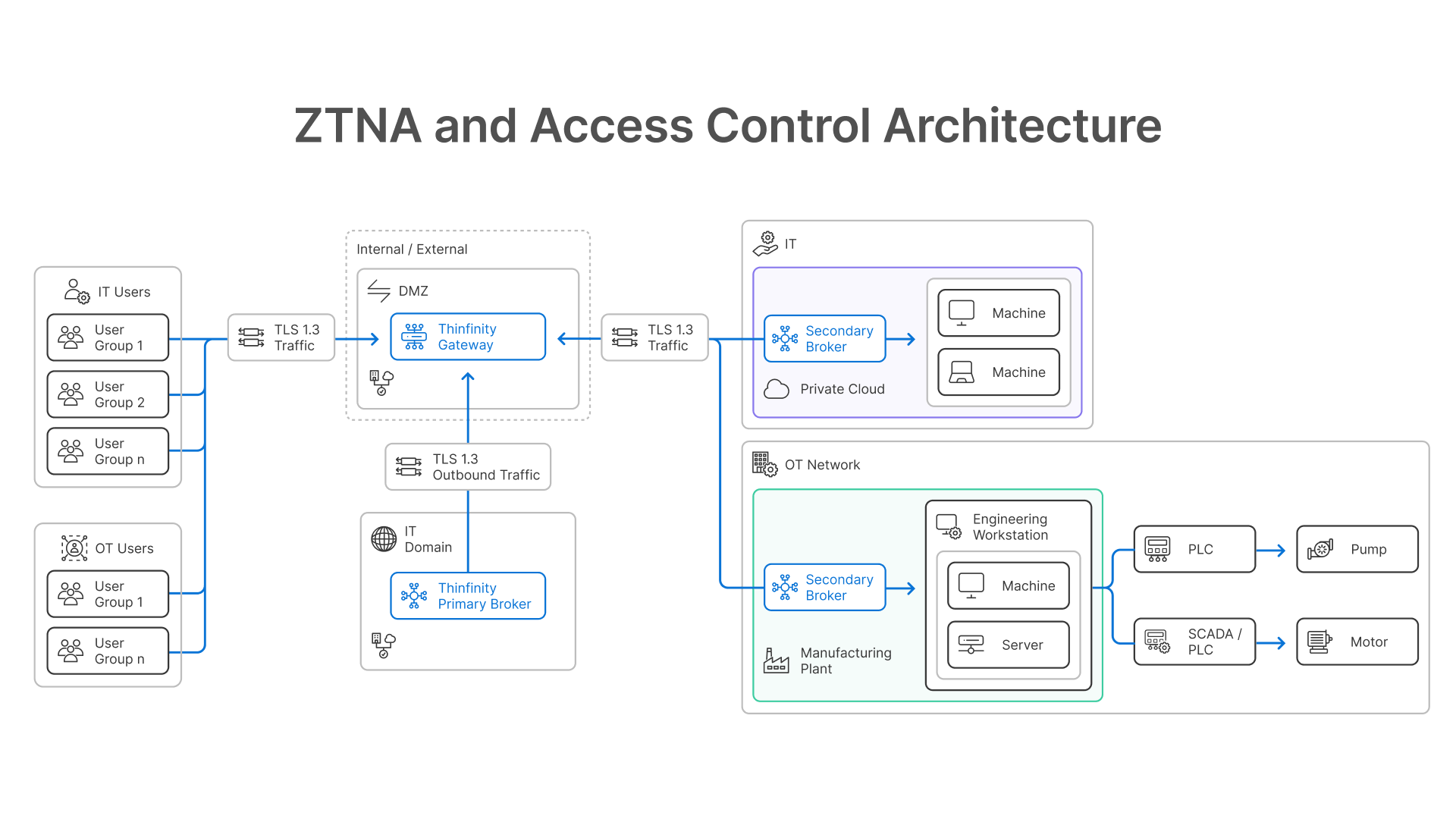
ZTNA and Access Control Layer (Core of the Architecture)
Why ZTNA replaces VPN in manufacturing
VPNs assume that once a user is connected, the internal network is trustworthy. This assumption is incompatible with modern manufacturing environments where:
- OT networks must remain isolated
- Contractors rotate frequently
- Credential compromise is a leading attack vector
- Lateral movement must be prevented
ZTNA in this architecture enforces application-level access, not network-level access.
Thinfinity as the ZTNA enforcement point
Thinfinity plays a central role here as a ZTNA gateway and workspace broker, not just a VDI front-end.
Key architectural characteristics:
- No inbound connections to plants
Thinfinity components inside OT or plant-adjacent networks establish outbound-only, reverse connections to the control plane.
- Application-level exposure
Users never see the network. They are granted access to specific desktops or applications, delivered through the workspace.
- Session containment
Each session is isolated. Even if credentials are compromised, lateral movement into OT networks is prevented.
This reverse connectivity model is critical in manufacturing, because it allows secure access without opening firewalls or exposing OT segments.
Workspace Orchestration Layer
Decoupling access logic from execution location
Manufacturing environments rarely migrate all plants simultaneously. The orchestration layer abstracts:
- Whether a workload runs on-prem or in OCI
- Whether access is session-based or desktop-based
- Whether the user is internal or external
Thinfinity’s orchestration capabilities allow:
- Central policy definition
- Per-role application catalogs
- Consistent user experience across heterogeneous environments
This avoids parallel access stacks (VPN + VDI + web portals), which are a major source of operational complexity.
Compute and Session Execution Layer (OCI)

Separation of workload classes
A critical architectural decision is to never collapse all users into a single desktop pool.
Instead, workloads are separated by behavior and risk profile:
- Task and operator desktops (pooled, stateless)
- Knowledge worker desktops (pooled with profiles)
- Engineering desktops (dedicated or GPU-backed)
OCI compute shapes allow precise sizing of each pool, avoiding the “average desktop” anti-pattern that inflates cost and complexity.
Separating workload classes and avoiding per-plant overprovisioning has a direct impact on the total cost of ownership of VDI in manufacturing, particularly when downtime and recovery effort are included in the model.
Engineering and OT-adjacent workloads
Engineering and OT-adjacent workloads often require:
- High and predictable CPU/GPU performance
- Low jitter rather than lowest possible latency
- Stable session behavior over long periods
These workloads are explicitly isolated from office user pools to prevent noisy-neighbor effects and simplify incident containment.
OT/IT Connectivity Layer
Reverse connectivity as a safety boundary
The defining feature of this architecture is directionality.
- OT and plant-adjacent systems initiate outbound connections
- No inbound sessions are allowed into OT networks
- Firewalls remain closed by default
This model dramatically reduces the attack surface and aligns with zero-trust principles.
Controlled integration points
Integration between IT and OT occurs through controlled mediation points:
- Virtual desktops that host OT-facing applications
- Jump-host–like execution environments without exposing networks
- Session recording and audit trails
Users interact with OT systems through the workspace, not with the network.
Observability, Security, and Governance Layer
Session-level visibility instead of packet inspection
Traditional network monitoring is of limited value in encrypted, identity-driven environments. This architecture emphasizes:
- Session telemetry
- Authentication and authorization events
- Application usage patterns
Thinfinity contributes session-level visibility that is meaningful for both security teams and operations.
Audit and compliance alignment
Because all access is mediated, logged, and identity-bound, the architecture supports:
- Access traceability
- Separation of duties
- Time-bound permissions
- Forensic readiness
This is particularly relevant for ISO 27001, NIST-based frameworks, and internal manufacturing governance requirements.
Scaling the Architecture Across Plants
The reference architecture is designed to scale through replication, not customization.
New plants are onboarded by:
- Deploying a local connector/broker
- Establishing outbound trust
- Applying existing access policies
No redesign of network topology or security model is required.
Conclusion: Manufacturing VDI Architecture Is a Control System
In 2026, manufacturing VDI architecture must be treated as a control system, not an IT convenience layer.
By combining OCI’s infrastructure primitives with a ZTNA-first workspace platform like Thinfinity, organizations can:
- Enable secure IT/OT integration without exposing OT networks
- Replace VPN-based access with application-level trust
- Support hybrid, phased modernization without parallel stacks
- Improve resilience, auditability, and operational confidence
The result is not just cloud VDI, but a governed access fabric that reflects how modern manufacturing actually operates.
This architecture is the technical execution layer behind a broader manufacturing workspace strategy in 2026—one where resilience, governance, and access control are treated as first-class design requirements, not afterthoughts.