

Introduction: Why Architecture Determines Success in Academic VDI
As universities move from traditional campus-based computing models toward cloud-based Virtual Desktop Infrastructure (VDI), many initiatives fail for reasons that have little to do with performance or features. In most cases, the root cause is architectural.
Cloud platforms make it deceptively easy to provision virtual desktops. A pilot environment can be online in days, users can connect successfully, and early feedback is often positive. Yet once the system is exposed to real academic conditions—hundreds or thousands of concurrent students, fixed class schedules, exam peaks, and mixed workloads—initial designs begin to show strain.
For higher education institutions, VDI reliability is not a function of scale alone. It is a function of architectural alignment with how academic environments actually operate. This article examines the architectural principles that separate sustainable cloud VDI deployments from those that quietly accumulate risk over time.
Why University VDI Architectures Are Structurally Different
Academic Usage Is Cyclical, Not Linear
Enterprise VDI environments often grow steadily and predictably. Education does not. Universities experience sharp concurrency spikes tied to class schedules, exams, and semester starts, followed by long periods of low utilization.
Architectures designed for constant demand struggle in this context. Overprovisioning becomes the norm, and infrastructure sized for peak usage remains idle for much of the year. Cloud VDI can address this imbalance—but only if elasticity is built into the design from the beginning.
User Diversity Increases Architectural Complexity
University VDI must simultaneously support:
- Students accessing short-lived, non-persistent desktops
- Faculty requiring persistent work environments
- Researchers using specialized or licensed software
- Administrative staff accessing internal systems
- External collaborators and visiting professors
Attempting to force all these users into a single desktop model creates unnecessary complexity and undermines reliability. A resilient architecture must allow multiple delivery patterns to coexist without interference.
The Core Architectural Shift: From Infrastructure-Centric to Access-Centric Design
Traditional VDI Architecture: Infrastructure First
In many legacy deployments, architecture is built from the infrastructure inward. Compute clusters, storage systems, and networks are defined first, and user access is layered on top through brokering and authentication services.
This approach works in static environments, but it becomes brittle in education. Changes to one layer often ripple outward, and scaling decisions are constrained by physical capacity or tightly coupled control planes.
Cloud VDI Architecture: Access and Orchestration First
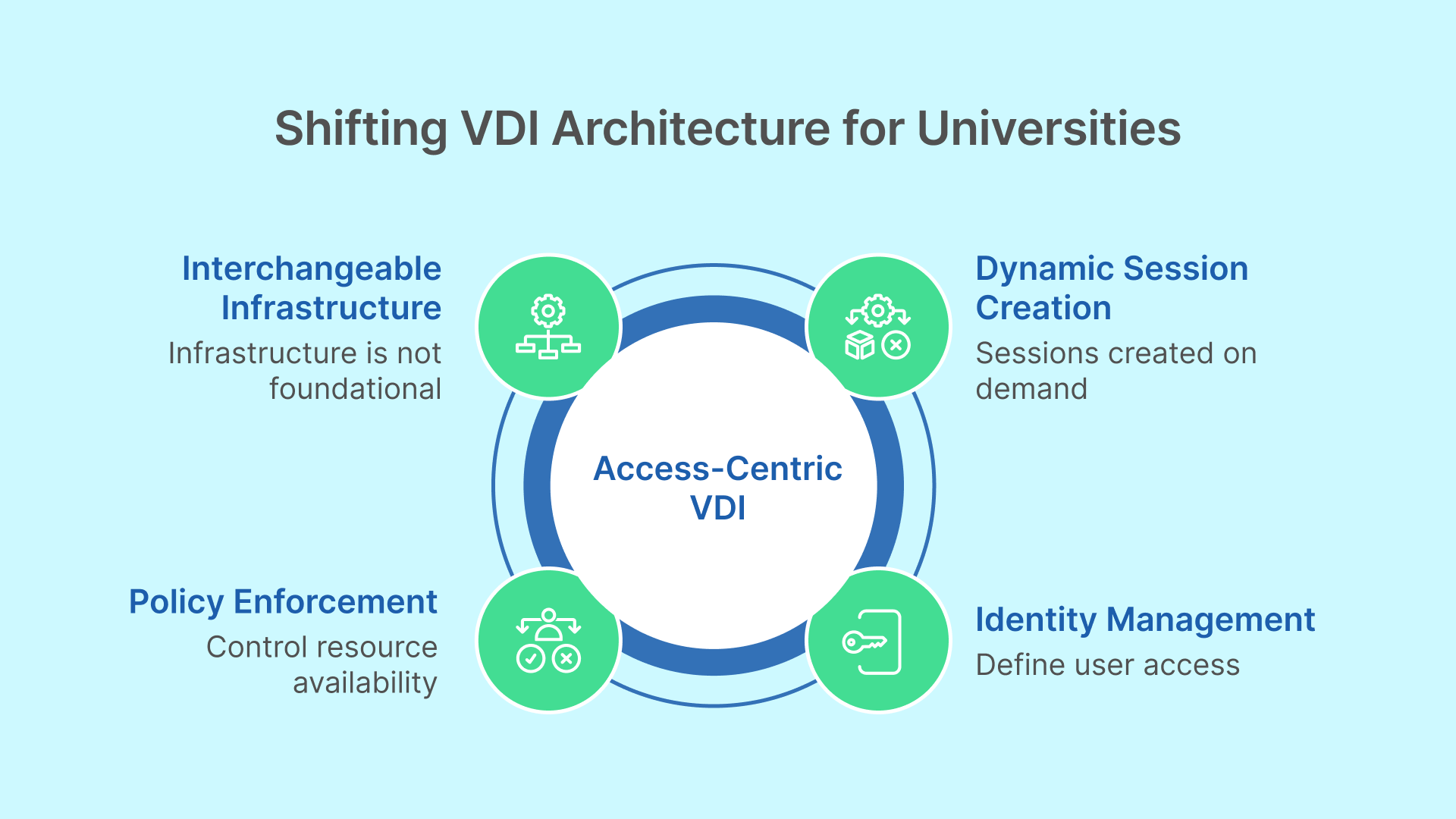
Modern cloud VDI architectures invert this model. Instead of centering on infrastructure, they center on access orchestration.
In an access-centric design:
- Identity defines who can connect
- Policies define what resources are available
- Sessions are created dynamically
- Infrastructure becomes interchangeable rather than foundational
This shift is critical for universities, where access patterns change more frequently than infrastructure requirements.
Control Plane vs Data Plane: A Non-Negotiable Separation
Why Most Large-Scale VDI Failures Originate in the Control Plane
In academic environments, large outages rarely occur because virtual machines stop running. They occur because:
- Authentication systems fail during mass logins
- Session brokers become overloaded at class start times
- Policy engines apply changes globally instead of locally
When control planes are tightly coupled to infrastructure or identity systems, small disruptions can cascade rapidly.
Designing for Isolation, Not Perfection
A resilient cloud VDI architecture separates:
- Control plane: identity, brokering, policy, session orchestration
- Data plane: desktops, applications, and user traffic
This separation allows failures to be isolated. Authentication issues do not automatically disrupt active sessions. Infrastructure maintenance does not invalidate access policies. Recovery paths remain clear and predictable.
For universities, this architectural discipline is often the difference between a localized incident and a campus-wide outage.
Hybrid Architecture as a Strategic Choice, Not a Compromise
Why Most Universities Cannot Move Everything at Once
Despite the appeal of full cloud adoption, many universities must maintain:
- On-prem labs for specialized hardware
- Legacy academic applications
- Regulatory or data residency constraints
- Existing datacenter investments
A well-designed cloud VDI architecture assumes coexistence rather than replacement.
Hybrid VDI Done Correctly
In a hybrid model:
- Access is unified across on-prem and cloud resources
- Identity and policy enforcement remain consistent
- Session routing is abstracted from physical location
- Migration occurs incrementally, not disruptively
This approach reduces risk while preserving long-term flexibility. Importantly, it allows institutions to modernize at their own pace without locking architectural decisions prematurely.
OCI as an Architectural Foundation for Academic Cloud VDI
Infrastructure That Encourages Simplicity
Oracle Cloud Infrastructure (OCI) supports cloud VDI architectures that favor clarity over abstraction. Its network model, performance characteristics, and pricing transparency reduce the need for cost-driven architectural workarounds.
For universities, this enables:
- Predictable behavior during sustained class hours
- Straightforward hybrid connectivity
- Easier capacity planning for academic calendars
- Fewer layers between users and compute resources
While OCI does not impose a VDI control plane, this neutrality is an architectural advantage. It allows institutions to select access and orchestration layers that match their governance and security models.
Thinfinity as an Access and Orchestration Layer in Academic VDI
Architectural Role, Not Platform Lock-In
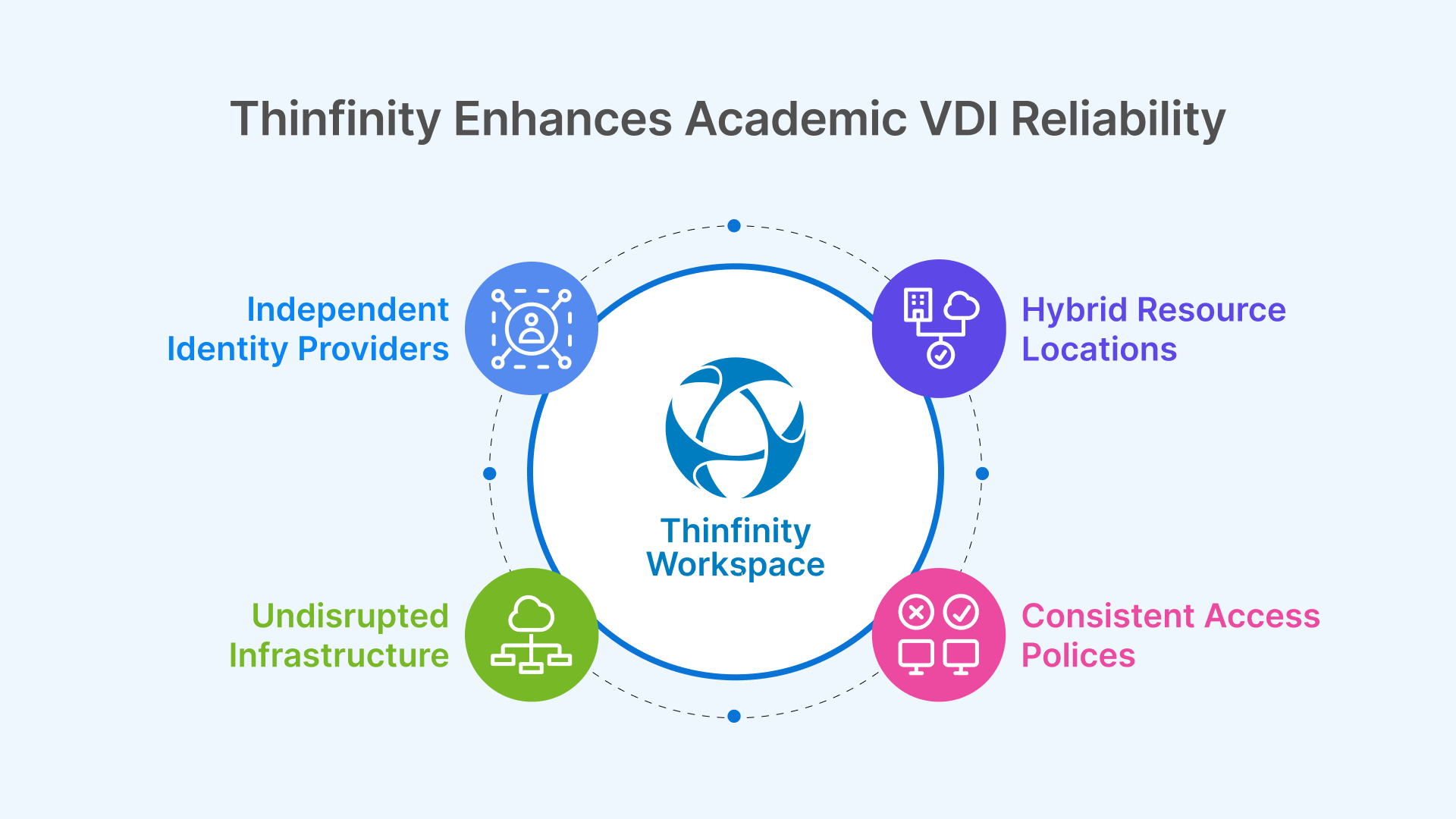
In cloud VDI architectures on OCI, Thinfinity Workspace typically occupies the access and orchestration layer rather than the infrastructure layer.
This means:
- Identity providers remain independent
- Desktops and applications can reside on-prem or in the cloud
- Access policies are enforced consistently
- Infrastructure can evolve without redesigning user access
For universities, this decoupling supports long-term reliability. Academic IT teams can adjust capacity, migrate workloads, or introduce new delivery models without disrupting students or faculty.
Supporting Multiple Academic Delivery Models
Within the same architectural framework, institutions can support:
- Non-persistent desktops for classrooms
- Persistent desktops for faculty
- Application-level delivery for shared tools
- Secure access to internal web and legacy systems
Reliability emerges from architectural flexibility rather than rigid standardization.
Designing for the Long Term: What University Leaders Should Prioritize
For executive leadership, cloud VDI architecture decisions should be evaluated against a single question:
Will this design remain stable as academic demand, security requirements, and delivery models change?
Architectures optimized only for rapid deployment or short-term savings tend to accumulate operational risk. Architectures built around access orchestration, control-plane separation, and hybrid flexibility are more likely to endure.
Conclusion: Architecture Is the Strategy in Academic Cloud VDI
In higher education, cloud VDI success is not determined by the cloud provider alone, nor by the desktop technology in isolation. It is determined by architecture.
Universities that design cloud VDI around access, identity, and orchestration—rather than infrastructure alone—achieve greater reliability, adaptability, and long-term sustainability.
As explored in the pillar article “Traditional VDI vs Cloud VDI for Education: Where Each Model Actually Works,” the most effective academic VDI strategies are those that align technical architecture with the realities of education itself.