

Following our previous article, “The MSP Economics Shift: Azure Virtual Desktop vs. Thinfinity VDI on Oracle Cloud,” this piece moves from cost strategy to operational execution—how multi-tenancy and automation determine profitability for Managed Service Providers (MSPs).
Azure Virtual Desktop (AVD) is a proven enterprise product, but its architecture creates challenges for MSPs serving small and midsize business (SMB) clients—typically 20 to 300 users per customer. Each client requires a separate Azure tenant, resource groups, and network configuration, multiplying operational overhead.
Thinfinity VDI on Oracle Cloud Infrastructure (OCI) was designed to simplify exactly this scenario. With built-in multi-tenancy, centralized automation, and predictable OCI pricing, MSPs can manage dozens of SMB environments from a single control plane—reducing cost, risk, and time-to-delivery.
The multi-tenant challenge with AVD
Fragmented tenant model
MSPs hosting multiple SMB customers through Azure Virtual Desktop must:
- Provision a separate Azure tenant for each customer.
- Manage delegated administration through Azure Lighthouse.
- Maintain unique VNETs, identities, and resource groups per tenant.
While this structure fits large enterprises with internal Azure teams, it does not scale efficiently for MSPs managing many SMB clients. Each new 20–300-user organization essentially becomes a fresh, complex deployment—demanding repeated configuration, separate billing, and ongoing patch management.
High overhead and limited automation
Even when optimized, AVD’s autoscaling relies on custom scripts or third-party tools. MSPs must manage per-tenant scaling rules, patch cycles, and cost tuning. For smaller tenants, these administrative tasks often outweigh the recurring revenue generated per user.
The result: low-margin complexity, especially for MSPs supporting multiple SMB clients where efficiency, not customization, drives profitability.
Thinfinity VDI on OCI: Multi-tenancy by design
Unified management, isolated control
With Thinfinity Cloud Manager, MSPs can host multiple SMB customers from one deployment while maintaining complete logical isolation for each environment. Each tenant has its own desktops, apps, and policies, but administrators operate everything through a unified console.
This multi-tenant design transforms the MSP delivery model:
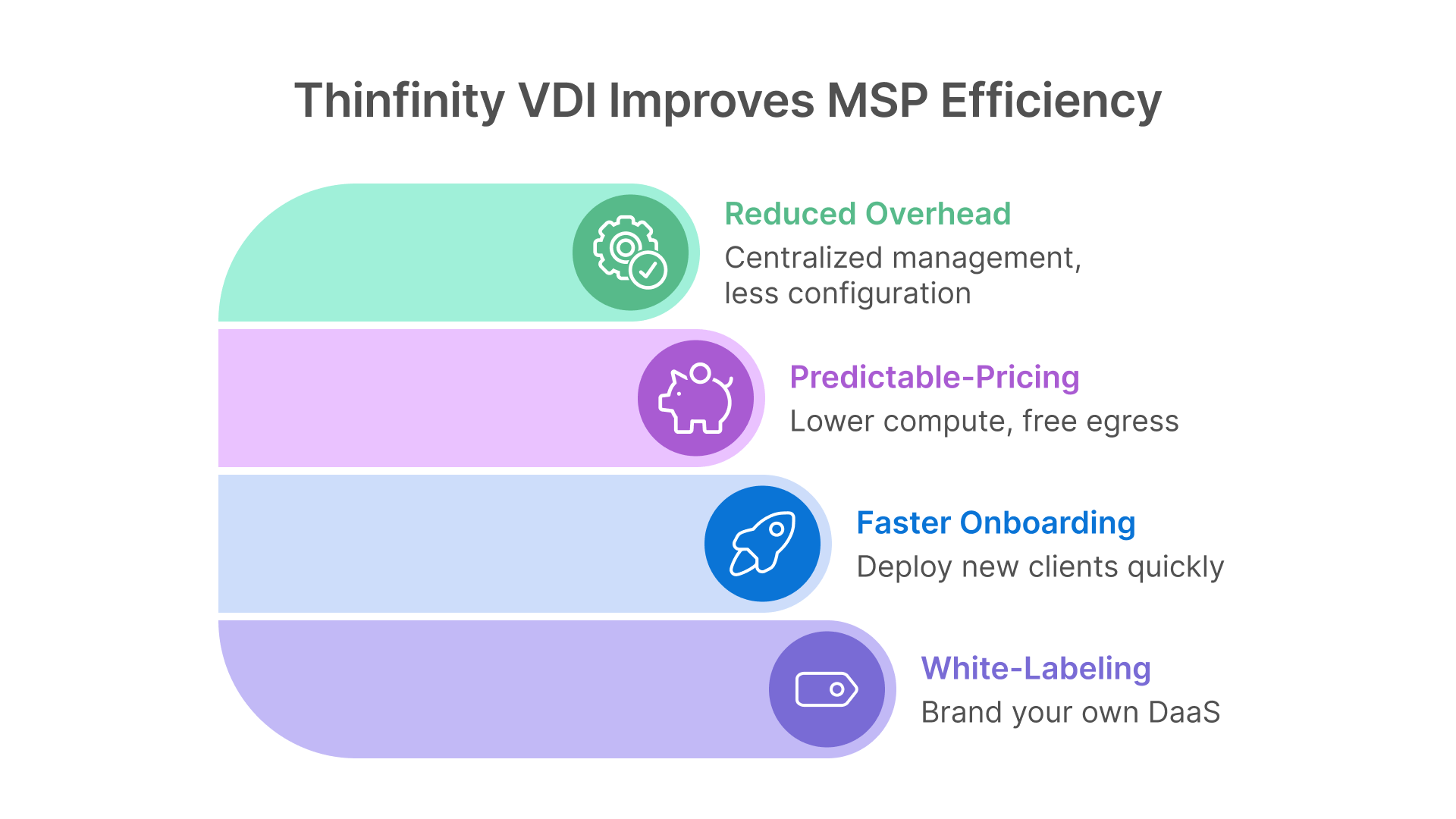
- Rapid onboarding: Deploy a new 20–300-user customer in hours, not days.
- Centralized golden images: Maintain shared templates across all tenants.
- Policy-based automation: Apply scaling, access, and cost controls consistently.
It’s the difference between managing 20 silos and operating one scalable workspace cloud.
OCI infrastructure advantage
For MSPs serving SMBs, infrastructure predictability is key. OCI delivers up to 50% lower compute costs and 10 TB of free monthly egress, giving MSPs a pricing structure that fits their clients’ budgets without sacrificing margin.
When combined with Thinfinity’s built-in autoscaling, idle desktops shut down automatically, ensuring that MSPs pay only for actual usage—critical for clients who might use their environments 8–10 hours per day, not 24/7.
Whitelabeling and service identity
Unlike Azure Virtual Desktop, which forces providers into Microsoft’s ecosystem and brand, Thinfinity enables MSPs to whitelabel the entire VDI portal—using their own logo, colors, and domain.
This branding freedom lets MSPs package “their own DaaS offering”—a strategic differentiator when selling to SMBs who value local expertise and personal support over hyperscaler complexity.
Thinfinity transforms MSPs from resellers into cloud workspace providers, delivering a branded, turnkey Zero Trust experience tailored to each customer size and SLA.
Operational comparison summary
| Azure Virtual Desktop (AVD) | Thinfinity VDI on OCI | |
|---|---|---|
| Target Use Case | Enterprise IT departments | MSPs hosting SMB clients (20–300 users each) |
| Tenant Model | Separate Azure tenant per customer | Multi-tenant architecture with isolated environments |
| Management | Azure Lighthouse + custom scripting | Unified Cloud Manager console |
| Scaling | Manual or 3rd-party autoscaling | Built-in, policy-driven autoscaling |
| Cost Predictability | Variable across tenants | Predictable OCI pricing with free egress |
| Branding | Microsoft-hosted experience | Fully whitelabeled MSP-branded workspace |
| Setup Time | 3–5 days per tenant | Hours with reusable templates |
| Access Model | RDP or client apps | Clientless, browser-based Zero Trust access |
Sources: Cybele Software Market Intelligence and Oracle Cloud pricing documentation
Why this matters for SMB-focused MSPs
MSPs serving 20–300-user organizations thrive on efficiency and margin control, not one-off engineering projects. Thinfinity on OCI gives them the ability to:
- Standardize delivery across all customers.
- Automate autoscaling and maintenance, minimizing manual intervention.
- Offer predictable, affordable pricing to SMB clients.
- Brand their own workspace platform, increasing loyalty and differentiation.
This approach aligns perfectly with SMB service economics: low complexity, fast ROI, and consistent user experience.