

A Reliability-First Perspective for CEOs, CIOs, and Enterprise IT Leaders
Virtual Desktop Infrastructure has entered a new phase. By 2026, the debate is no longer about whether public cloud platforms can host VDI workloads. Every major provider can. The real question for enterprise leaders is far more consequential:
Which cloud delivers reliable, predictable VDI outcomes over years of sustained use—without forcing hidden architectural compromises?
For CEOs and executive teams, VDI reliability is not a technical nuance. It directly affects workforce productivity, security posture, operational cost predictability, and long-term IT strategy. A platform that appears efficient in a pilot often behaves very differently once thousands of users are connected eight to ten hours per day.
This article compares Oracle Cloud Infrastructure (OCI), Microsoft Azure, and Amazon Web Services (AWS) through a single, non-negotiable lens: reliability at scale. The analysis focuses on three structural forces that ultimately determine success or failure in cloud VDI deployments: network economics, GPU resource behavior, and control-plane maturity.
Why Reliability Is the Executive Metric That Matters Most in Cloud VDI
From a leadership perspective, reliability is not defined by service-level agreements or marketing claims of “five nines.” In VDI, reliability is experienced by users, measured in moments of friction that accumulate silently over time.
A virtual desktop that stutters during peak hours, a design workstation that drops frames when GPU resources are shared too aggressively, or an authentication outage that blocks thousands of employees from starting their day—each of these erodes trust in IT and creates downstream business impact.
Reliable VDI environments share several characteristics. They behave consistently under load. They scale without unpredictable cost spikes. They allow IT teams to isolate failures rather than suffer cascading outages. Most importantly, they remain stable even as usage patterns evolve.
These qualities are not accidental. They emerge from architectural decisions that cloud providers make at the infrastructure, economic, and control-plane levels.
Network Economics: How Cost Models Shape VDI Reliability
Why Network Design Is the Foundation of Stable VDI
VDI is fundamentally a network-intensive workload. Unlike transactional applications, virtual desktops maintain continuous, bidirectional connections that are highly sensitive to latency, jitter, and packet loss. When network costs become unpredictable, organizations inevitably respond by altering traffic patterns, compressing protocols more aggressively, or introducing architectural complexity to reduce egress.
Each of these mitigations may control spend, but they also introduce fragility. Over time, network economics become one of the most common—and least visible—sources of reliability degradation in cloud VDI environments.
OCI Network Model: Reliability Through Predictability
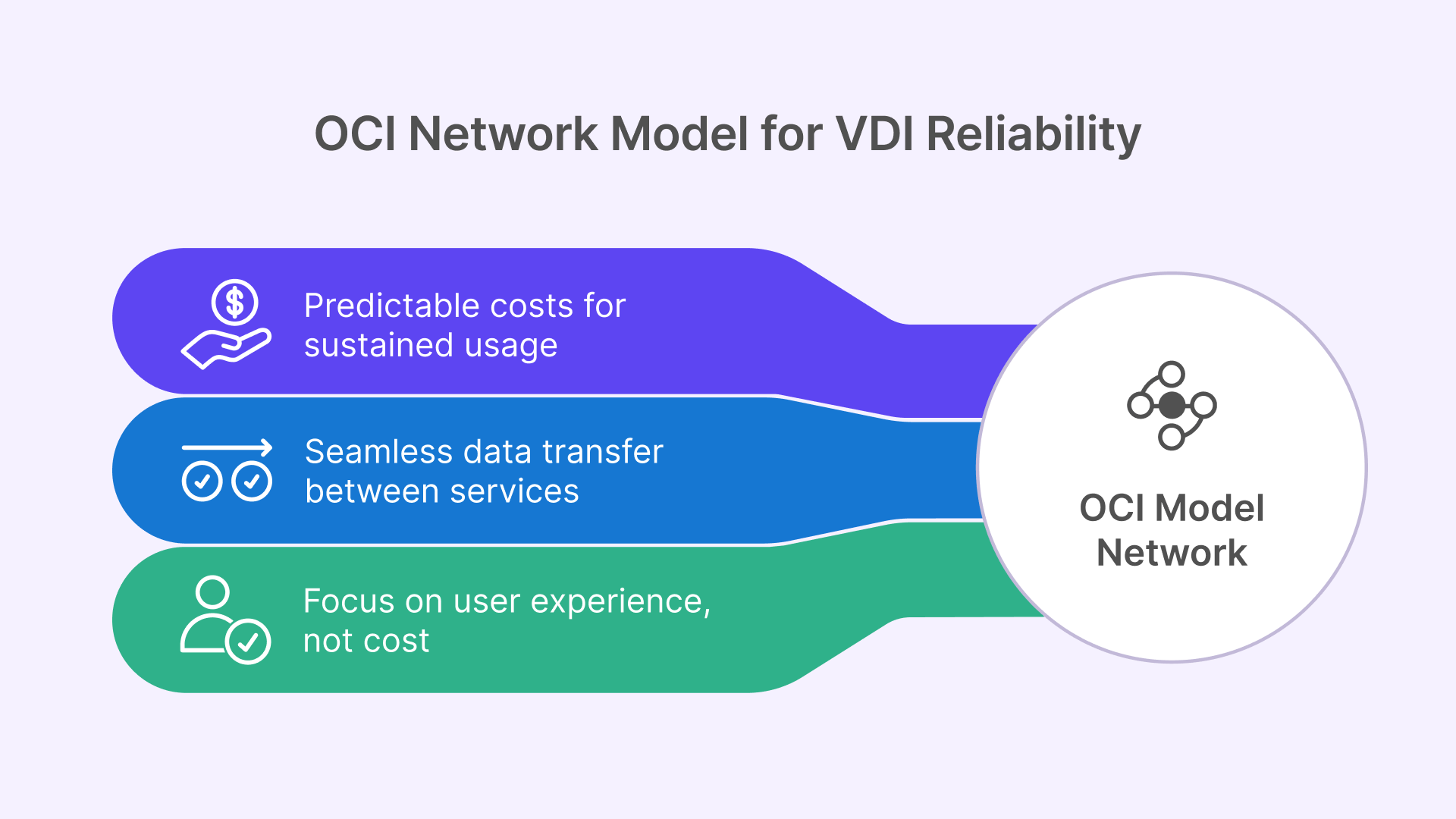
Oracle Cloud Infrastructure takes a markedly different approach to network economics. Its flat, low egress pricing and minimal inter-service transfer penalties allow architects to design VDI environments around performance rather than cost avoidance.
From a reliability standpoint, this simplicity has profound implications. VDI traffic does not need to be rerouted or constrained to stay within budget. High-resolution sessions, multi-monitor configurations, and persistent desktops behave consistently throughout the day because the underlying network model does not punish sustained usage.
Over time, this predictability reduces architectural drift. IT teams are less likely to introduce fragile optimizations that solve short-term cost issues while creating long-term operational risk. As a result, OCI environments tend to remain stable as VDI adoption grows.
For enterprises running always-on desktops, hybrid VDI scenarios, or graphics-intensive workloads, OCI’s network economics directly support long-term reliability rather than undermining it.
Azure Networking: Reliable, but Economically Influential
Microsoft Azure delivers a highly capable and enterprise-ready network, tightly integrated with its identity, security, and desktop services. In many organizations, this integration is a strategic advantage, enabling faster deployments and unified management.
However, Azure’s network pricing model becomes increasingly complex as environments scale. Data transfer costs vary by region, service, and architectural path, creating incentives to optimize traffic flows primarily for cost efficiency.
From a reliability perspective, this introduces a subtle but important dynamic. As VDI environments grow, network design decisions are often influenced by budget constraints rather than pure performance requirements. Over time, this can lead to layered architectures that are harder to troubleshoot and more sensitive to change.
Azure remains a strong and reliable platform, particularly for Microsoft-centric enterprises, but its network economics require ongoing discipline to prevent cost optimization from eroding user experience and operational stability.
AWS Networking: Power with Operational Consequences
AWS offers unmatched flexibility in network design. Its global footprint and modular services allow organizations to build highly customized VDI architectures tailored to specific geographic, regulatory, or performance requirements.
That flexibility, however, comes with responsibility. AWS network environments frequently involve multiple virtual networks, gateways, load balancers, and routing layers. Each component introduces potential latency variation and additional points of failure.
In well-architected environments managed by experienced cloud teams, AWS can deliver exceptional reliability. In less mature deployments, complexity itself becomes the risk. Small misconfigurations or cost-driven shortcuts can ripple outward, affecting large numbers of users.
For executive teams, the key insight is that AWS reliability in VDI is not automatic. It is earned through architectural rigor, governance, and sustained operational investment.
GPU Economics: Reliability Is Consistency, Not Peak Performance
Why GPU Behavior Defines User Trust in Modern VDI
As VDI expands beyond task workers into engineering, design, analytics, and AI-assisted workflows, GPU access has become a central reliability concern. Users do not evaluate GPU desktops based on benchmark scores. They evaluate them based on consistency.
A GPU that performs well in isolation but degrades when multiple sessions compete for resources creates distrust in the platform. Over time, this erodes adoption and drives shadow IT behavior.
OCI GPU Model: Deterministic Performance at Scale
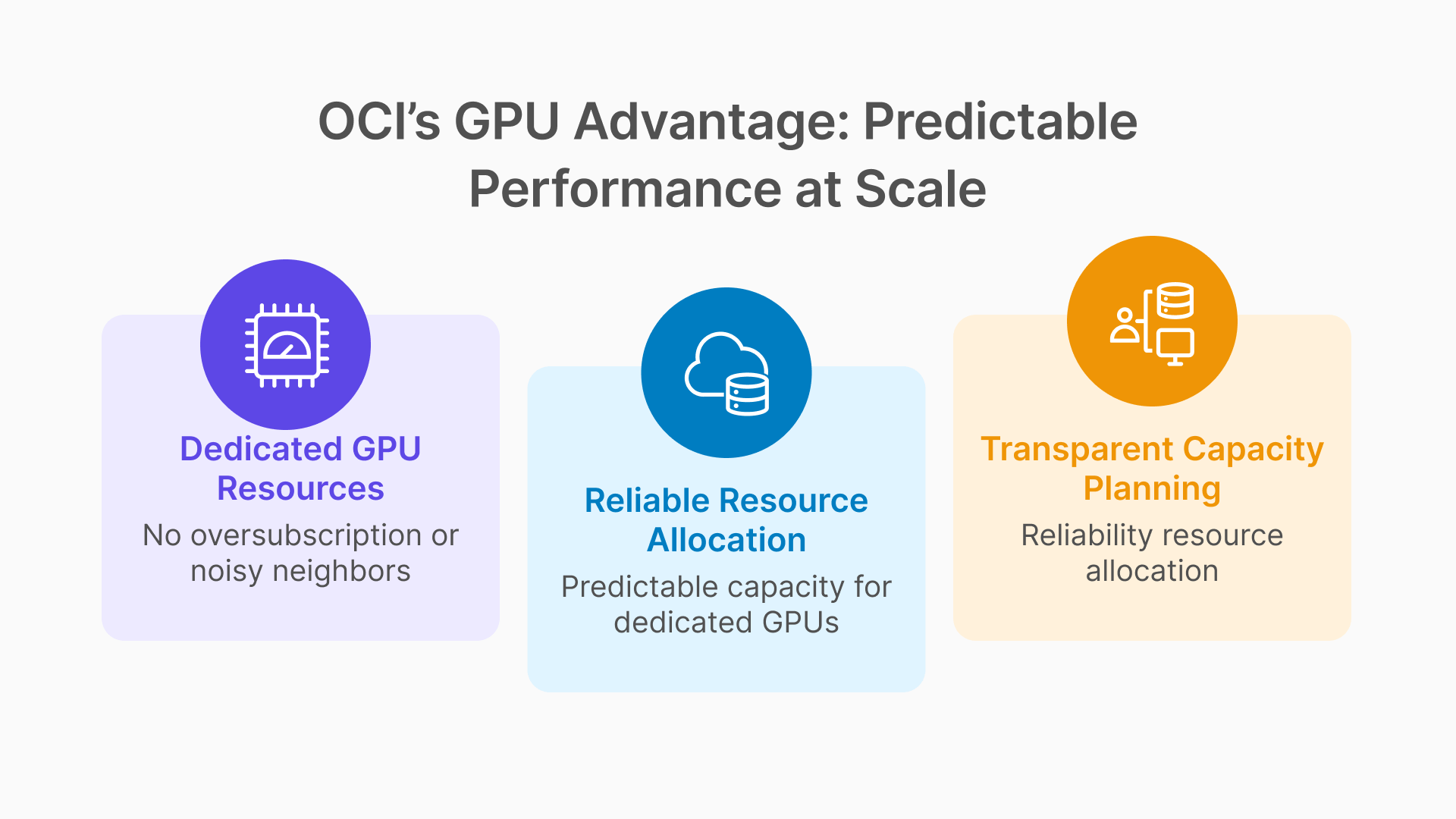
OCI’s GPU strategy emphasizes transparency and predictability. By offering dedicated GPU resources, including bare metal options, OCI minimizes oversubscription and noisy-neighbor effects.
From a reliability standpoint, this approach simplifies capacity planning and ensures that performance characteristics remain stable throughout the workday. GPU-backed desktops behave similarly at peak and off-peak hours, which is essential for professional users who depend on sustained performance.
This deterministic behavior makes OCI particularly well suited for long-running, graphics-intensive VDI workloads where performance variability is unacceptable.
Azure GPU Offerings: Enterprise Stability with Cost Trade-Offs
Azure provides a robust portfolio of GPU-enabled virtual machines, supported by strong ISV relationships and enterprise-grade driver management. Performance is generally excellent, and reliability is high.
The trade-off lies in economics. GPU instances in Azure are premium resources, and organizations often manage cost by limiting session density or over-provisioning to avoid contention. While this preserves performance, it reduces efficiency and increases per-user cost.
For regulated industries and enterprises prioritizing vendor support and certification, Azure’s GPU reliability is compelling. For cost-sensitive environments, the economics can become restrictive over time.
AWS GPU Portfolio: Breadth with Variability
AWS offers the widest selection of GPU instance types, supporting a broad range of workloads and price points. This breadth enables innovation and global reach, but it also introduces variability.
Not all GPU instances behave the same under sustained VDI load. Reliability depends heavily on instance selection, regional capacity, and active monitoring. Without careful management, performance consistency can suffer as concurrency increases.
AWS excels in scenarios where GPU workloads are bursty, experimental, or geographically distributed. For always-on professional desktops, achieving consistent reliability requires deeper operational engagement.
Control Plane Maturity: The Hidden Determinant of VDI Stability
Why Control Planes Fail More Often Than Infrastructure
In most large-scale VDI outages, the underlying compute and network resources remain available. Failures occur instead in identity systems, brokering services, or policy engines—the control plane.
When control planes are tightly coupled or overly abstracted, small disruptions can cascade rapidly, affecting thousands of users simultaneously.
OCI Control Philosophy: Decoupled by Design
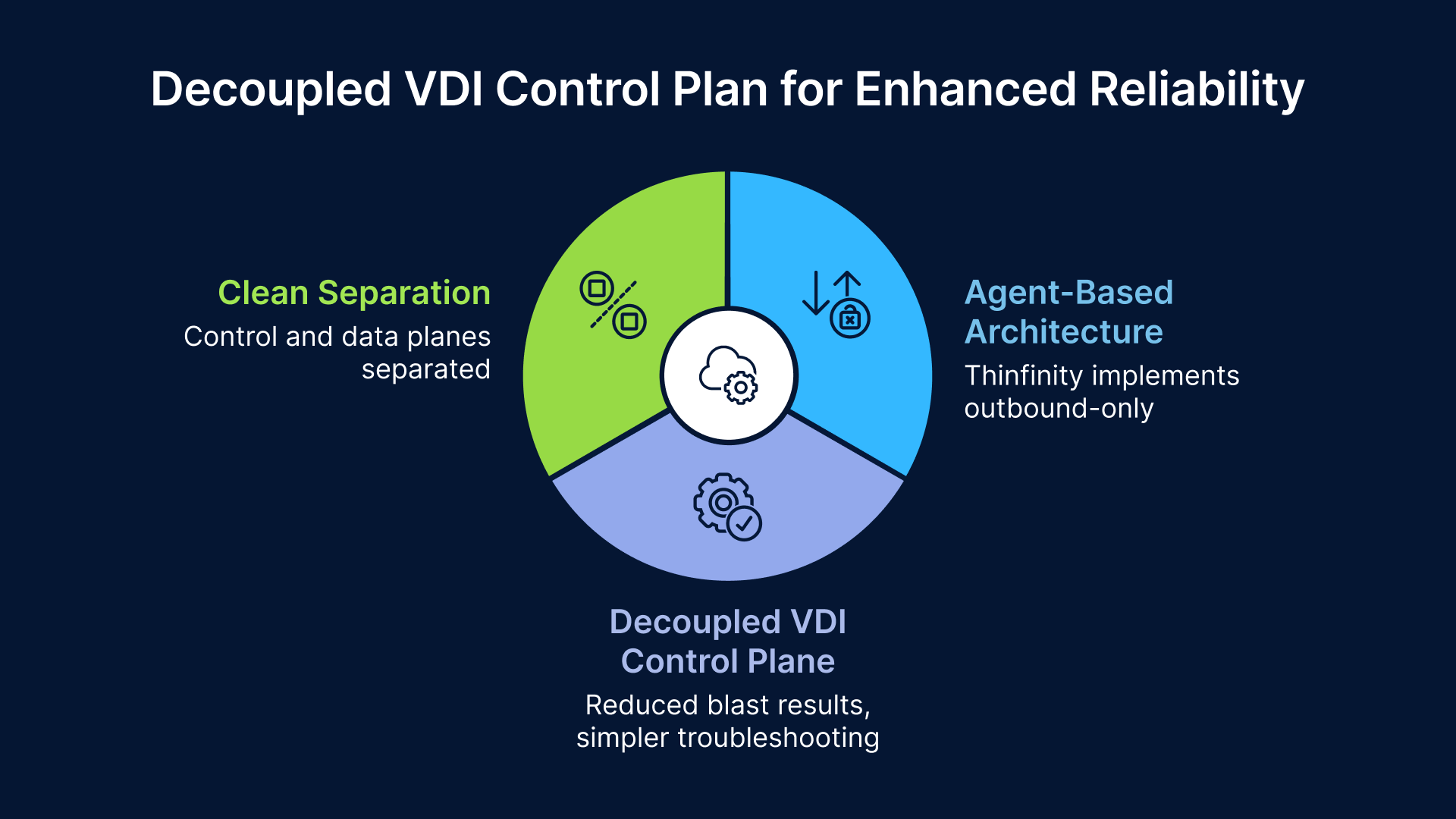
OCI intentionally avoids imposing an opinionated VDI control plane. This allows platforms such as Thinfinity to implement agent-based, outbound-only architectures that cleanly separate control and data planes.
From a reliability perspective, this separation reduces blast radius. Authentication issues, management plane events, or regional disruptions can be isolated more effectively. Troubleshooting is simpler, and recovery paths are clearer.
This architectural neutrality makes OCI especially attractive for Zero Trust models, hybrid deployments, and organizations that value long-term control over their VDI architecture.
Azure Control Plane: Mature but Interdependent
Azure’s control plane is highly automated and deeply integrated with Microsoft’s broader ecosystem. For many enterprises, this integration simplifies operations and accelerates deployment.
The downside is coupling. Identity, policy, and desktop services are interwoven, meaning disruptions in one area often affect others. While Azure invests heavily in resilience, customers have limited ability to decouple or bypass control-plane dependencies during incidents.
Azure control planes deliver excellent day-to-day reliability, but flexibility during exceptional events is constrained by design.
AWS Control Plane: Reliability as an Engineering Outcome
AWS provides primitives rather than prescriptions. Organizations assemble their own control planes using identity services, load balancing, automation, and monitoring tools.
This approach allows exceptional resilience when designed well, but it places the burden of reliability squarely on the customer. Control-plane failures are often architectural rather than platform-driven.
For organizations with mature SRE practices, this can be a strength. For others, it becomes an ongoing risk.
Executive Summary: Where Each Cloud Actually Wins for VDI Reliability
OCI delivers reliability through predictability. Its flat network economics, deterministic GPU performance, and decoupled control philosophy create stable VDI environments that scale without forcing architectural compromise.
Azure delivers reliability through integration. It excels in standardized, Microsoft-aligned enterprises where operational consistency and vendor alignment outweigh cost flexibility.
AWS delivers reliability through control. It rewards organizations that are willing to engineer resilience themselves and accept operational complexity in exchange for flexibility.
The strategic takeaway for executives is clear. Cloud VDI reliability is not inherited by default. It is shaped by economic models, architectural freedom, and control-plane design.
The most successful enterprises choose the platform whose reliability philosophy aligns with their operating model—not the one with the longest feature list.