

TL;DR for busy MSP leaders
- VDI demand keeps climbing in 2025, driven by hybrid work, security, and compliance.
- Legacy stacks (Citrix/VMware) suffer from price shocks and “architecture debt” that erodes MSP margins.
- Thinfinity Workspace on Oracle Cloud Infrastructure (OCI) delivers clientless, Zero-Trust, autoscaling VDI with concurrent licensing and white-label options—built for MSP economics.
- Expect lower TCO, faster onboarding, and new recurring revenue tiers (multi-monitor, GPU, compliance bundles).
Why 2025 Is the MSP Tipping Point for VDI
The VDI market continues its rapid expansion in 2025. Enterprises want secure, compliant, cloud-native delivery of desktops and applications that flexes with hybrid work and seasonal demand. At the same time, MSPs are doubling down on recurring revenue and predictable margins. That combination makes VDI-as-a-Service (DaaS) one of this year’s most attractive growth lanes for providers—if the underlying platform cooperates.
The problem: traditional stacks no longer do. Price surprises, heavy infrastructure footprints, and long change cycles are undermining profitability. MSPs need a modern alternative that is simpler to run, cheaper to scale, and safer by design.
The Legacy VDI Crisis: Why Traditional Platforms Sap MSP Margins
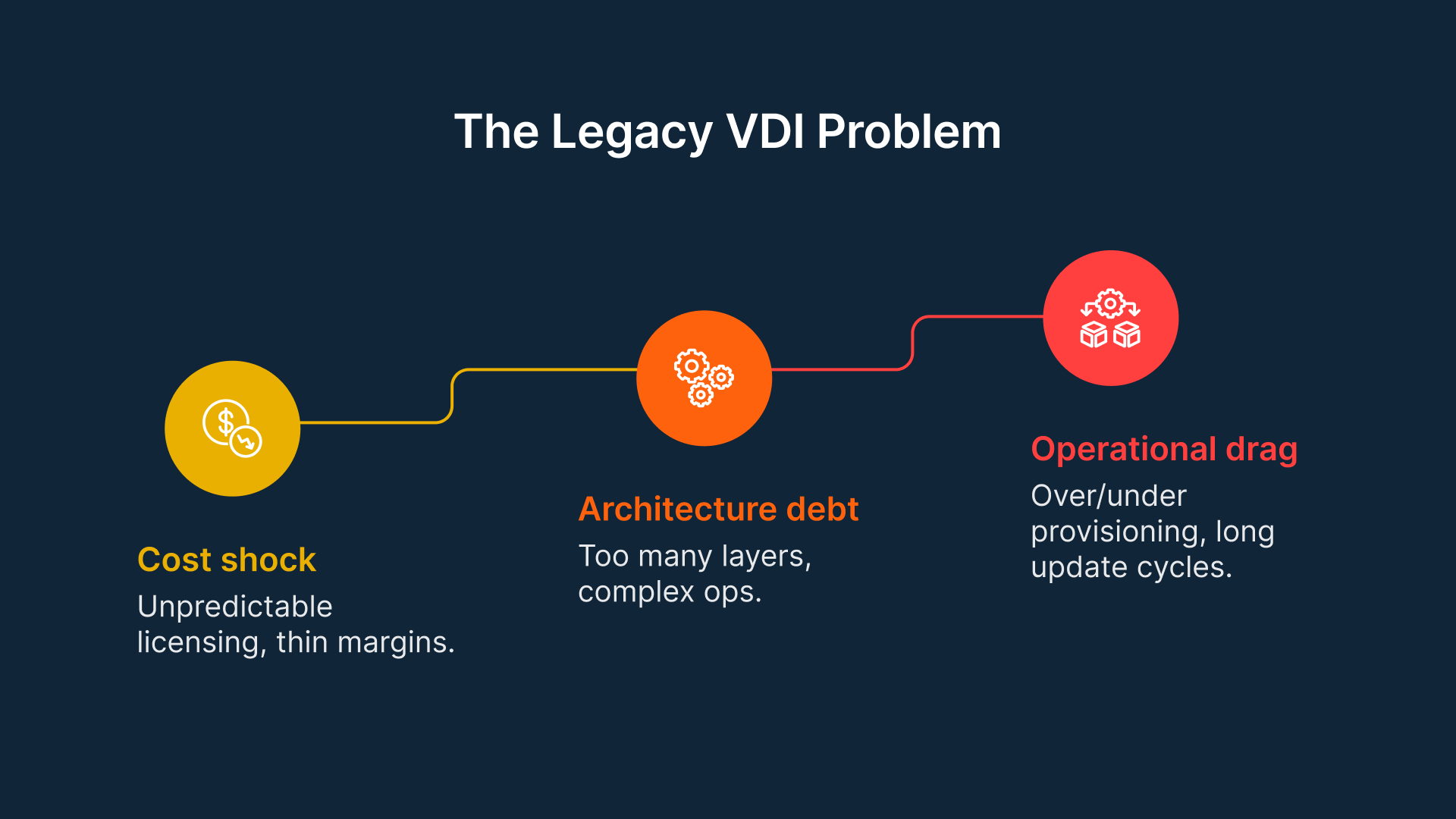
Cost shocks. In the last 12–18 months, many MSPs experienced dramatic licensing shifts from legacy vendors—higher minimums, bundled features they didn’t ask for, and pricing models that punish moderate growth. Forecasting is harder; margins are thinner.
Architecture debt. Legacy designs grew layer upon layer: brokers, ADCs, thick clients, golden image gymnastics, and complex upgrade paths. Every added moving part creates work: patching, monitoring, incident response, and highly specialized talent that is scarce and expensive.
Operational drag. Over-provisioning for peaks wastes spend; under-provisioning triggers tickets and churn. Image updates and app changes take weeks, not hours. Perimeter-centric security patterns clash with today’s Zero Trust requirements.
Bottom line: the model that once worked for a handful of large customers now breaks when you’re managing dozens of tenants at MSP scale.
Thinfinity Workspace on OCI: Built for MSP Economics
Thinfinity Workspace on Oracle Cloud Infrastructure replaces layered complexity with cloud-native simplicity. It’s engineered around four MSP imperatives:
- Clientless by default
- 100% HTML5 delivery; no thick client sprawl.
- Fewer version mismatches, fewer tickets, faster rollouts.
- Automation everywhere
- Infrastructure as Code (Terraform/Ansible) for repeatable deployments.
- Policy-driven autoscaling and auto-hibernate to eliminate idle burn.
- API-first operations for provisioning, access, lifecycle, and reporting.
- Zero Trust at the core
- Identity-centric auth (SAML/OIDC), MFA, device/context checks.
- Micro-segmentation and least privilege for application access.
- End-to-end encryption, session recording, and auditable trails.
- Concurrency and flexibility
- Concurrent licensing aligns cost to actual usage.
- Mix GPU, multi-monitor, and session-based pools under one roof.
- Hybrid paths: orchestrate on-prem VMware/Hyper-V and OCI as you migrate.
Why OCI for MSPs: Cost, Performance, Predictability
OCI’s architecture and pricing are a natural fit for managed VDI:
- Strong price-performance on compute and block storage—especially for E-series shapes.
- Predictable egress and regional pricing that simplifies quotes and renewals.
- Global scale (dozens of regions) for low-latency access and data-residency needs.
- Native capabilities MSPs care about: autoscaling, IAM/RBAC, KMS-backed encryption, logging, metrics, and alarms.
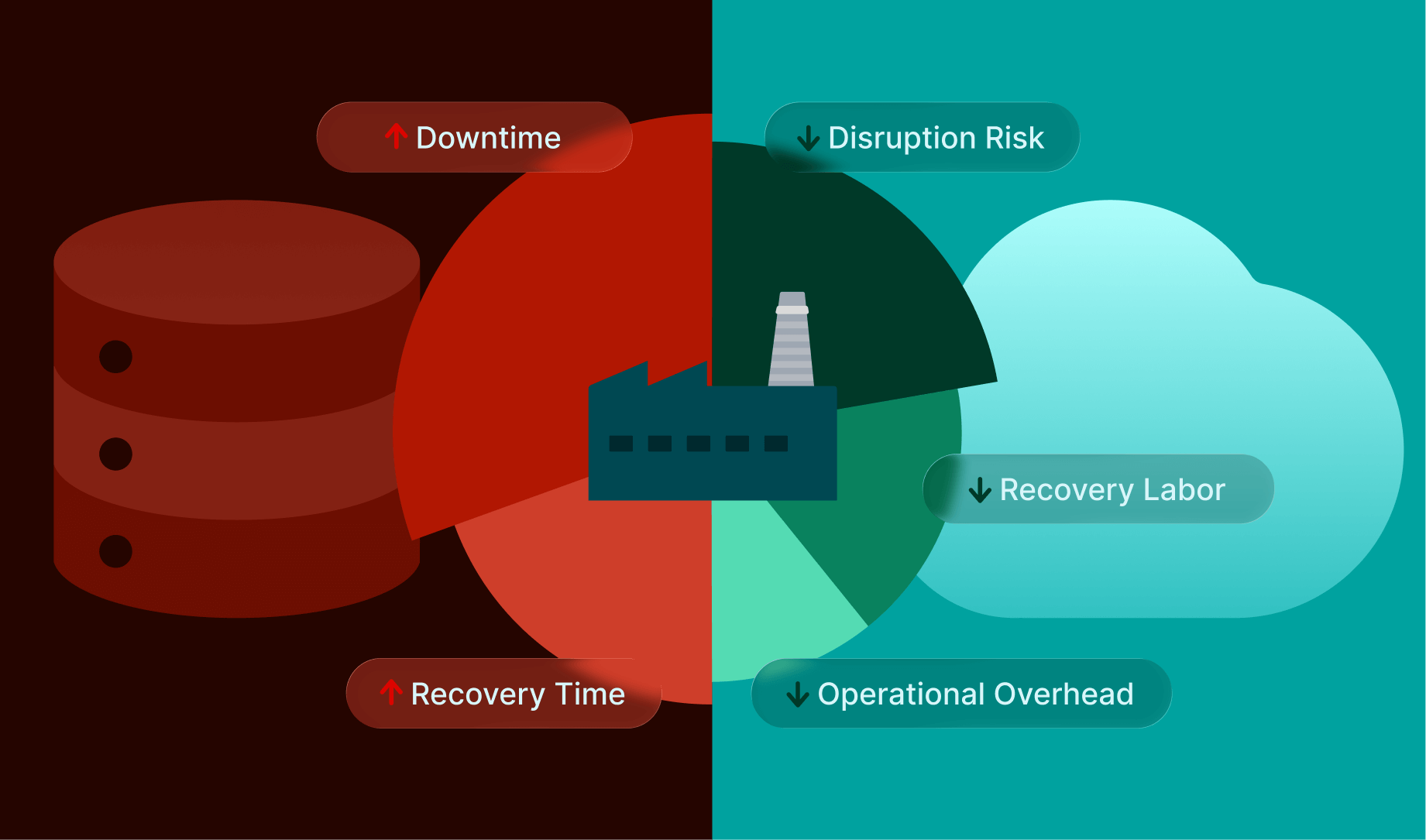
Result: lower steady-state costs, less variance between environments, and fewer “gotchas” during renewal.
Quantified Business Impact (Representative 100-User Scenario)
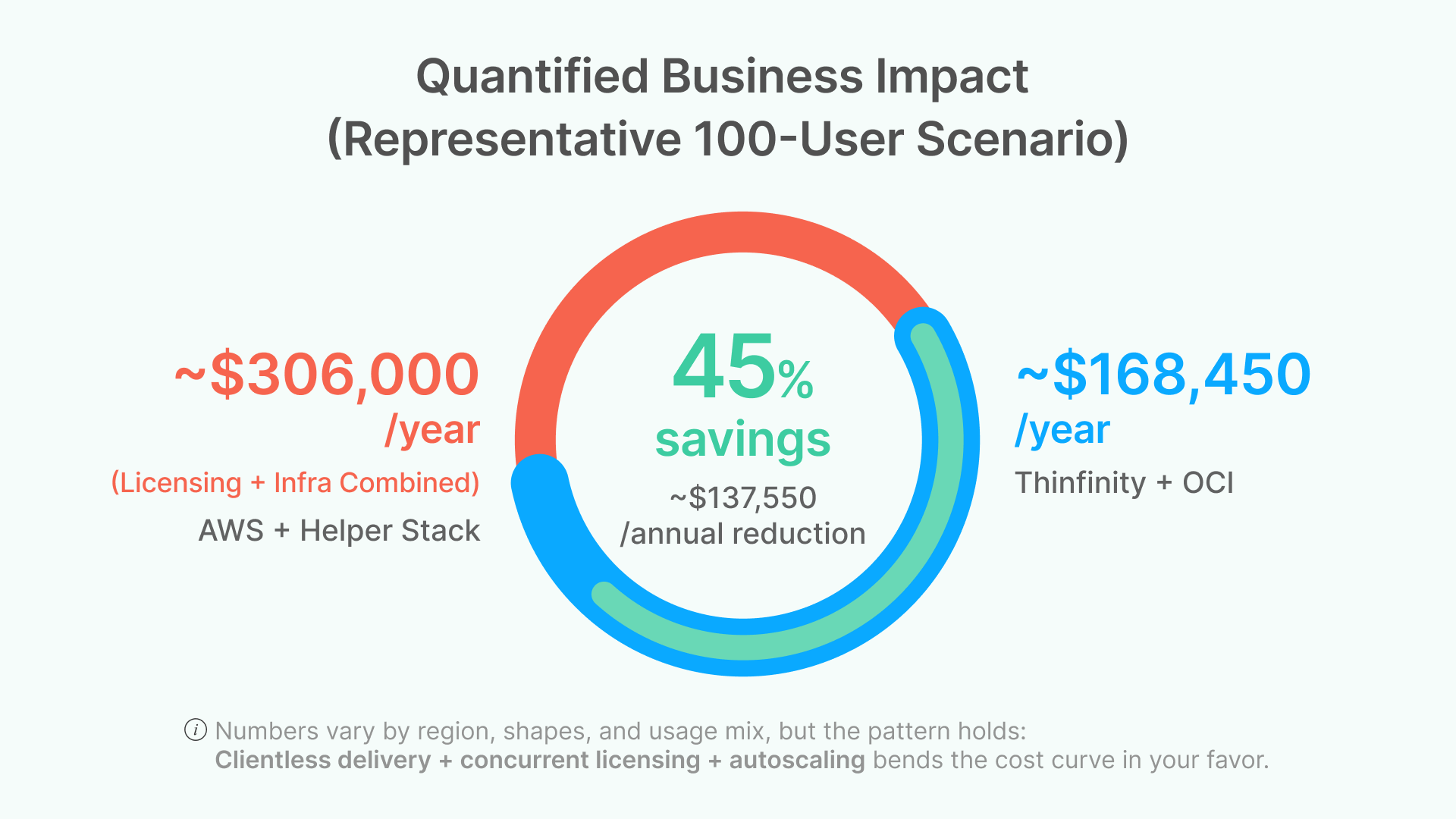
- AVD + helper stack: ~$306,000/year (licensing + infra combined)
- Thinfinity + OCI: ~$168,450/year
- Savings: ~$137,550 / 45% annual reduction
Numbers vary by region, shapes, and usage mix, but the pattern holds: clientless delivery + concurrent licensing + autoscaling bends the cost curve in your favor.
Revenue Design: How MSPs Monetize Thinfinity on OCI
White-label DaaS
Offer your branded workspace with your SLAs, your compliance bundles, your support. Stand apart from commodity marketplaces.
Tiered plans (sell outcomes, not instances)
- Business Pro: 2 monitors, Office apps, SSO, baseline security.
- Power User: 4 monitors, heavier apps, enhanced data policies.
- Trader/Designer: 6–8 monitors, GPU, priority QoS.
Add-ons: HIPAA/PCI packs, advanced logging, long-term archive, premium support.
Vertical SKUs
- Healthcare: charting + secure imaging, session recording, data-loss guardrails.
- Financial services: multi-monitor trading, strict RBAC, immutable audit.
- Engineering/Media: GPU pools for CAD/3D/video with burst capability.
- Education: lab scheduling, pooled desktops, budget-friendly hours-based billing.
Operating Model: Cut Tickets, Not Corners
Unified console
One pane to provision tenants, pools, access rules, storage, autoscaling, and reporting. Multi-tenant, multi-region, same workflows.
Fewer specialists required
Because you’re not nursing brokers/ADCs/thick-client fleets, generalist engineers can run most operations. Reserve senior talent for exceptions, not every Tuesday.
Change at cloud speed
Golden image refreshes and app updates flow through IaC pipelines; tenants inherit fixes predictably. Roll forward, roll back, audit everything.
Built-in observability
Integrate with OCI metrics/logs or your SIEM to monitor concurrency, latency, GPU utilization, and session stability. Flag anomalies before users do.
Technical Deep Dive (What Good Looks Like)
Reference pattern
- Front door: OCI LB/WAF → Thinfinity Gateway (stateless)
- Control: Thinfinity Broker (HA) + IdP (Azure Entra/Okta/OCI Identity)
- Compute pools: OCI VMs (session-based, 1:1 persistent, GPU)
- Storage: FSLogix profile containers + block/object storage tiers
- Security: KMS encryption, VCN micro-segmentation, private endpoints
- Ops: Terraform/Ansible pipelines, OCI Alarms, log shipping to SIEM
Resiliency basics
- Gateways are horizontally scalable; Brokers deployed in pairs or more.
- Separate subnets for control vs. session traffic; strict security lists.
- Regional pairs for DR; image registry + IaC for quick re-hydration.
Performance touchpoints
- Multi-monitor encoding optimized per pool; GPU pools for graphics.
- Profile disk warm-up and app pre-launch for snappy first sessions.
- Autoscale thresholds: concurrency, CPU/RAM/GPU utilization, and queue depth.
AI-Assisted Operations (Practical, Not Hype)
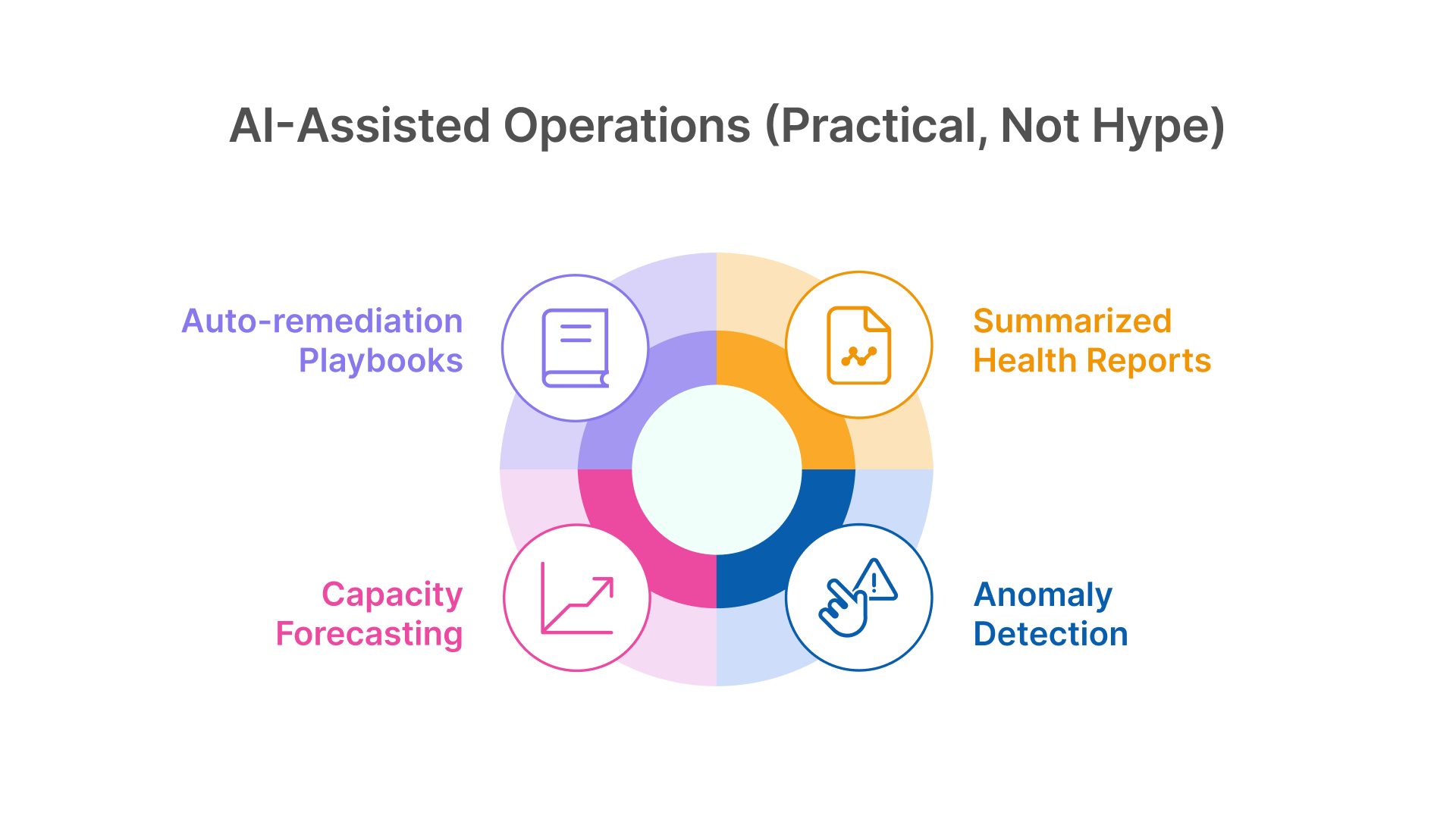
- Capacity forecasting: predict peaks (payroll, month-end, enrollment) to pre-scale.
- Anomaly detection: spot auth failures, latency spikes, or GPU contention early.
- Auto-remediation playbooks: drain sick nodes, redeploy golden images, nudge scale-out before user impact.
- Summarized health reports: exec-friendly posture, SLA, and cost optimization insights.
Migration Playbook: From Legacy to Thinfinity + OCI
- Discovery & sizing
Segment users (task, knowledge, power, graphics). Map app dependencies and data gravity. - Pilot (30–50 users)
Prove HTML5 performance, SSO, MFA, and policy controls. Measure logins, frame rates, task completion. - Parallel run
Stand up production pools; route targeted cohorts. Keep legacy as safety net. - Cutover & decommission
Roll in waves; retire overlapping licenses/hardware; re-capture spend. - Optimize & upsell
Introduce multi-monitor tiers, GPU bundles, and compliance packs. Publish monthly value reports.
Time-to-value shrinks when your sales motion includes an instant, browser-based demo. No client install. No RDP surprises. Just “click and see.”
Security & Compliance, Simplified
- Identity everywhere: enforce SAML/OIDC, MFA, conditional access, device posture.
- Least privilege by design: per-app authorization; no flat networks.
- Data-centric controls: clipboard/drive rules, watermarking, download guards.
- Auditability: session recording, immutable logs, retention policies aligned to your verticals.
- Framework alignment: map controls to HIPAA, PCI DSS, GDPR, ISO 27001, NIST CSF to accelerate audits.
MSP KPI Scorecard (What to Track Monthly)
- Gross margin per tenant (target up and to the right).
- Tickets per 100 users (drive down via clientless + autoscale + IaC).
- Avg. time to onboard (from contract to first session).
- Concurrency vs. license pool (prove ROI of concurrent model).
- SLA attainment (99.9%+ with transparent incident postmortems).
- Upsell rate (GPU, multi-monitor tiers, compliance packs).
Packaging Template You Can Copy
| Plan | Core Use Case | Monitors | GPU | Security & Compliance | Support |
|---|---|---|---|---|---|
| Business Pro | Office & SaaS, branch staff | 2 | Optional | SSO/MFA, baseline DLP | 8×5 |
| Power User | Analysts, devs, designers (light) | 4 | Optional | Advanced DLP, session record | 12×5 |
| Trader/Designer | Trading floors, CAD/3D, media | 6–8 | Yes | Hardened policies, long-term audit | 24×7 |
Add-ons: HIPAA/PCI bundles, DR region, analytics pack, premium response.
Conclusion: Make 2025 the Year You Fix VDI Economics
Customers want secure, compliant, high-performing virtual workspaces. MSPs want predictable margins and recurring revenue without babysitting brittle architectures.
Thinfinity Workspace on OCI aligns both goals:
- Lower TCO via clientless delivery, concurrent licensing, and autoscaling
- Higher velocity with IaC pipelines and unified multi-tenant ops
- More revenue from white-label offerings, multi-monitor tiers, GPU, and compliance packs
- Future-proof with Zero Trust, AI-assisted operations, and hybrid/multi-cloud flexibility
If you’re ready to replace architecture debt with a modern MSP advantage, build your pilot this month—and turn VDI back into a growth engine.