


Executive Summary
The third quarter of 2025 reinforced the Virtual Desktop Infrastructure (VDI) market as one of the fastest-growing pillars of enterprise IT strategy. The global cloud-based VDI market reached a quarterly valuation of $10.31 billion, maintaining an impressive 14.15% growth rate, which signals not only strong adoption but also an accelerated shift away from legacy desktop delivery models. This period was defined by a convergence of three pressures: spiraling costs for enterprises, escalating cybersecurity incidents, and uncertainty surrounding traditional VDI vendors.
For CIOs and CTOs, cost unpredictability from platforms like Azure Virtual Desktop, coupled with budget overruns of up to 60%, highlighted the urgent need for more transparent pricing models. CISOs confronted the harsh reality that 84% of organizations suffered cyber incidents in 2025, revealing gaps in endpoint control and incomplete Zero Trust implementations. Meanwhile, service providers found themselves in a unique position to capture opportunity, as enterprises increasingly outsourced both security operations and complex migration projects following the instability of VMware and Citrix.
This report positions Thinfinity VDI on Oracle Cloud Infrastructure (OCI) as a differentiated response to these challenges. With its predictable pricing, built-in Zero Trust security, and browser-based simplicity, Thinfinity VDI provides CIOs, CISOs, and MSPs with a reliable platform that sidesteps the complexity and hidden costs plaguing traditional VDI solutions.
Section I: CIO and CTO Strategic Priorities
Q3 2025 Enterprise Leadership Challenges
Cost Management Crisis Escalates
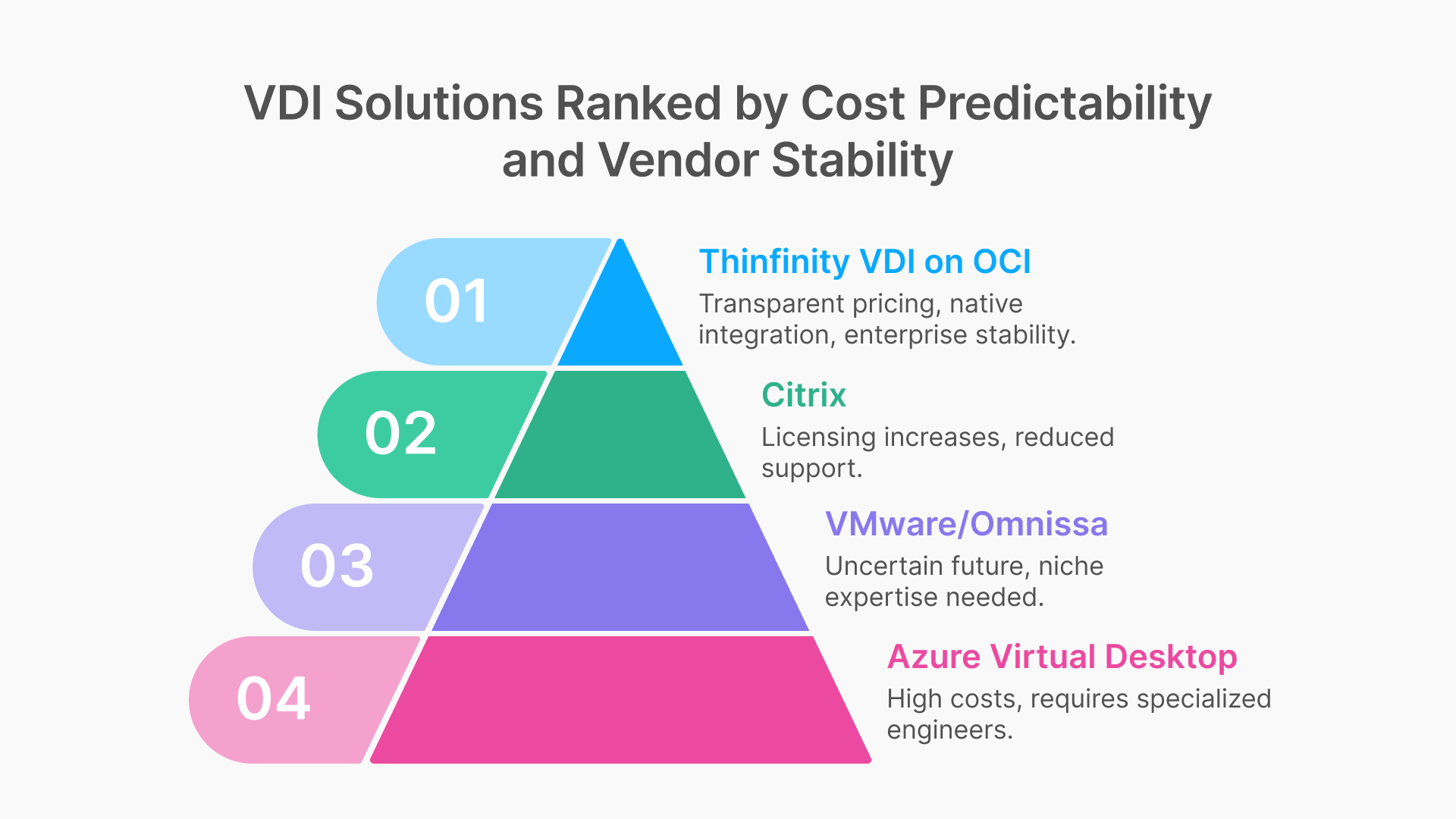
One of the most urgent themes of Q3 was the escalation of cost management challenges in VDI deployments. Enterprises reported that Microsoft Azure Virtual Desktop (AVD) projects consistently ran 40–60% above budget once production scaling began. These overruns were not limited to consumption charges alone; they included the hidden cost of hiring and retaining highly specialized Azure VDI engineers capable of optimizing workloads and managing complex scaling behaviors.
At the same time, 33% of enterprises reported spending more than $12 million annually on cloud services, a level that has forced CIOs to reconsider the long-term sustainability of their cloud vendor commitments. With the majority of IT teams—91% according to industry surveys—admitting to prioritizing cost over performance when selecting vendors, a dangerous paradox has emerged: short-term cost minimization often results in long-term budget instability due to unanticipated charges and the constant need for optimization tools, consultants, and custom automation scripts.
The conclusion is clear: organizations that treat VDI as a commodity purchase are discovering that they are locking themselves into unpredictable and expensive cycles of cost overruns.
Vendor Stability Concerns Intensify
Q3 2025 also brought significant disruptions tied to vendor stability. The Broadcom acquisition of VMware (rebranded as Omnissa) left nearly two-thirds of its enterprise customer base uncertain about future product direction, licensing conditions, and roadmap visibility. Specialized VMware talent, once a cornerstone of IT infrastructure, has now become a niche and expensive expertise, driving further cost pressures and talent retention challenges.
Meanwhile, Citrix under Cloud Software Group implemented licensing increases exceeding 200%, forcing enterprises to accelerate migration assessments. These sudden price escalations, combined with reduced customer support responsiveness, led many CIOs to cite vendor trust and continuity as top-level strategic concerns.
Enterprises no longer evaluate vendors purely on functionality; they now require evidence of long-term stability and clarity of vision to mitigate the risk of sudden cost hikes, forced migrations, and talent shortages.
Thinfinity VDI on OCI: Addressing CIO/CTO Pain Points
Transparent Cost Structure
Thinfinity VDI on OCI stands out by offering predictable, transparent, and enterprise-oriented pricing. Unlike Azure’s pay-as-you-go unpredictability, Oracle Cloud delivers straightforward models with committed-use discounts and capped costs. Enterprises adopting Thinfinity VDI have reported 25–40% reductions in total cost of ownership (TCO), with no hidden optimization charges or unpredictable usage spikes.
This allows CIOs and CFOs to align IT budgets with business forecasts, ensuring that VDI becomes a stable cost center rather than an unpredictable financial liability.
Technical Advantage Through Native OCI Integration
Thinfinity VDI leverages OCI’s native KVM hypervisor and integrates seamlessly with Infrastructure-as-Code automation, drastically reducing operational complexity. Features such as automated scaling, rapid provisioning, and lifecycle management eliminate the need for dedicated Azure or VMware engineers, replacing niche expertise with intuitive automation.
This not only accelerates deployments but also reduces the long-term dependency on rare skills, a growing concern in 2025 as VDI specialists remain in short supply. CIOs gain both speed and resilience, with deployments that scale effortlessly as business demand evolves.
Enterprise Vendor Stability
Unlike smaller or acquisition-disrupted providers, Oracle provides a foundation of unmatched enterprise stability. With 44 global regions, industry-leading SLAs, and an $80 billion investment into AI and next-generation infrastructure, Oracle demonstrates a long-term commitment to cloud infrastructure innovation.
For CIOs, this translates into roadmap certainty—the reassurance that their desktop strategy will not be undermined by vendor consolidation, sudden licensing shifts, or lack of support. Thinfinity VDI’s integration into OCI makes it not just a VDI solution but a future-proof investment in enterprise cloud modernization.
Simplified Management Architecture
Thinfinity replaces the multi-layered complexity of legacy VDI (brokers, load balancers, connection servers) with a single, browser-based layer. This simplicity reduces deployment times by up to 60% and administrative overhead by 90%, directly addressing the scarcity of senior VDI specialists.
For CIOs and IT leaders, this means less reliance on expensive consultants and fewer operational bottlenecks, empowering in-house teams to manage VDI environments without the overhead of legacy architectures.
Section II: CISO Enterprise Security Priorities
Q3 2025 Security Landscape
Cyber Attack Surge
Security teams faced a sobering reality this quarter: 84% of enterprises suffered cyber incidents, up from 65% just two years prior. While phishing, ransomware, and credential theft remain top threats, the report shows that 88% of breaches were linked to human error, revealing that traditional training alone cannot safeguard the modern enterprise.
This underscores the need for architectural solutions—environments that reduce attack surface and enforce continuous verification rather than relying solely on user vigilance.
Zero Trust Implementation Gaps
Although Zero Trust has been widely embraced in theory, only 76% of enterprises maintain mature Zero Trust programs. For many organizations, complexity, fragmented tooling, and overlapping security stacks have slowed adoption, leaving exploitable gaps in policy enforcement and access control.
BYOD and Endpoint Security Complexity
The BYOD movement accelerated in Q3, with 82% of organizations now supporting personal device access. While this has increased productivity by nearly 70%, it has also made endpoint protection significantly more complex. Enterprises must now manage devices across uncontrolled networks and operating systems, dramatically expanding the attack surface.
Compliance Pressure
Across healthcare, finance, and government, regulatory scrutiny intensified in Q3. Enterprises face rising costs in compliance-ready architectures, audit trail requirements, and data residency assurances. Those failing to align risk reputational damage, financial penalties, and operational disruption.
Thinfinity VDI on OCI: CISO Security Advantages
Thinfinity VDI eliminates the patchwork approach to security by embedding protection into the core architecture:
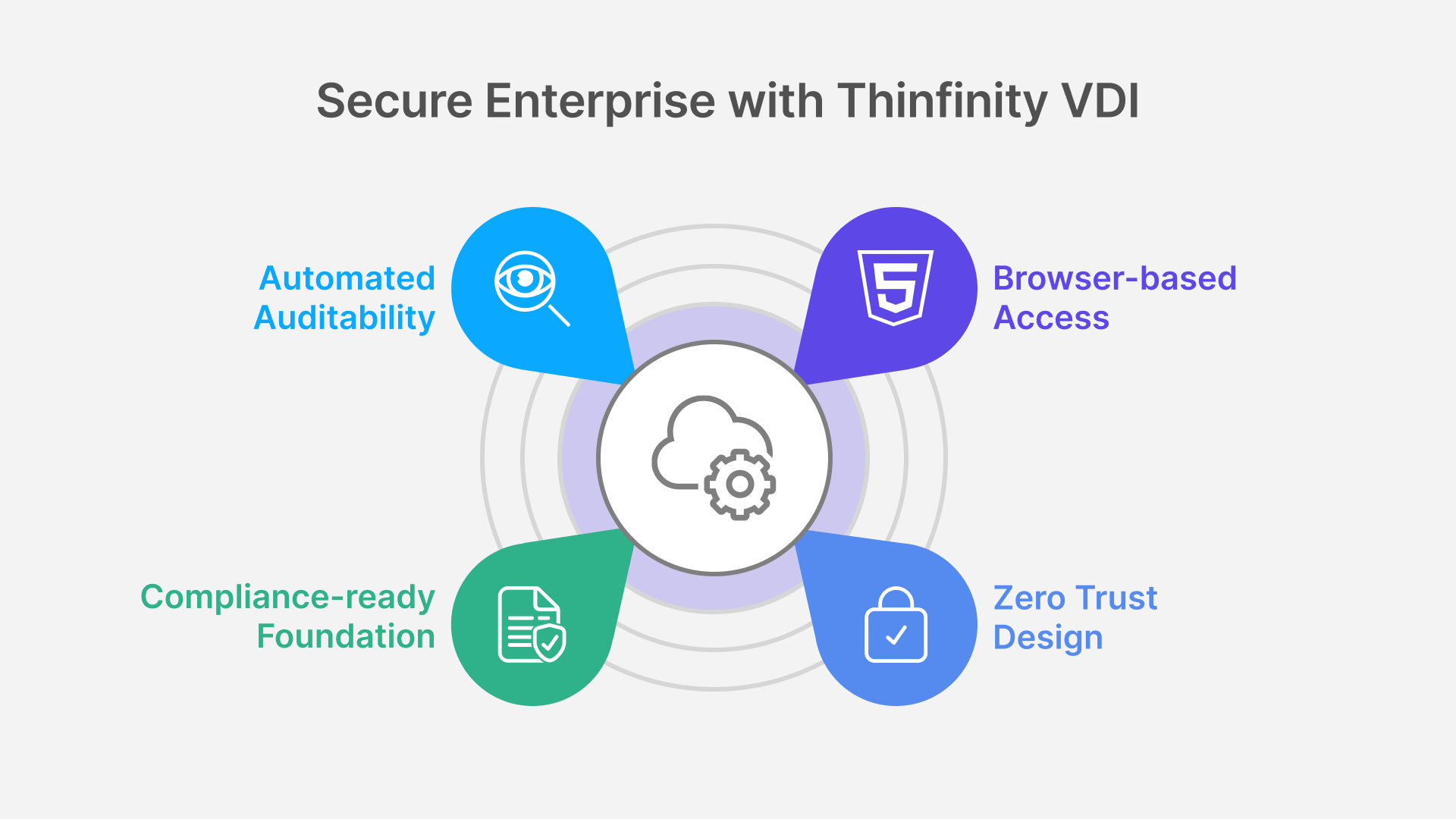
- Zero Trust by design: microsegmentation, identity verification, and role-based access controls at every stage.
- Browser-based access: applications and data remain centralized in OCI, removing endpoint vulnerabilities and erasing client installation risks.
- Compliance-ready foundation: encryption at rest and in transit, IAM controls, and alignment with HIPAA, GDPR, PCI-DSS, and FedRAMP.
- Automated auditability: OCI-native logging and monitoring enable real-time compliance reporting and rapid incident response.
For CISOs, Thinfinity VDI on OCI provides a security-first foundation that removes the need for multiple overlapping tools and accelerates regulatory readiness.
Section III: Service Provider Market Opportunities
MSP Market Dynamics in Q3 2025
The service provider market emerged as one of the biggest winners this quarter. The MSP segment of VDI reached $2.8B, growing at a rapid 35% quarterly rate, as enterprises increasingly abandoned traditional VPNs and in-house VDI in favor of outsourced DaaS and Zero Trust services.
The demand profile is clear:
- Zero Trust services grew 76%, creating an $890M opportunity.
- Cloud migration projects generated $1.2B, driven by enterprises fleeing VMware and Citrix uncertainty.
- Managed VDI security services hit $1.8B, as talent shortages forced enterprises to outsource specialized functions.
Service providers now sit at the center of enterprise digital transformation, provided they can deliver solutions with speed, scalability, and predictable costs.
Thinfinity VDI on OCI: MSP Advantages
- Accelerated service delivery: Thinfinity’s architecture reduces deployment time by 60%.
- Higher margin services: Built-in Zero Trust reduces integration complexity, allowing MSPs to package security as a premium offering.
- Global reach: Oracle’s 44-region footprint enables worldwide delivery without infrastructure investment.
- Predictable margins: OCI pricing models allow MSPs to scale without risking financial unpredictability.
Q3 2025 Market Outlook
The third quarter confirmed that VDI is no longer optional; it is now a critical enterprise infrastructure layer. But with Azure’s unpredictability, VMware’s instability, and Citrix’s aggressive pricing, enterprises are eager for new strategic partners.
Thinfinity VDI on Oracle Cloud Infrastructure has emerged as a compelling alternative—delivering cost predictability, enterprise-grade security, and management simplicity backed by Oracle’s global scale.
Looking ahead into Q4 2025, the market will continue to evolve around three priorities:
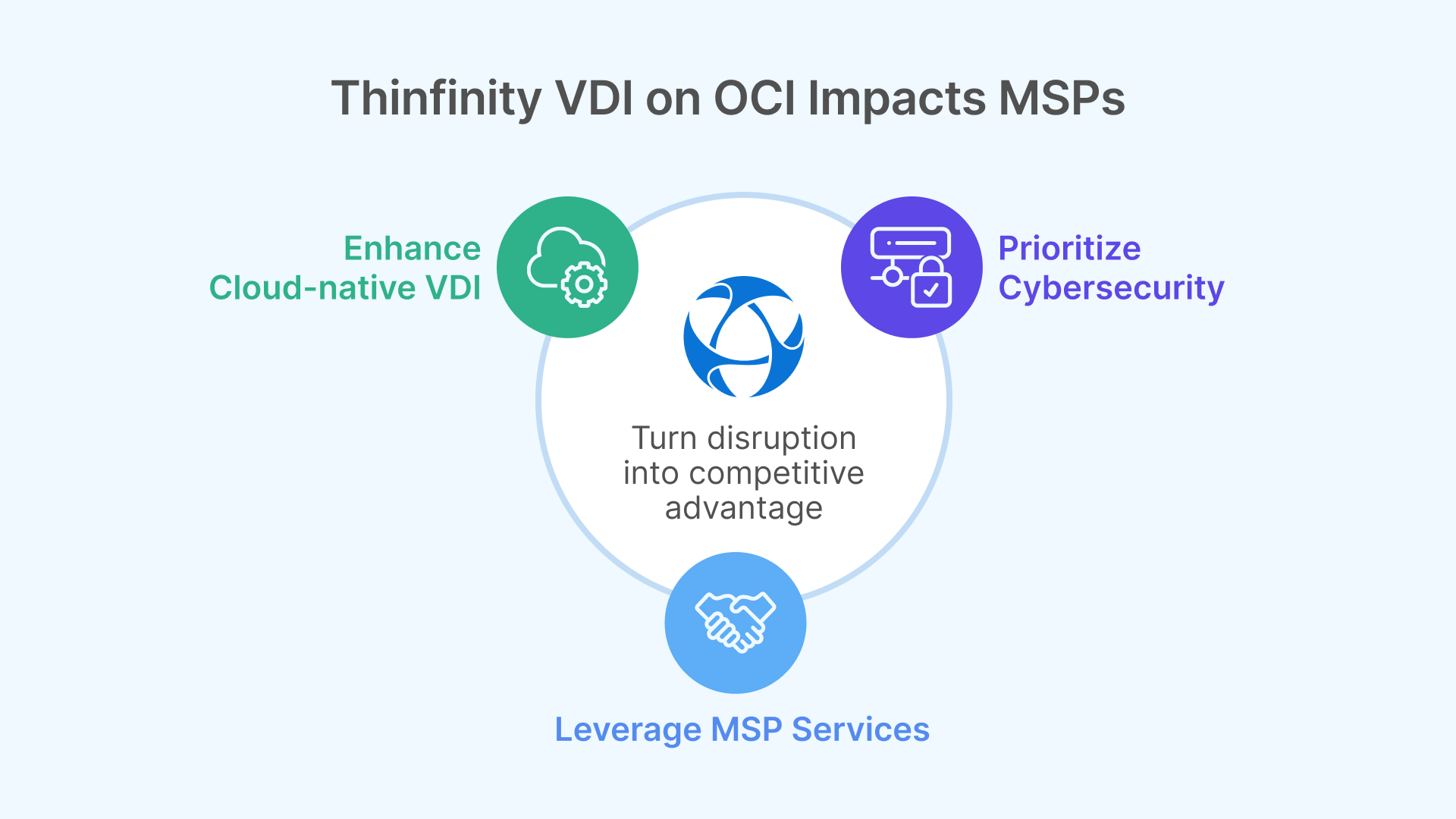
- Expanded adoption of cloud-native VDI as legacy platforms lose ground.
- Increased cybersecurity budgets tied to Zero Trust initiatives.
- Rising demand for MSP-driven services, especially in compliance-heavy industries.
For enterprises and service providers alike, adopting platforms like Thinfinity VDI on OCI offers not only a way to survive this turbulence, but a chance to turn market disruption into a competitive advantage.