


Summary
- Awingu is now Parallels Secure Workspace. Alludo rebranded Awingu to Parallels Secure Workspace on October 31, 2023, and stated the product itself was unchanged; it remains a clientless, browser-based Zero Trust workspace that aggregates RDP apps, desktops, file shares, and web apps into one portal.
- Thinfinity is the simplicity play: one platform delivers VDI desktops, published Windows apps (VDA), Linux and Java apps, Remote Browser Isolation, and terminal emulation under a single Universal ZTNA, with one management plane and concurrent licensing.
- Reliability on OCI is architectural: stateless reverse gateways, non-persistent desktop pools, multi-region and multi-AD high availability, and self-healing on Oracle Kubernetes Engine, with a pixels-only endpoint model that isolates device risk.
- Roadmap continuity is a legitimate evaluation criterion. Acquisitions and rebrands are normal, but worth diligence. Thinfinity is a single, continuously developed platform from one independent vendor with a consistent VDI/VDA/ZTNA direction.
- Parallels still wins in specific cases: deep Azure commitment points to Parallels DaaS (a mature, well-regarded managed-AVD option for Azure-committed organizations), and pure browser aggregation of existing RDP backends with multi-tenancy points to Parallels Secure Workspace.
If you are evaluating an Awingu alternative, you are almost certainly weighing what changed after the rebrand: Awingu is now Parallels Secure Workspace, part of the wider Parallels and Alludo portfolio. This article is written for IT teams (IT directors, infrastructure leads, and CISOs) who need a secure desktop and application platform that is simple to run, reliable under load, and backed by a predictable roadmap. We compare Parallels Secure Workspace (formerly Awingu), Parallels DaaS, and Thinfinity Workspace deployed on Oracle Cloud Infrastructure, and we do it fairly: where Parallels is the stronger fit, we say so.
This is the buyer-side view. If your interest is partner economics (margins, white-label, and SKU strategy for MSPs and ISVs), read our companion piece, Parallels Alternative: Thinfinity vs Parallels, which covers that ground in depth. Here we stay focused on the three questions IT leaders actually ask during evaluation: How simple is it to operate? How reliable is it in production? And can I trust the roadmap for the next three to five years?
Why is everyone searching for an “Awingu alternative” now?
The short answer: the name changed, and name changes prompt re-evaluation. On October 31, 2023, Alludo announced that Awingu would be marketed as Parallels Secure Workspace. The press release framed this as a rebrand: the underlying product stayed the same, but the go-to-market identity moved under the Parallels banner. Awingu had already been acquired by Parallels (then under Corel, later Alludo) in 2021, so the 2023 rebrand was the visible step in a longer consolidation.
For an IT buyer, a rebrand is a natural trigger to ask whether the platform still fits. That is healthy diligence, not alarmism. When a product moves into a larger multi-brand portfolio, three practical questions follow: Where does this product sit relative to its siblings? Will investment stay focused on it? And does the licensing and support model still match how we buy? Those are exactly the questions this comparison is built to answer.
It helps to be precise about what each product is, because “Parallels” now covers several distinct things.
What is Parallels Secure Workspace (formerly Awingu)?
Parallels Secure Workspace is a clientless, browser-based Zero Trust workspace. It uses RDP-to-HTML5 translation to aggregate published RDP applications and desktops, file shares, and web or SaaS applications into a single browser portal. It is multi-tenant and ships with built-in multi-factor authentication, SAML and OpenID identity federation, and session recording. Its core value is aggregation: if you already run RDS or other RDP backends and want to expose them through one hardened browser front door, Secure Workspace is purpose-built for that.
What is Parallels DaaS?
Parallels DaaS is a separate, cloud-native desktop-as-a-service offering that simplifies Microsoft Azure Virtual Desktop. It is built on and requires the customer’s own Azure subscription and Microsoft Entra ID, sold per user, and operated through a microservices and container-based control plane. Parallels DaaS is a strong choice for organizations that are already deeply committed to Azure and want a more streamlined management layer over AVD.
What is Thinfinity Workspace on OCI?
Thinfinity Workspace is a single platform that delivers full virtual desktops (VDI) and published Windows applications (VDA), both over the RDC protocol, plus Linux and Java applications, Remote Browser Isolation, and containerized app and session delivery on Kubernetes and Oracle Kubernetes Engine (OKE). It includes built-in Thinfinity Terminal Emulation for mainframe and AS/400 access. Users reach everything through any HTML5 browser or native Windows, Linux, and mobile clients, all governed by one Universal ZTNA. It runs on Oracle Cloud Infrastructure, where Oracle is a Cybele partner, and equally on any other cloud or on-premises. See the native OCI VDI for enterprises solution for the reference deployment.
How do the three options compare at a glance?
| Dimension | Thinfinity VDI on OCI | Parallels Secure Workspace (ex-Awingu) | Parallels DaaS |
|---|---|---|---|
| Platform scope | One platform: VDI, VDA/published apps, Linux/Java apps, RBI, terminal emulation | Browser aggregation of RDP apps, desktops, file shares, and web/SaaS apps | Cloud-native DaaS layer over Azure Virtual Desktop |
| Architecture & inbound ports | Reverse gateway on 443/TLS 1.3; host agent dials outbound; zero inbound ports on firewall or host | Reverse-proxy gateway to internal RDP backends; browser is the client | Control plane in Parallels cloud orchestrating AVD session hosts in customer Azure |
| Endpoint model | Pixels-only stream; no endpoint management; endpoint gets no network or resource access | Clientless browser session; nothing installed on the device | AVD/Windows session delivered to Azure-registered clients |
| Identity | Built-in MFA, SAML/OpenID, integrates with existing AD/IdP; no cloud IdP mandated | Built-in MFA, SAML/OpenID; multi-tenant | Requires Microsoft Entra ID |
| Reliability / HA model | Stateless gateways, non-persistent pools, multi-region and multi-AD on OCI, OKE self-healing | HA depends on the underlying RDP backends and gateway redundancy you build | Inherits Azure region and AVD availability design |
| Licensing | Concurrent single licensing (not per named user) | Per-user subscription | Per-user subscription plus Azure consumption |
| Roadmap / vendor focus | Single continuously developed platform from one independent vendor (Cybele Software) | One product within the multi-brand Parallels/Alludo portfolio | Azure-tied product within the Parallels/Alludo portfolio |
| Legacy / terminal emulation | Built-in emulation for mainframe/AS/400 | Via published RDP apps you already run | Via apps published on AVD session hosts |
Simplicity: how many moving parts are you really signing up for?
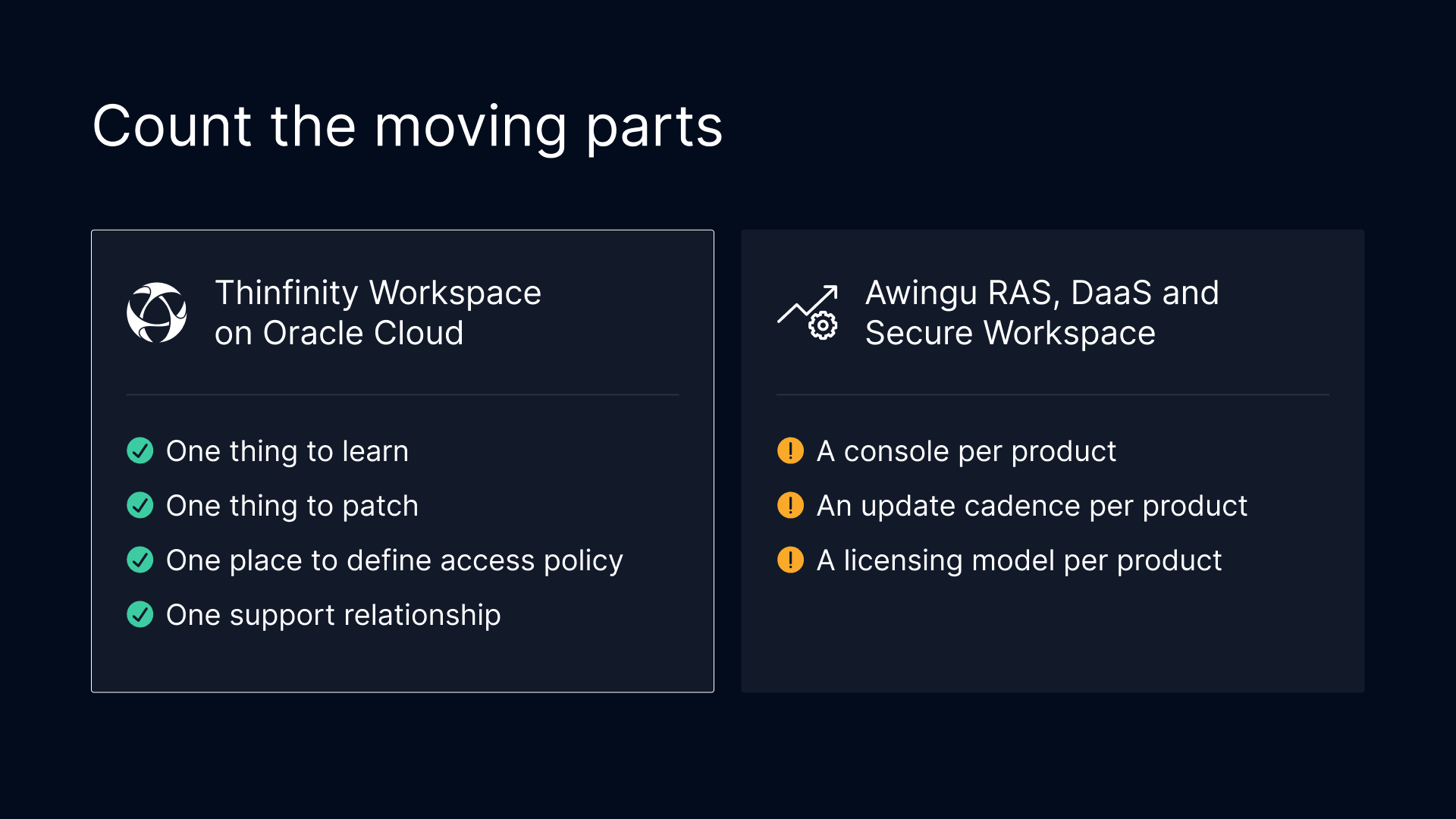
Simplicity is not a slogan; it is a count of the things your team has to deploy, patch, monitor, and license. This is where the portfolio structure matters most for an IT buyer. Parallels and Alludo span several products: Parallels RAS for on-premises and hybrid publishing, Parallels DaaS for Azure, and Parallels Secure Workspace for browser-based Zero Trust access, alongside Desktop for Mac, Toolbox, and Access. Each is capable in its lane. But if your requirement spans full VDI desktops, published apps, browser isolation, and legacy terminal access, you may find yourself mapping that requirement across two or three of those products (RAS plus DaaS plus Secure Workspace), each with its own console, update cadence, and licensing.
Thinfinity approaches the same requirement as one platform. Full desktops and published Windows applications both run over the RDC protocol; Linux and Java apps, Remote Browser Isolation, and containerized delivery on OKE sit in the same product; terminal emulation is built in. There is one management plane and one Universal ZTNA policy layer over all of it. For the IT team, that means one thing to learn, one thing to patch, one place to define access policy, and one support relationship. That is the practical meaning of simplicity: fewer consoles, fewer integration seams, fewer places for configuration drift to hide.
Does a single architecture actually reduce operational load?
Yes, and the clearest example is the network path. In Thinfinity, the client connects to a reverse gateway on port 443 over TLS 1.3. The host agent dials outbound to that gateway and streams the session up. The result is zero inbound ports on the firewall or on the host itself. You are not opening RDP to the internet, not publishing backend listeners, and not maintaining a separate DMZ pattern per workload type. One connection model covers desktops, apps, and isolated browsers alike.
That single path also simplifies change management. When there is one gateway tier and one agent model, upgrades are predictable and rollback is contained. Compare that with stitching a publishing product, a DaaS layer, and a browser-access product together: each seam is a place where an upgrade to one component can surprise another. The fewer the seams, the fewer the surprises.
Deploying on OCI without a cloud-identity mandate
Thinfinity deploys on Oracle Cloud Infrastructure as a first-class target, and Oracle is a Cybele partner, so the reference architecture is well trodden. Crucially, Thinfinity integrates with the identity you already run (Active Directory or your existing IdP through SAML or OpenID) without mandating a particular cloud identity provider. This is a meaningful contrast with Parallels DaaS, which is built on Azure and requires Microsoft Entra ID. If your organization is not Azure-centric, avoiding a forced cloud-identity dependency removes an entire category of setup, licensing, and ongoing coordination work.
Reliability: what keeps the service up when something fails?
Reliability is designed in, not bolted on. The Thinfinity architecture on OCI is built so that no single component failure takes down user access. The reverse gateway tier is stateless, which means you can run several gateways behind an OCI load balancer and lose one without dropping the fleet. Desktop pools are non-persistent, so a failed host is replaced from a template rather than nursed back to health. For containerized workloads, Oracle Kubernetes Engine provides self-healing: unhealthy pods are rescheduled automatically.
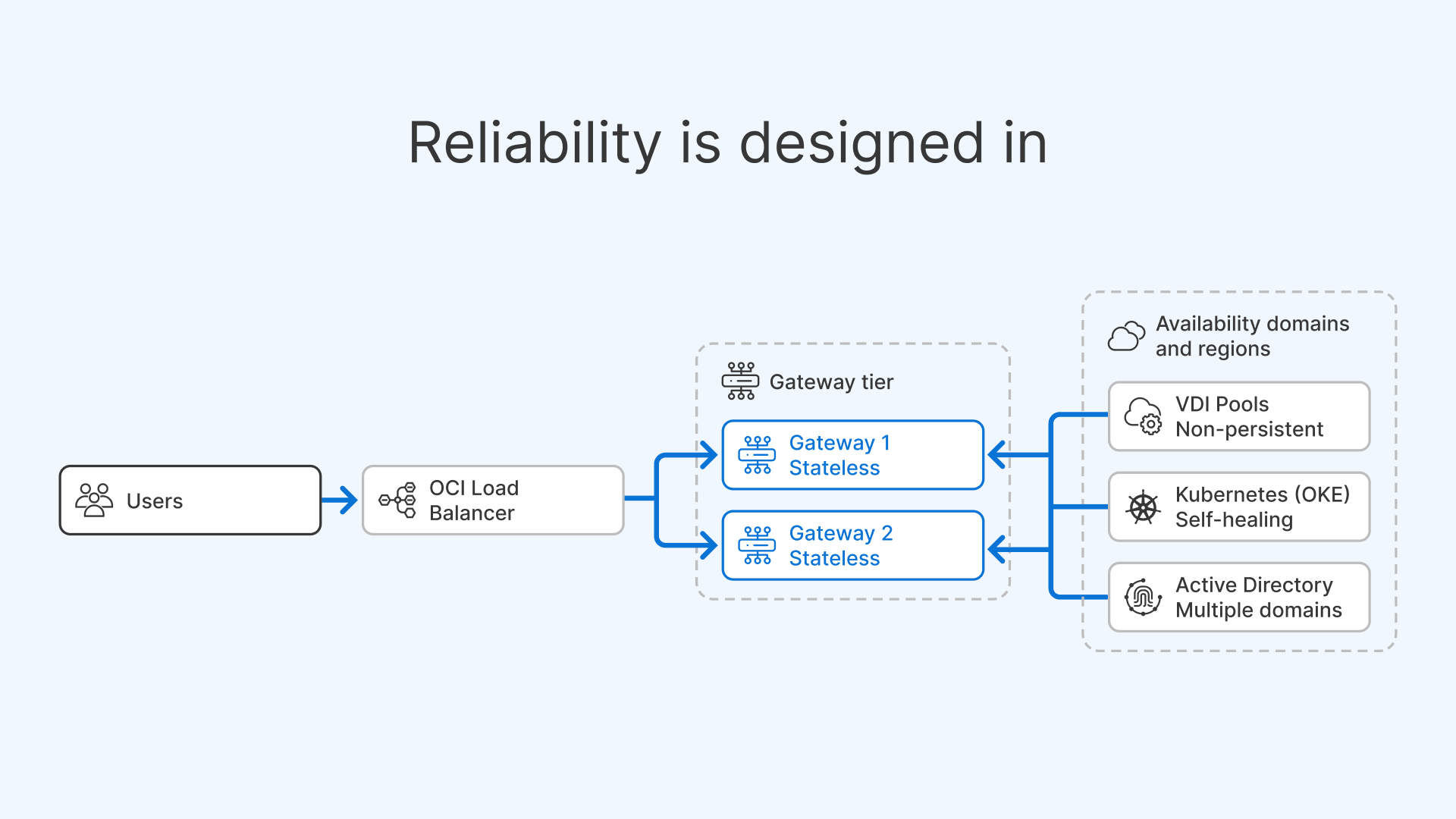

Availability domains are isolated from each other, fault tolerant, and very unlikely to fail simultaneously.

On top of that, OCI lets you span multiple availability domains and multiple regions, and Thinfinity supports multiple Active Directory domains, so you can design for both infrastructure failure and identity-domain isolation. The combination (stateless front end, disposable back end, multi-AD and multi-region reach) is what turns “we have backups” into “users keep working during a failure.” For a concrete build, our walkthrough on high availability VDI on OCI with FSLogix and Windows clusters shows the pattern end to end.
How does the endpoint model affect reliability and security?
The endpoint model is where reliability and security meet. In Thinfinity, the endpoint receives only a pixel stream. It gets no network route into your environment and no direct access to resources. This “pixels-only” design, what we call pixel streaming, means an endpoint vulnerability stays on the endpoint: a compromised or unmanaged device cannot pivot into the session host or the network behind it, because it never had a path there in the first place. That is also why Thinfinity needs no endpoint management agent. There is nothing to enroll, nothing to keep patched on the device side, and one less fleet to worry about when a laptop is lost or a contractor rotates off. This is the same reasoning that underpins NIST SP 800-207 on Zero Trust Architecture.
Perimeter-based network security has also been shown to be insufficient since once attackers breach the perimeter, further lateral movement is unhindered.
Parallels Secure Workspace shares the clientless, browser-based virtue here: nothing is installed on the device, and the browser is the client. The architectural difference is what sits behind the front door. Secure Workspace aggregates and proxies your existing RDP backends, so the reliability of the whole depends on the reliability you have already engineered into those backends and the redundancy of the gateway tier. Thinfinity brings the desktop, app, and isolation layers into one platform whose HA characteristics you configure directly on OCI, rather than inheriting them from separately managed backends.
Predictable roadmap: why vendor focus belongs on your checklist
Let us be careful and fair here, because roadmap discussion invites fear, uncertainty, and doubt, and that is not the goal. The verifiable facts are these: Awingu was acquired and then rebranded to Parallels Secure Workspace in 2023, and Parallels/Alludo is a multi-brand portfolio spanning several workspace products. None of that is a criticism. Acquisitions and rebrands are ordinary events in enterprise software, and a large portfolio brings real advantages in resources and reach. We are not predicting anything about Parallels’ future direction, and you should not either.
What we are saying is narrower and defensible: roadmap continuity is a legitimate criterion to evaluate for yourself. When a product lives among siblings that overlap in adjacent use cases, it is reasonable to ask where sustained investment will land, and to seek your own assurances from the vendor. Do that diligence directly: ask about release cadence, support lifecycle, and how the products in the portfolio are positioned relative to each other over your planning horizon.
Against that backdrop, Thinfinity’s proposition is straightforward: it is a single, continuously developed platform from one independent vendor, Cybele Software, with a consistent VDI, VDA, and ZTNA direction. There is no ambiguity about which product carries the desktop, app, isolation, and terminal-emulation strategy, because it is all one product. That focus is itself a form of predictability.
What does concurrent licensing have to do with the roadmap?
More than it first appears. Thinfinity uses concurrent single licensing: you license simultaneous sessions, not named users. For organizations with shift workers, seasonal peaks, contractors, or task-based access, concurrent licensing tracks actual usage rather than headcount, and it keeps your cost model stable as your user list churns. Parallels Secure Workspace and Parallels DaaS are sold per user, and DaaS layers Azure consumption on top of that. Neither model is wrong, but a per-user model ties your spend to how many accounts exist, while a concurrent model ties it to how many people are actually working at once. Predictability of cost is part of predictability of roadmap: it is easier to plan multi-year when the licensing metric does not swing with every org-chart change. Our companion partner article covers the margin and packaging implications of these models for MSPs in more detail.
When is Parallels the better fit?
An honest comparison names the cases where the competitor should win, and there are clear ones.
You are deeply committed to Azure. If your desktops, identity, and data gravity already live in Microsoft Azure and Entra ID, Parallels DaaS is designed exactly for you. It streamlines Azure Virtual Desktop with a cloud-native control plane, and it is a mature, well-regarded managed-AVD option for Azure-committed organizations. If you want a managed AVD experience, it belongs on your shortlist.
You need to aggregate existing RDP backends into a browser, with multi-tenancy. If your goal is narrower, putting a single hardened, clientless browser portal in front of RDP applications and desktops you already run, with built-in MFA, SAML/OpenID, session recording, and tenant separation, Parallels Secure Workspace is purpose-built for that aggregation pattern. If you do not need full VDI, Linux and Java delivery, browser isolation, or built-in terminal emulation in the same product, the broader Thinfinity platform may be more than you require.
In short: choose Parallels DaaS when Azure is the center of gravity, choose Parallels Secure Workspace when browser aggregation of existing RDP is the whole job, and choose Thinfinity when you want one platform to cover VDI, apps, isolation, and legacy access with a single architecture on OCI or anywhere else.
How should an IT team run this evaluation?
Keep it grounded in your own three themes. For simplicity, list every distinct use case (desktops, published apps, Linux or Java apps, browser isolation, terminal emulation) and count how many separate products and consoles each vendor requires to cover them. For reliability, sketch the failure modes that matter to you and ask each vendor to show the specific HA design that survives them, on the cloud you actually use. For roadmap, ask direct questions about release cadence, support lifecycle, licensing metric, and product positioning, and get the answers in writing.
Then pilot. A short proof of concept on OCI will tell you more about operational simplicity than any datasheet: how long the first deployment takes, how a gateway upgrade feels, how identity integrates, and how the pixels-only model behaves with your real endpoints. Reliability and roadmap are promises until you have watched a failover and read a support commitment; simplicity you can feel in the first afternoon. Explore the platform capabilities on the Thinfinity Workspace page and the Universal ZTNA overview before you scope the pilot.