



Capital markets operate under the harshest intersection of regulatory scrutiny, cyber risk, and real-time performance requirements. Trading floors must simultaneously ensure sub-10 ms latency, enforce strict segregation of duties, store records immutably, and prevent any leakage of sensitive market data—whether traders are working on-premises, at home, or in regulated international environments.
Traditional VDI and physical trading towers were never designed for this landscape. They assume trusted networks, trusted devices, and perimeter firewalls—models that no longer match the way trading firms operate. In 2025, regulatory agencies expect firms to adopt Zero-Trust principles, enforce strict identity governance, and produce immutable audit evidence on demand.
Browser-native desktops running on Oracle Cloud Infrastructure (OCI) provide a direct path to achieving this. They eliminate the endpoint as a threat vector, record sessions immutably, centralize policy enforcement, and store all regulatory evidence in WORM form. For CISOs and compliance leaders, this architecture simplifies what was previously a patchwork of tools and controls into a single, governable system.
To understand the architecture powering browser-native trading desktops, start with our foundational guide.
Why Zero-Trust Matters in Trading Environments
Trading floors remain one of the highest-value targets for cyber-attacks. Sophisticated adversaries are now specifically exploiting unmanaged home networks, personal devices, and VPN tunnel exposures. A compromised trader laptop is not simply an IT issue—it can lead to unauthorized trades, leaked models, or regulatory violations.
Zero-Trust VDI removes trust from the endpoint entirely. Every session is authenticated, authorized, segmented, monitored, and recorded, regardless of the user’s location. Nothing on the device has privileged access. No data ever lands on the endpoint. Every action is captured for compliance.
Thinfinity’s browser-native protocol and OCI’s defense-in-depth controls create a hardened pathway for financial workloads: low-latency, high-fidelity, and compliant by design.
How Browser-Native Desktops Achieve Zero-Trust
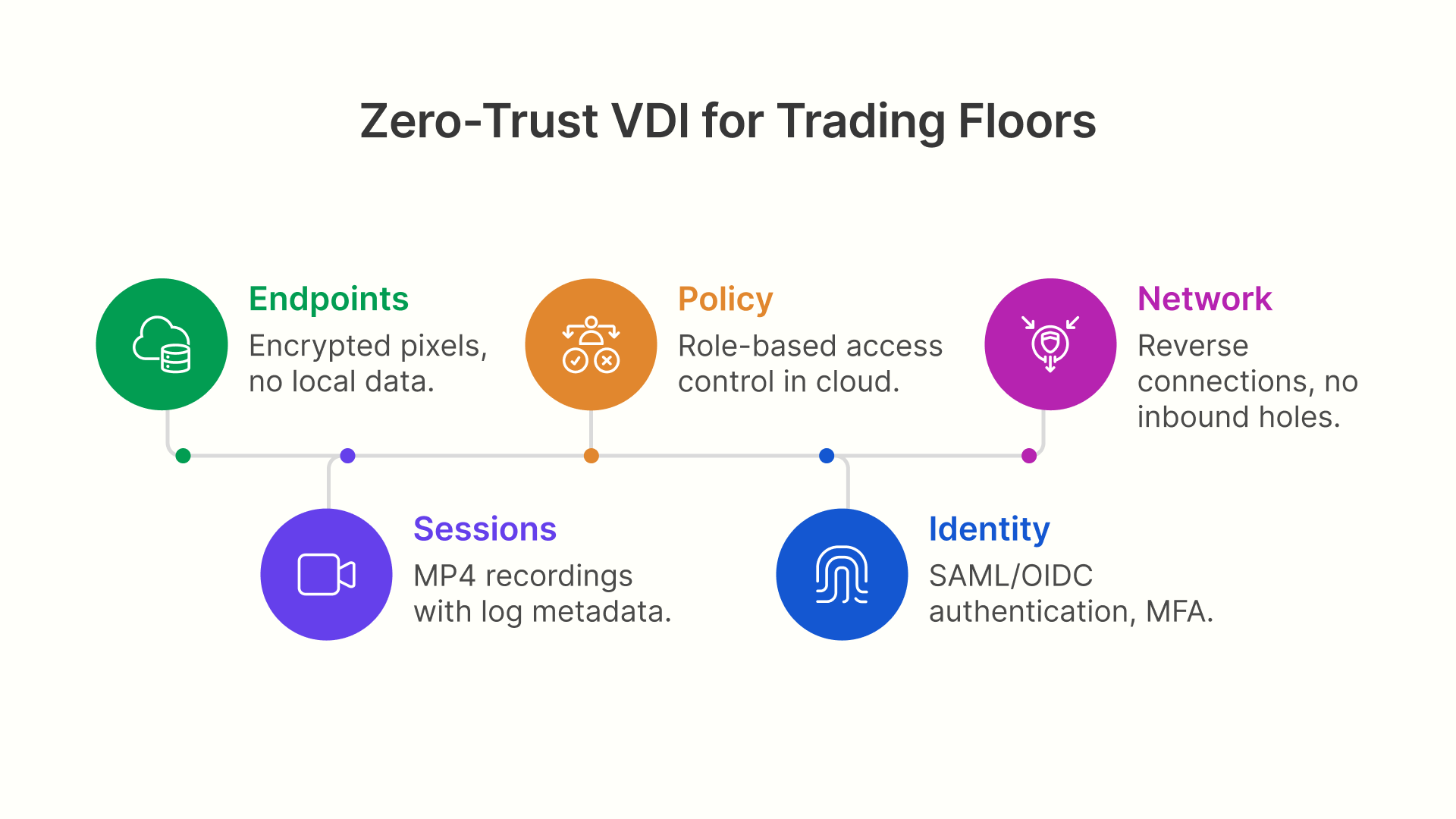
Zero-Trust is not a feature—it is an operational model. Browser-native desktops on OCI enforce this model through five architectural principles that traditional VDI cannot replicate.
1. Endpoints Carry Zero Data
Because all rendering is performed through WebGL and HTML5 canvas, the endpoint receives only encrypted pixels. No files, credentials, or cached artifacts are ever present locally. Lost or compromised devices become irrelevant to risk assessment.
2. Sessions Are Recorded and Stored Immutably
Every trader session is captured as an MP4 with correlated log metadata. OCI Object Storage WORM ensures these recordings cannot be altered, overwritten, or deleted before their retention period expires. This directly satisfies requirements under SEC 17a-4(f), FINRA 4511, and CFTC 1.31(b).
3. Policy Enforcement Is Centralized in the Cloud
Role-based access control defines exactly which applications, data sets, market-data sources, and execution systems a trader can access. No policy exists at the device level—everything is authenticated and enforced from the cloud, reducing regulatory drift and shadow-IT exposure.
4. Identity Is Federated Through SAML or OIDC
Identity becomes the new perimeter. Traders authenticate using the firm’s enterprise identity provider, MFA, and device posture checks. This removes password sprawl, eliminates local credential exposure, and provides a consistent control plane across jurisdictions.
5. Network Paths Are Outbound-Only
Thinfinity connects resources using outbound reverse connections. There are no inbound firewall holes, no exposed RDP ports, and no VPN tunnels to compromise. This architecture maintains Zero-Trust at the network edge without sacrificing performance.
Meeting SEC, FINRA, and CFTC Requirements
Most financial institutions still maintain a web of tools to satisfy evidentiary, retention, and reporting obligations. Browser-native VDI consolidates these requirements into a single audit pipeline.
Immutable Storage (WORM) — SEC 17a-4(f)
OCI Object Storage WORM guarantees that no session recording, audit log, or encryption key can be altered or removed during the mandated retention period. This satisfies non-rewrite, non-erase mandates without specialized appliances.
Recordkeeping Integrity — FINRA 4511
Every workspace interaction is time-stamped, signed, and indexed. Data lineage becomes deterministic, producing standardized evidence files ready for FINRA reviews or internal audit.
Books and Records — CFTC 1.31
Browser-native desktops generate structured logs and tamper-proof session evidence that meets CFTC requirements for electronic records, metadata completeness, and accessibility.
Browser-native VDI does not approximate compliance—it achieves it by design.
Blueprint: Zero-Trust VDI for a Trading Floor (90 Days)
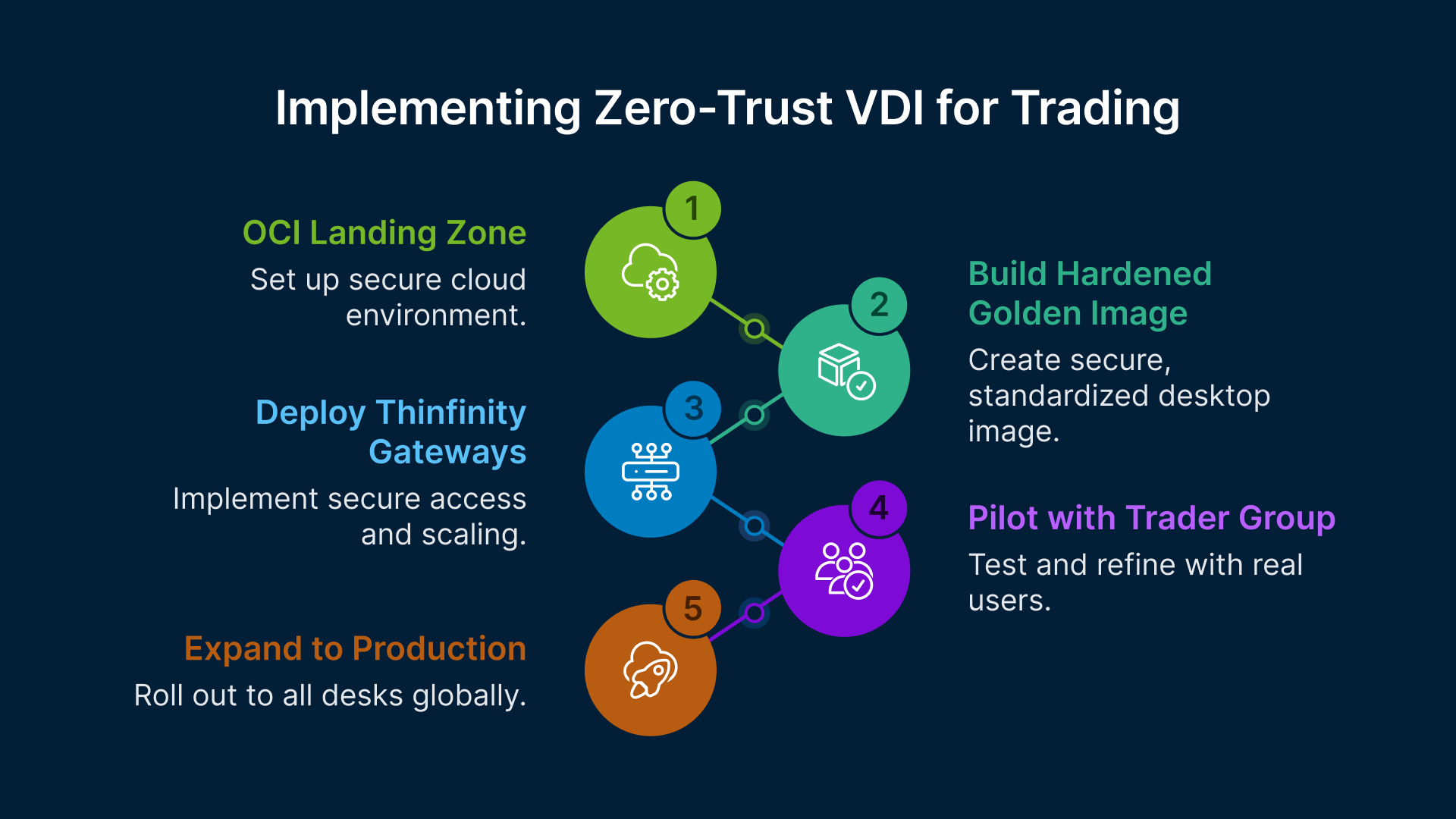
A Zero-Trust trading floor is not a multi-year transformation. Most firms complete the transition within 90 days using the following model:
Phase 1: Establish the OCI landing zone, identity federation, network segmentation, and Cloud Guard baselines.
Phase 2: Build the hardened golden image including Bloomberg, Eikon, Excel libraries, market data entitlements, and internal tools.
Phase 3: Deploy Thinfinity dual gateways, autoscaling GPU pools, and WORM storage policies.
Phase 4: Pilot with a 50-trader group under compliance observation.
Phase 5: Expand to full production with standardized controls across all desks and jurisdictions.
This creates a verifiable, compliant, and inspectable environment that regulators immediately understand and trust.
Zero-Trust as a Competitive Advantage
In capital markets, security and compliance are not abstract mandates—they influence trade execution reliability, time-to-market, talent retention, and the ability to operate across global jurisdictions. A Zero-Trust desktop model built on browser-native delivery gives firms a competitive edge by combining security, operational discipline, and low latency in one architecture.
The shift away from physical trading towers is no longer only about efficiency; it is about building an environment where compliance, auditability, identity governance, and performance coexist without compromise. Browser-native desktops make that possible.